#Apollo#Lunar Module#LM#Grumman#Moon
- 01Overview
- 02The lunar module in figures
- 03Lunar module dimensions
- 04Why Apollo needed a separate landing craft
- 05Anatomy of the Lunar Module
- 06Two stages for two different tasks
- 07Two spacecraft in one
- 08The ascent stage
- 09Why it looked so unusual
- 10Legs and landing
- 11Engines that carried their own oxidizer
- 12The descent stage
- 13A cabin flown standing up
- 14Inside the cabin
- 15From launch vehicle to lunar surface
- 16Apollo 11 step by step
- 17All ten lunar module flights
- 18Six lunar landings
- 19Flight register
- 20Tests and the rescue mission
- 21The tests that made landing possible
- 22From the first landing to more precise expeditions
- 23Aquarius: the landing craft as a lifeboat
- 24The extended version for Apollo 15–17
- 25What remained on the Moon
- 26Key facts
- 27Related technology and program
- 28Sources
- 29Connections
The Apollo Lunar Module (LM) carried two astronauts from lunar orbit to the surface and back to the command module. Ten flight vehicles were launched between 1968 and 1972. Six landed on the Moon, three performed flight tests and one helped save the Apollo 13 crew. Its story begins before Eagle and extends beyond the landing sites. [1] [2]
The lunar module in figures
- Flown vehicles
- 10
- Lunar landings
- 6
- Normal crew
- 2
- Height with legs extended
- ≈7m
- Span across landing pads
- ≈9.45m
Lunar module dimensions

Infographic · technical reconstruction supplied by Spaceflightpedia.
Why Apollo needed a separate landing craft
NASA considered several ways of reaching the Moon when planning the Apollo program. Choosing lunar orbit rendezvous divided the work between two spacecraft. The command and service modules handled the main journey between Earth and the Moon and the return home. The smaller lunar module only had to land and take off again. John Houbolt was a prominent advocate of this approach. [1]
This avoided carrying all the equipment and propellants needed for the journey home down to the surface. Saving mass came at the cost of having to rendezvous reliably with another spacecraft. Grumman built the LM. Its original name, Lunar Excursion Module, explains the abbreviation LEM found in contemporary technical documents. [3] [4]
Anatomy of the Lunar Module

Infographic · technical reconstruction supplied by Spaceflightpedia.
Two stages for two different tasks
The lower descent stage carried the landing engine, tanks, landing gear and equipment storage. After touchdown it provided a base and, at departure, a launch platform. The upper ascent stage contained the pressurized cabin, its own engine and propellants, and the systems needed to return to orbit. Pyrotechnic devices separated the stages for liftoff, leaving the landing gear and the large, empty lower structure behind. [5]
With its legs extended, the module stood about seven metres high and spanned roughly 9.45 metres between opposite landing pads. These dimensions do not describe its folded launch configuration. Mass depended on the vehicle and flight phase: later LMs weighed about 16.4 tonnes with crew and propellants. A figure without its configuration can be misleading. [5]
Two spacecraft in one

Infographic · technical reconstruction supplied by Spaceflightpedia.
The ascent stage

Infographic · technical reconstruction supplied by Spaceflightpedia.
Why it looked so unusual
The LM operated in a vacuum. It needed neither an aerodynamic shape nor wings or an atmospheric-entry heat shield. Its exterior reflected thermal-protection requirements and the arrangement of its systems. Shiny and gold-coloured surfaces formed parts of multilayer insulation, with the load-bearing structure underneath. Confusing the insulation with the cabin wall gives the mistaken impression that a thin sheet of foil alone protected the astronauts. [5] [6]
Four legs distributed the landing loads, while crushable honeycomb cartridges absorbed touchdown energy. Probes beneath three landing pads on the landing vehicles illuminated a contact indication when they touched the surface. There was no probe beneath the forward leg carrying the ladder. The indication helped the crew determine when to shut down the engine. [7] [5]
Legs and landing

Infographic · technical reconstruction supplied by Spaceflightpedia.
Engines that carried their own oxidizer
The descent engine varied its thrust with the flight phase: initial braking required high thrust, while the final approach required much less. Its approved operating regions did not permit arbitrary continuous throttling across the entire range. Landing software respected these limits and adjusted the guidance commands accordingly. [8] [9]
The ascent engine operated at a fixed thrust of approximately 15.6 kN. Both main propulsion systems used storable hypergolic propellants: Aerozine 50 fuel and nitrogen tetroxide, N₂O₄, as oxidizer. They ignited spontaneously on contact. Sixteen small thrusters in four clusters also controlled the spacecraft's attitude. The reaction-control system had its own propellant supply, separate from the main engines. [10] [11] [12]
The descent stage

Infographic · technical reconstruction supplied by Spaceflightpedia.
Video: How the Apollo Lunar Module Really Worked
A cabin flown standing up
The commander and lunar module pilot worked side by side, with the commander on the left and the pilot on the right. Standing saved the mass of seats and allowed a downward view through small windows. During a normal descent the commander flew the spacecraft while the other astronaut monitored systems, readings and procedures. The title lunar module pilot therefore does not mean that this astronaut always performed the landing. [13]
The pressurized cabin volume was about 6.65 m³, with roughly 4.53 m³ of habitable space. Its atmosphere was oxygen at a pressure of around 33 kPa. The two volume figures describe different things. There was no separate airlock: the entire cabin had to be depressurized before opening the forward hatch. [14] [15]
The module provided oxygen, carbon-dioxide removal, cooling and water. Silver-zinc batteries supplied electricity. Consumables supported the short independent portion of the mission; the LM was not a long-duration orbital station. Suits, noise, limited space and work schedules complicated rest. Later crews used suspended hammocks. [16] [17]
Inside the cabin

Infographic · technical reconstruction supplied by Spaceflightpedia.
From launch vehicle to lunar surface
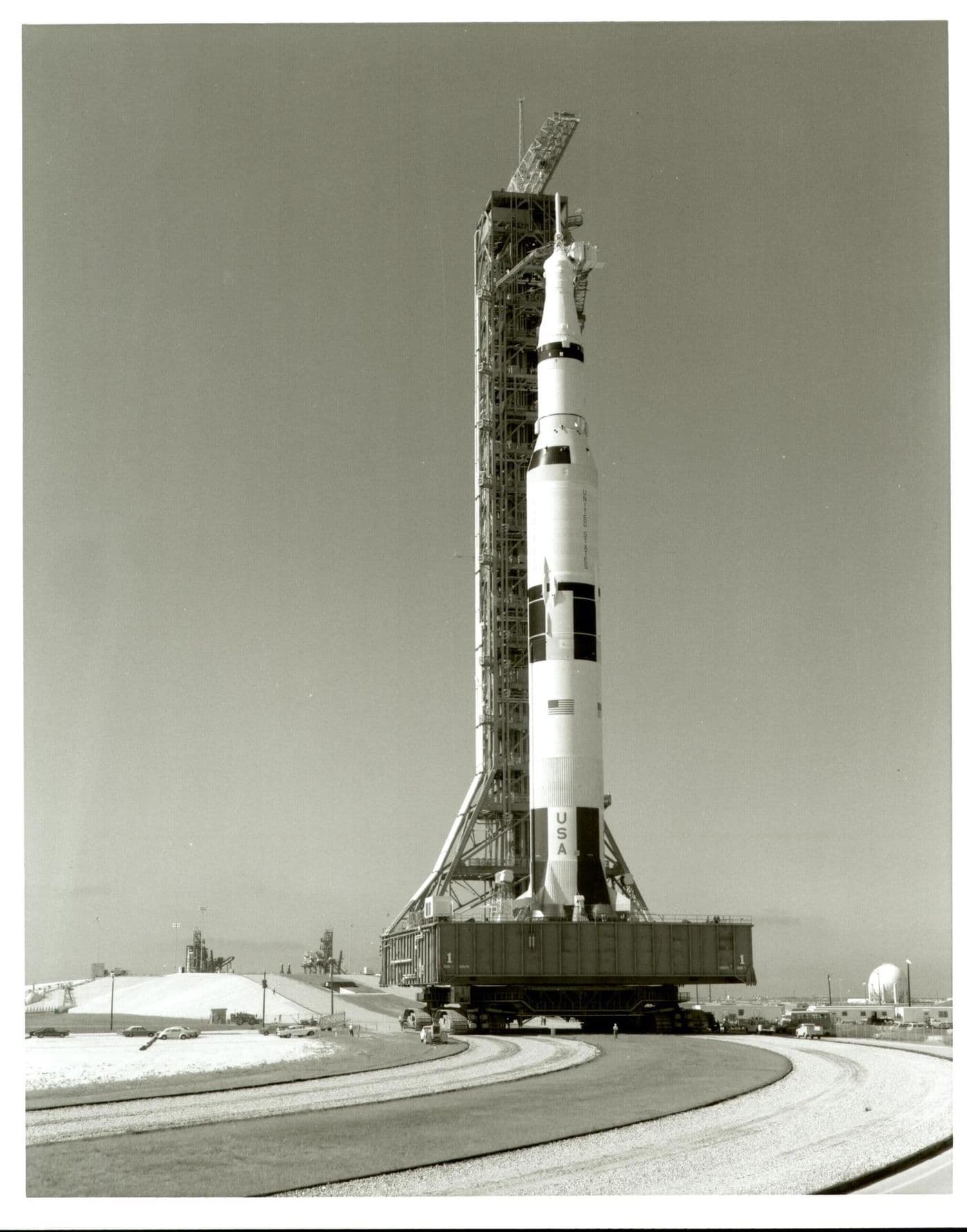
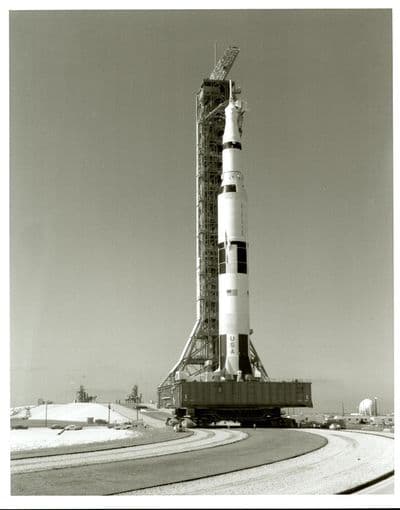
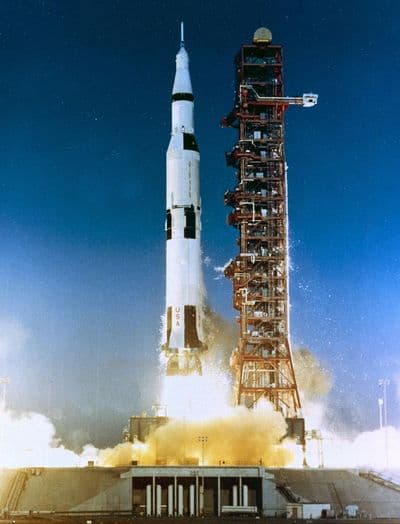
During a Saturn V launch the LM sat inside an adapter below the command and service modules. After injection towards the Moon, the CSM separated, turned around, docked with the LM and extracted it from the adapter. Before landing, two astronauts entered the LM through the connecting tunnel; the third remained in the command module in lunar orbit. [18]
Descent was not simply a vertical drop. The LM first had to remove its orbital velocity, approach its target and transition into the final descent. Program P63 handled braking, P64 the approach, and P66 allowed the commander to control the final descent with computer assistance. The exact flight profile changed between missions. [9]
After surface exploration, the ascent stage lifted off, rendezvoused and docked with the CSM. The astronauts and their samples transferred to the command module. That capsule carried the heat shield required for entry into Earth's atmosphere. [19]

Follow us
Follow us on social media
New plates, trivia and behind-the-scenes updates as soon as they are ready.
All ten lunar module flights
The following flight register distinguishes tests, landings and emergency use. Landing dates are in UTC; crew names refer to the LM's independent flight or surface landing, except for Apollo 13, which supported all three astronauts while attached to the command module.
Six lunar landings

Infographic · technical reconstruction supplied by Spaceflightpedia.
Flight register
- Apollo 5 — LM-1 (no callsign). 1968: uncrewed propulsion and abort-staging tests in Earth orbit; launched by Saturn IB. [2] [20] [21] [22] [23] [24] [25]
- Apollo 9 — LM-3 Spider. 1969: crewed tests in Earth orbit, independent flight and redocking; James McDivitt and Russell Schweickart. [2] [20] [21] [22] [23] [24] [25]
- Apollo 10 — LM-4 Snoopy. 1969: lunar rehearsal, descending to about 15 km without landing; Thomas Stafford and Eugene Cernan. [2] [20] [21] [22] [23] [24] [25]
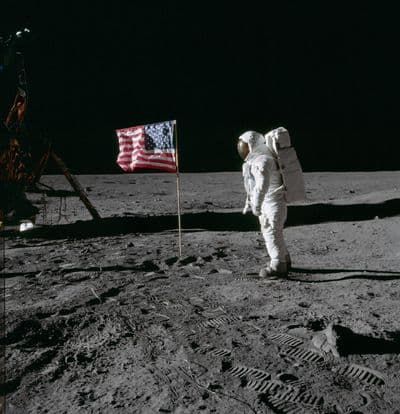
- Apollo 11 — LM-5 Eagle. Landed 20 July 1969 at the Sea of Tranquility; Neil Armstrong and Buzz Aldrin. [2] [20] [21] [22] [23] [24] [25]
- Apollo 12 — LM-6 Intrepid. Landed 19 November 1969 in the Ocean of Storms near Surveyor 3; Charles Conrad and Alan Bean. [2] [20] [21] [22] [23] [24] [25]
- Apollo 13 — LM-7 Aquarius. 1970: emergency life support and return manoeuvres; no landing or independent crewed LM flight. Supported Lovell, Haise and Swigert in the docked spacecraft. [2] [20] [21] [22] [23] [24] [25]
- Apollo 14 — LM-8 Antares. Landed 5 February 1971 at Fra Mauro; Alan Shepard and Edgar Mitchell. [2] [20] [21] [22] [23] [24] [25]
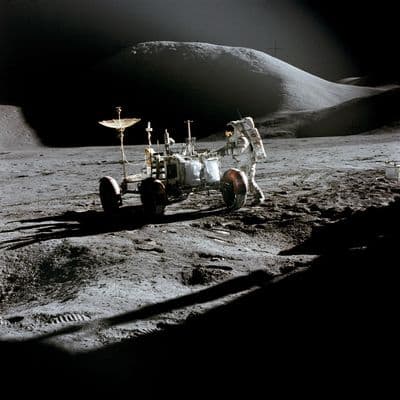
- Apollo 15 — LM-10 Falcon. Landed 30 July 1971 at Hadley–Apennine; first extended LM with a rover; David Scott and James Irwin. [2] [20] [21] [22] [23] [24] [25]
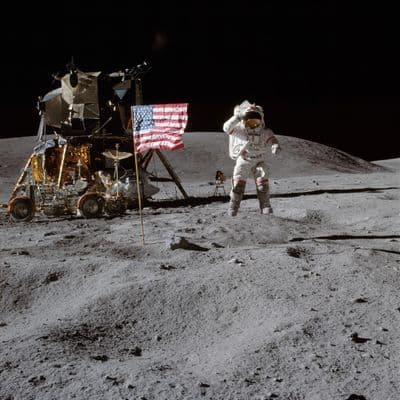
- Apollo 16 — LM-11 Orion. Landed 21 April 1972 in the Descartes highlands; John Young and Charles Duke. [2] [20] [21] [22] [23] [24] [25]
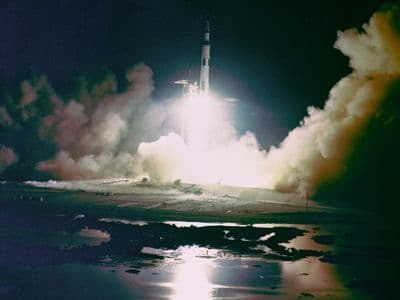
- Apollo 17 — LM-12 Challenger. Landed 11 December 1972 at Taurus–Littrow; Eugene Cernan and Harrison Schmitt. [2] [20] [21] [22] [23] [24] [25]
Six lunar landings
Tests and the rescue mission
The tests that made landing possible
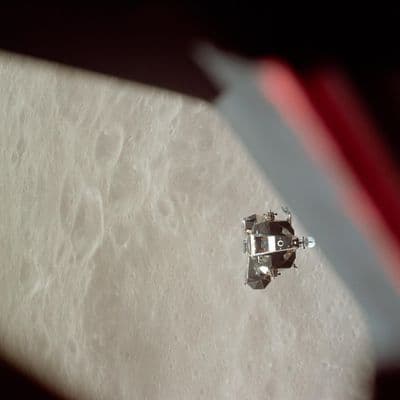
Apollo 5 launched on 22 January 1968. The first planned descent-engine firing ended early because the test program's limits were too conservative. An alternative sequence nevertheless verified both propulsion systems and staging during a simulated descent abort. The test illustrates why a mission cannot be judged solely by whether its original plan proceeded unchanged. [2]
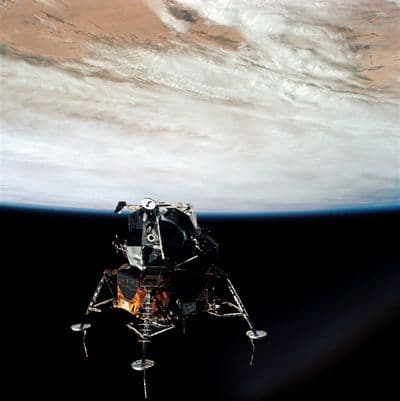
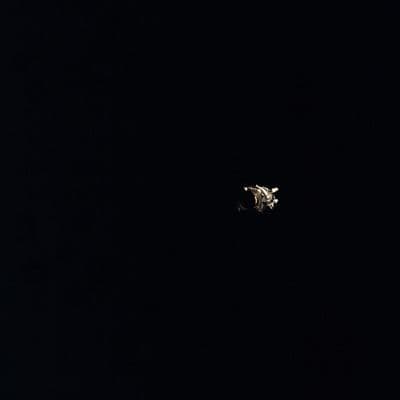
Apollo 9 in March 1969 tested crew operations in the LM, independent manoeuvring and return to the command module. Apollo 10 took the test to the Moon in May. Snoopy approached the surface, discarded its descent stage and rehearsed the return. This was preparation for landing, rather than a failed attempt to touch down. [20] [21]
From the first landing to more precise expeditions
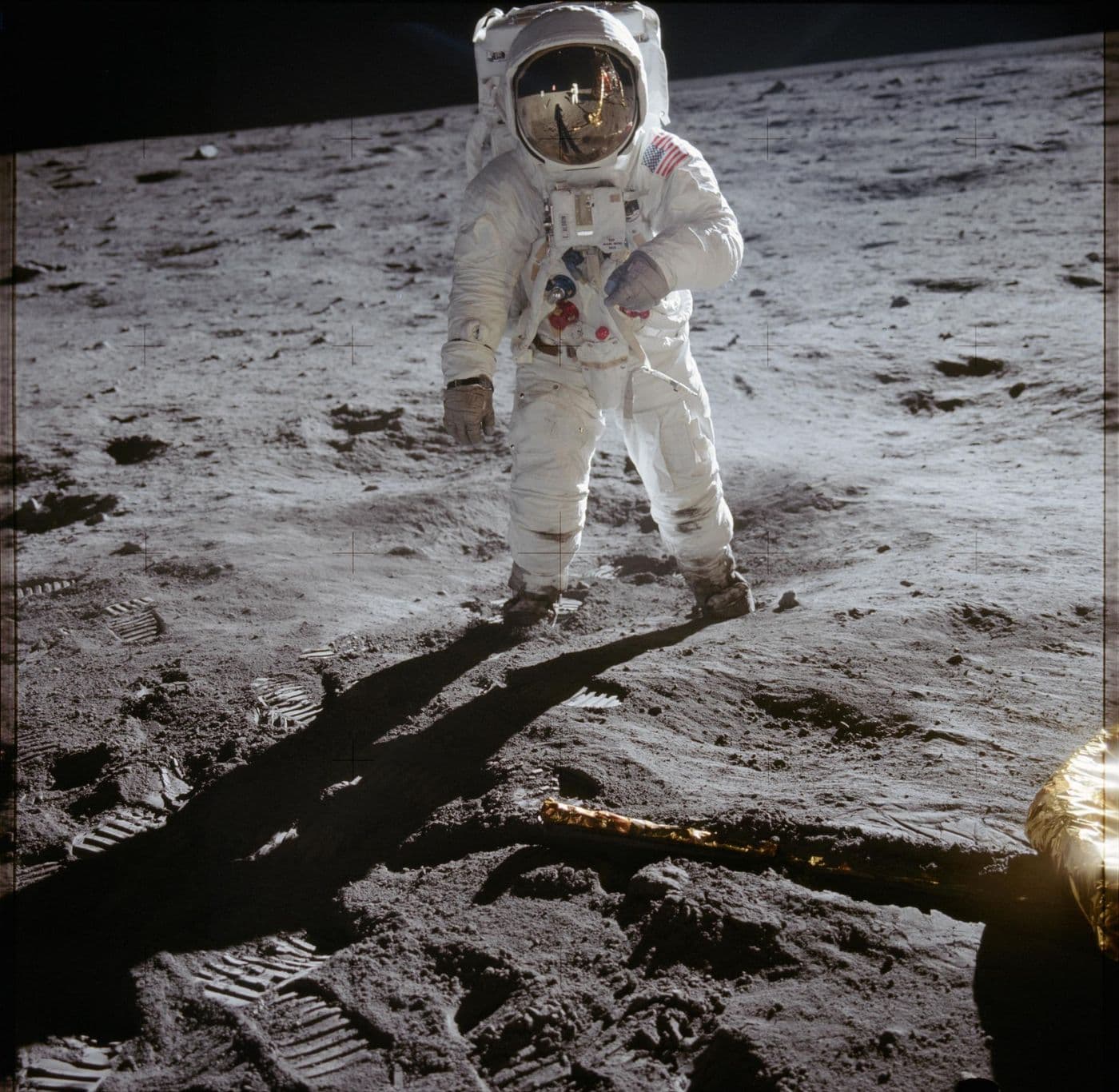
Computer alarms 1201 and 1202 created tense moments during Apollo 11's landing. They indicated an overload of computer work; the restart mechanism preserved essential flight tasks and mission control cleared the crew to continue. Armstrong selected a more suitable touchdown location during the final approach. Describing the landing as entirely manual after computer failure overlooks the continuing role of automatic control. [26] [27]
Apollo 12 demonstrated the value of landing accurately near Surveyor 3. Its crew could visit the earlier probe and retrieve components. Apollo 14 landed at Fra Mauro, the area originally assigned to Apollo 13, and stayed on the surface for about 33.5 hours. [28] [29]
Aquarius: the landing craft as a lifeboat
After the service-module oxygen-tank accident on Apollo 13, Aquarius supplied the crew and enabled manoeuvres needed for the return journey. Jim Lovell, Fred Haise and Jack Swigert had to conserve both water and electrical power. The command module was prepared for the final atmospheric entry. [30]
Removing carbon dioxide was one of the problems. Following instructions from the ground, the astronauts assembled an adapter allowing command-module lithium-hydroxide canisters to work with the LM system. Their rescue depended on cooperation between several systems, the crew and ground teams. Aquarius itself could not land on Earth: it was discarded before entry and burned up in the atmosphere. [31] [32]
The extended version for Apollo 15–17
The final three landings expanded the scope of the expeditions. The extended LM had more consumables and electrical capacity, together with an upgraded descent propulsion system. It supported surface stays of approximately 67 to 75 hours and carried the folded Lunar Roving Vehicle (LRV). The rover travelled in a descent-stage bay and was unfolded on the surface. [14] [16] [33]
Apollo 15 explored Hadley–Apennine, Apollo 16 the Descartes highlands, and Apollo 17 the Taurus–Littrow valley. Greater endurance and the rover made the LM a base for more extensive geological work. On the final expedition, Cernan and Schmitt spent approximately 75 hours on the surface. [34] [35] [25]
What remained on the Moon
Six descent stages remain at the landing sites. The ascent stages had different fates: Intrepid, Antares, Falcon and Challenger were deliberately directed into the Moon to support seismic measurements. Orion's planned controlled impact failed and its impact site is unknown. Eagle also has no documented impact site. Snoopy's ascent stage was sent into heliocentric orbit. [32]
A museum LM is not a spacecraft recovered from the Moon. LM-2, for example, never flew: after Apollo 5's success NASA cancelled the second uncrewed test, used the vehicle for ground testing and later transferred it to a museum. Production numbers are not an uninterrupted sequence of flown missions. Falcon LM-10 therefore followed Antares LM-8. [36] [23]
Key facts
- The LM could not re-enter the atmosphere: its crew had to return to the command module. [19]
- LM numbers are not mission numbers: Apollo 11 carried LM-5, and Apollo 15 LM-10. [23]
- Apollo 7 and Apollo 8 did not carry an operational LM. The job title lunar module pilot alone does not establish its presence. [23]
Related technology and program
Sources & further reading
- Apollo’s Lunar Module Bridged Technological Leap to the Moon — primary technical or historical reference; checked 14 October 2026.
- Apollo 5 — primary technical or historical reference; checked 14 October 2026.
- Apollo Command and Service Module Contract and Mission Architecture — primary technical or historical reference; checked 14 October 2026.
- The First Test Flight of the Apollo Lunar Module — primary technical or historical reference; checked 14 October 2026.
- Grumman — Lunar Module: Structure and Dimensions (LV) — primary technical or historical reference; checked 14 October 2026.
- Protecting Historic Lunar Artifacts — primary technical or historical reference; checked 14 October 2026.
- Apollo Experience Report — Lunar Module Landing Gear — primary technical or historical reference; checked 14 October 2026.
- Apollo Experience Report — Descent Propulsion System — primary technical or historical reference; checked 14 October 2026.
- Allan R. Klumpp — Apollo Lunar-Descent Guidance, R-695 (1971) — primary technical or historical reference; checked 14 October 2026.
- Grumman — Main Propulsion (MP) — primary technical or historical reference; checked 14 October 2026.
- Apollo Experience Report — Ascent Propulsion System — primary technical or historical reference; checked 14 October 2026.
- Grumman — Reaction Control (RC) — primary technical or historical reference; checked 14 October 2026.
- Apollo Experience Report — Lunar Module Display and Control — primary technical or historical reference; checked 14 October 2026.
- Apollo Lunar Lander — Medical & Human Performance Perspective, Rev A (2023) — primary technical or historical reference; checked 14 October 2026.
- Grumman — Environmental Control (EC) — primary technical or historical reference; checked 14 October 2026.
- Grumman — Electrical Power (EP) — primary technical or historical reference; checked 14 October 2026.
- Apollo Lunar Surface Journal — Sleep — primary technical or historical reference; checked 14 October 2026.
- Apollo 11 Mission Overview — primary technical or historical reference; checked 14 October 2026.
- The Apollo Program — primary technical or historical reference; checked 14 October 2026.
- Apollo 9: Mission Details — primary technical or historical reference; checked 14 October 2026.
- Apollo 10: Mission Details — primary technical or historical reference; checked 14 October 2026.
- Apollo Lunar Missions — primary technical or historical reference; checked 14 October 2026.
- Apollo Program Summary Report, NASA-TM-X-68725 (1975) — primary technical or historical reference; checked 14 October 2026.
- Apollo 14: Mission Details — primary technical or historical reference; checked 14 October 2026.
- Apollo 17: Mission Details — primary technical or historical reference; checked 14 October 2026.
- Apollo 11 — Program Alarms — primary technical or historical reference; checked 14 October 2026.
- One Small Step, One Giant Leap — primary technical or historical reference; checked 14 October 2026.
- Apollo 12: The Pinpoint Mission — primary technical or historical reference; checked 14 October 2026.
- Apollo 14 Heads for Home — primary technical or historical reference; checked 14 October 2026.
- Apollo 13: Mission Details — primary technical or historical reference; checked 14 October 2026.
- Putting a Square Peg in a Round Hole — primary technical or historical reference; checked 14 October 2026.
- Apollo: Where Are They Now? — primary technical or historical reference; checked 14 October 2026.
- The Apollo Lunar Roving Vehicle — primary technical or historical reference; checked 14 October 2026.
- Apollo 15 — primary technical or historical reference; checked 14 October 2026.
- Apollo 16 — primary technical or historical reference; checked 14 October 2026.
- Cancellation of the LM-2 Mission — primary technical or historical reference; checked 14 October 2026.
Spaceflightpedia. (n.d.). Apollo Lunar Module. Retrieved 15 October 2026, from https://spaceflightpedia.com/article/lunarni-modul-apollo
article text — CC-BY-SA · ◉ NASA photography — public domain · ✦ AI illustration — marked, generated from sources