- Mission
- Apollo 7
#Apollo#MIT#software#Margaret Hamilton
- 01The woman behind Apollo’s software
- 02From mathematics to weather prediction
- 03SAGE: learning reliability
- 04Apollo: software inside a spacecraft
- 05The 1201 and 1202 landing alarms
- 06What the famous photograph shows
- 07Making software an engineering discipline
- 08Recognition and legacy
- 09Life in dates
- 10Related articles
- 11Sources
- 12Connections
The woman behind Apollo’s software
Margaret Hamilton (17 August 1936 – 30 September 2026) was among the people whose work on the journey to the Moon remained invisible in television pictures. At MIT’s Instrumentation Laboratory, she led Apollo onboard software development. Her responsibilities involved programs that worked with navigation instruments, controlled flight and supported crew decisions when there was little time for recovery. [1, 2]
Her contribution combined programming, team leadership and systematic thinking about errors. Software needed to recognize unexpected conditions, alert the human operator and preserve essential functions. This capability became crucial during the first human lunar landing. [3, 4]
From mathematics to weather prediction
Born Margaret Heafield in Paoli, Indiana, she graduated in mathematics from Earlham College in 1958. After moving to Massachusetts, she began programming at MIT for meteorologist Edward Lorenz. She developed weather prediction software when programming was still far from today’s established academic profession. [1, 5]
Scientific computing led her to a question that would shape her career: how could a result depend on reliable behavior throughout a system as well as a correct algorithm? She later described these early experiences in detail in her Computer History Museum oral history. [6]
SAGE: learning reliability
From 1961 to 1963, Hamilton worked at MIT Lincoln Laboratory on the SAGE air defense system. This large project linked radar observations with computer processing. Programming the prototype AN/FSQ-7 exposed her to a system where failures were immediately apparent to its operators. [5, 6]
Her interest in reliability deepened. A program ran on an actual machine, shared resources with other tasks and served people who depended on it. She brought this experience to the space program. [5, 6]
Apollo: software inside a spacecraft
At MIT, Hamilton progressively took on leadership responsibilities for Apollo onboard software. Development covered the command and lunar modules and required extensive testing. The onboard computer handled tasks of different urgency: some operations needed precise timing, while others could wait. [2, 3, 4]
Preparing for departures from the expected sequence mattered just as much. Recalling Apollo, Hamilton stressed that the team knew there would be little room for a second chance during a mission. Development, testing and designing recovery mechanisms were parts of the same undertaking. [3]
Eyewitness account
“There was no choice but to be pioneers.”
The 1201 and 1202 landing alarms
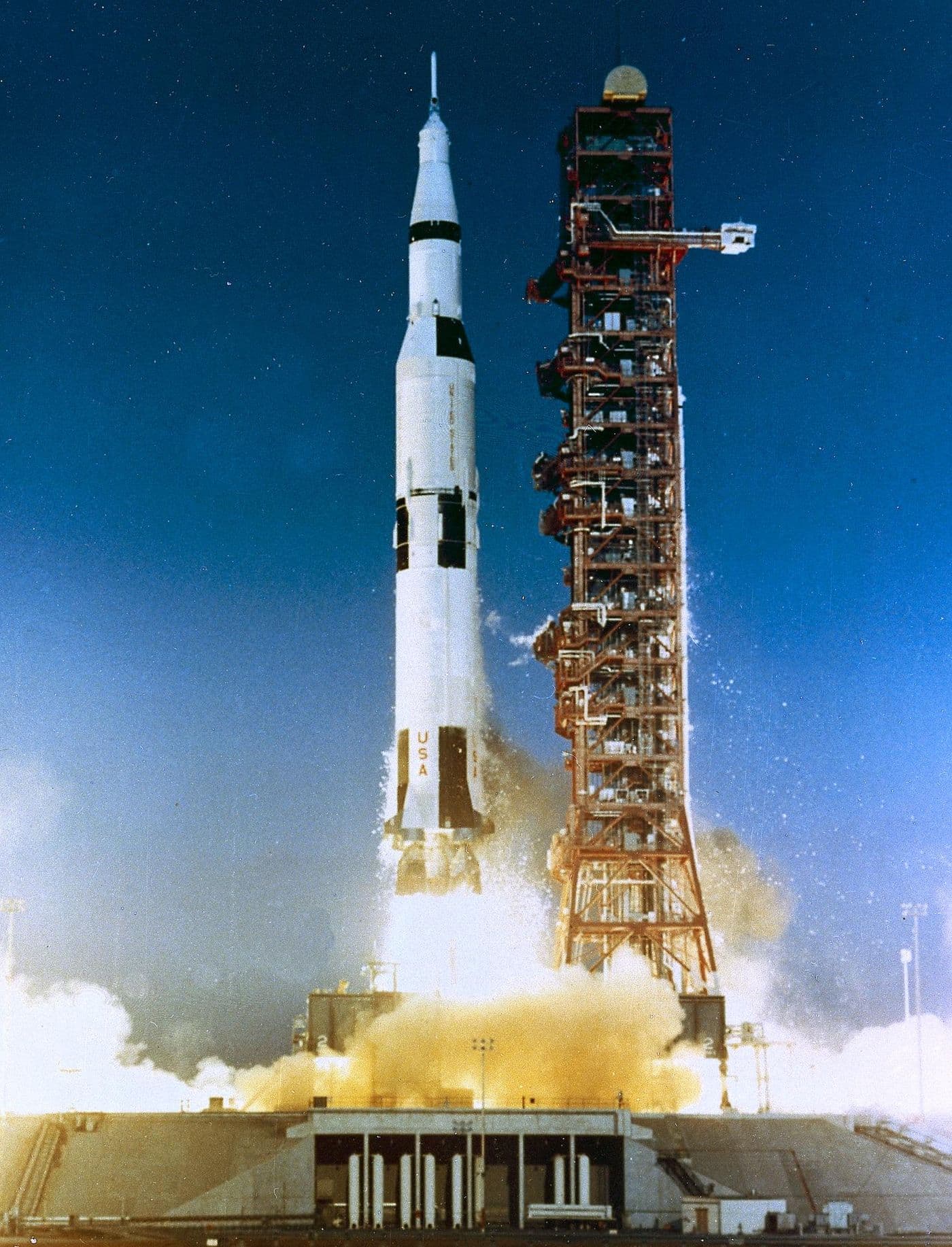
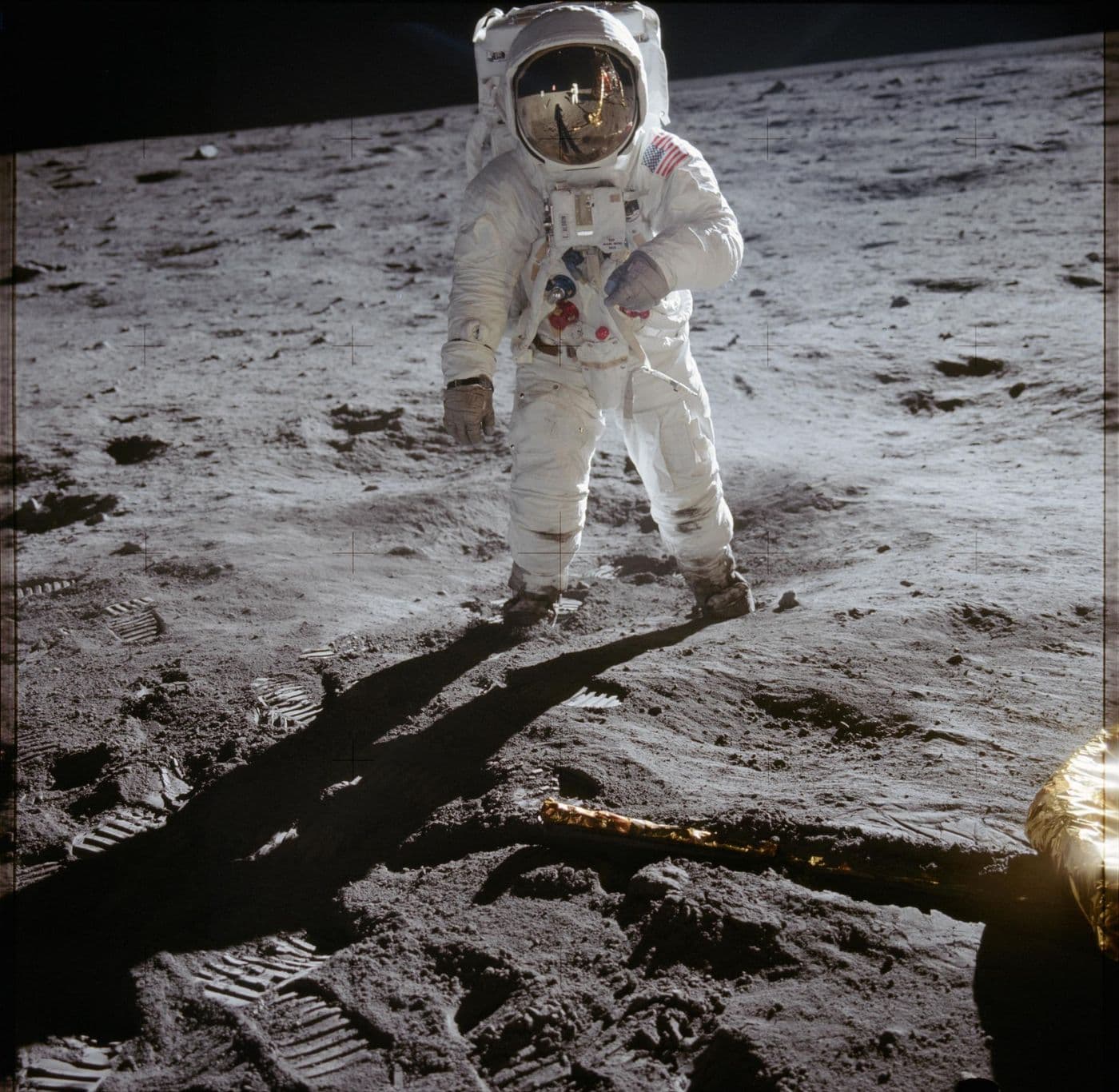
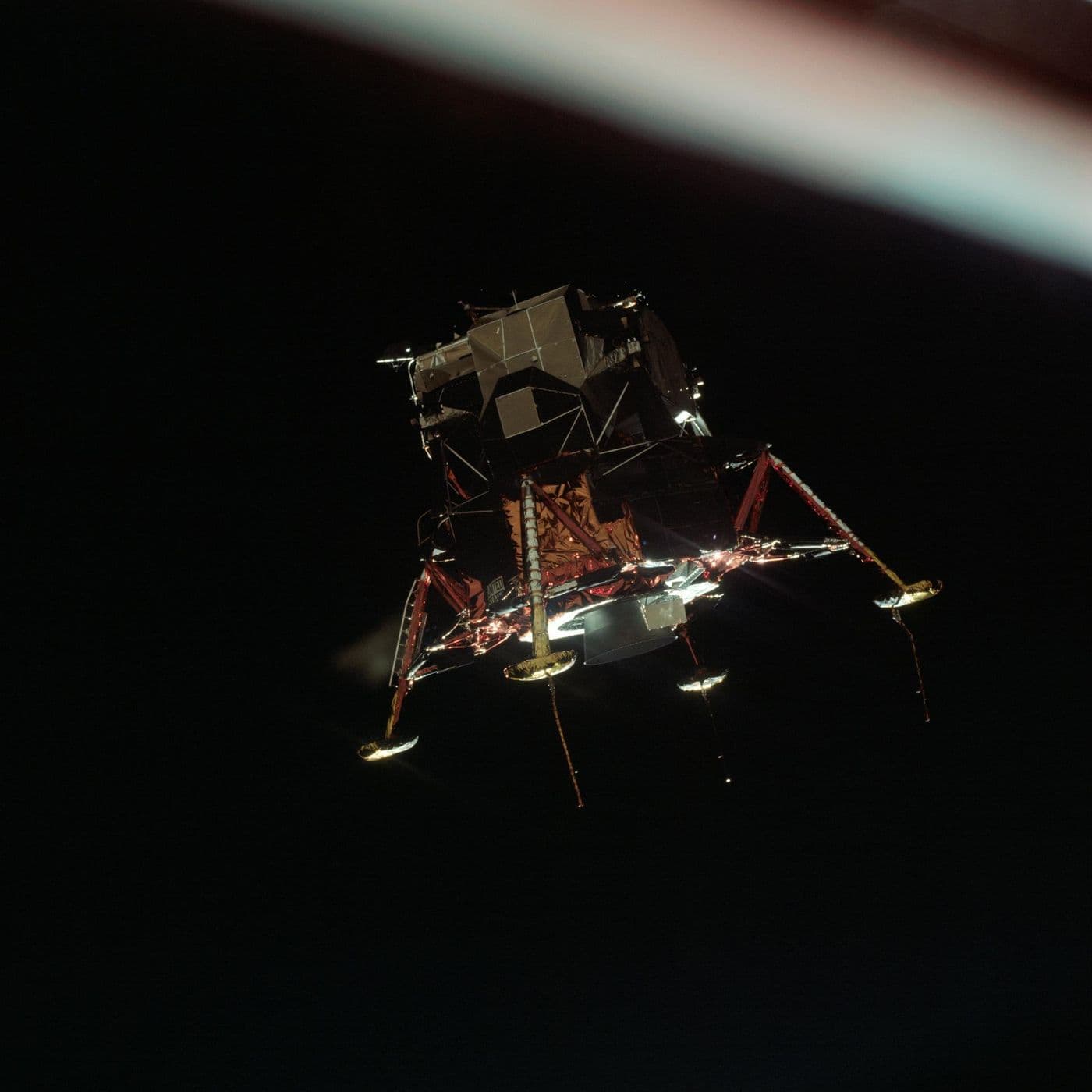
On 20 July 1969, as the lunar module Eagle descended, its computer reported 1201 and 1202 alarms. These indicated overload: the rendezvous radar interface imposed an additional processing burden that reduced time available for landing operations. The warnings identified a shortage of resources for scheduled tasks. [4]
The software recovered and restarted essential operations, including descent guidance and control. Lower priority work gave way. Previous testing of restart behavior helped Mission Control assess the situation and authorize continuing the landing. This was a shared achievement of software developers, the crew and ground specialists. [3, 4]
Hamilton monitored communications at MIT during the descent. Her contribution lay in work completed before launch: the system could respond to a problem that emerged at a critical moment. [3]
What the famous photograph shows
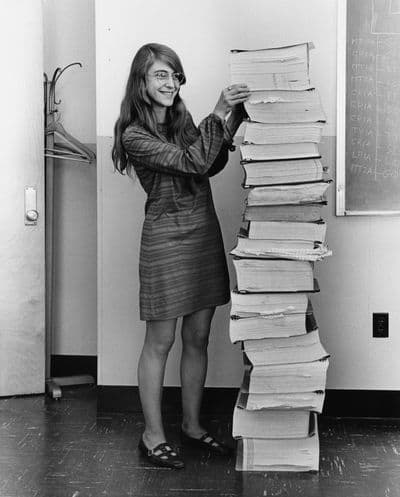
In the 1969 photograph, Hamilton stands beside a stack of onboard software listings. A laboratory photographer took the picture to publicize Apollo work. The listings represent software developed by Hamilton and the teams she led for the command and lunar modules. [2]
The image later found a new audience online. It gives otherwise intangible software a visible scale and recalls the considerable human effort behind the onboard computer’s behavior. [2]
Follow us
Follow us on social media
New plates, trivia and behind-the-scenes updates as soon as they are ready.
Making software an engineering discipline
Hamilton championed the term software engineering to give programmers’ work standing alongside other technical disciplines. Her approach emphasized error prevention, priority management and cooperation between human operators and automated systems. NASA credits her with helping popularize this concept. [2, 7]
After Apollo she took these ideas into business, co-founding Higher Order Software in 1976 and founding Hamilton Technologies in 1986. The latter is associated with Universal Systems Language, a language and methodology for modeling complex systems with an emphasis on preventing errors. [1, 5]
Recognition and legacy
On 22 November 2016, Barack Obama presented Hamilton with the Presidential Medal of Freedom. The official citation highlighted her leadership of command and lunar module software development and her contributions to highly reliable system design. The Computer History Museum honored her as a Fellow in 2017. [5, 7]
Hamilton died on 30 September 2026 at the age of 90; MIT announced her death on 7 October. Her career remains significant to both spaceflight and computing history. It demonstrates how the safety of a complex machine also depends on software design, testing and preparation for conditions outside an ideal plan. [1, 3]
Life in dates
- 1958 — mathematics degree from Earlham College.
- 1961–1963 — work on the SAGE air defense system.
- 1969 — onboard software handled overload during Apollo 11’s landing.
- 1976 / 1986 — Higher Order Software and Hamilton Technologies.
- 2016 — Presidential Medal of Freedom.
Related articles
Sources & further reading
- Janine Liberty: Margaret Hamilton, computing pioneer who led software development for the Apollo program, dies at 90. MIT News, 7 October 2026.
- Maia Weinstock: Margaret Hamilton’s Apollo Code. MIT News / NASA Science, 17 August 2016.
- Recalling the Giant Leap. MIT News, 17 July 2009. Recollections by Margaret Hamilton and fellow Apollo engineers.
- Apollo 11 Lunar Surface Journal: Program Alarms. Technical explanation of task priorities and restart protection.
- Dag Spicer: 2017 CHM Fellow Margaret Hamilton. Computer History Museum, 27 April 2017.
- Oral History of Margaret Hamilton. Interviewed by David C. Brock, 2017; revised transcript 2021. CHM Ref. X8164.2017.
- Kristin Lee: Celebrating Presidential Medal of Freedom Winners in Science and Tech: Garwin, Hopper, and Hamilton. White House, 22 November 2016.
Spaceflightpedia. (n.d.). Margaret Hamilton. Retrieved 9 October 2026, from https://spaceflightpedia.com/article/margaret-hamilton
article text — CC-BY-SA · ◉ NASA photography — public domain · ✦ AI illustration — marked, generated from sources