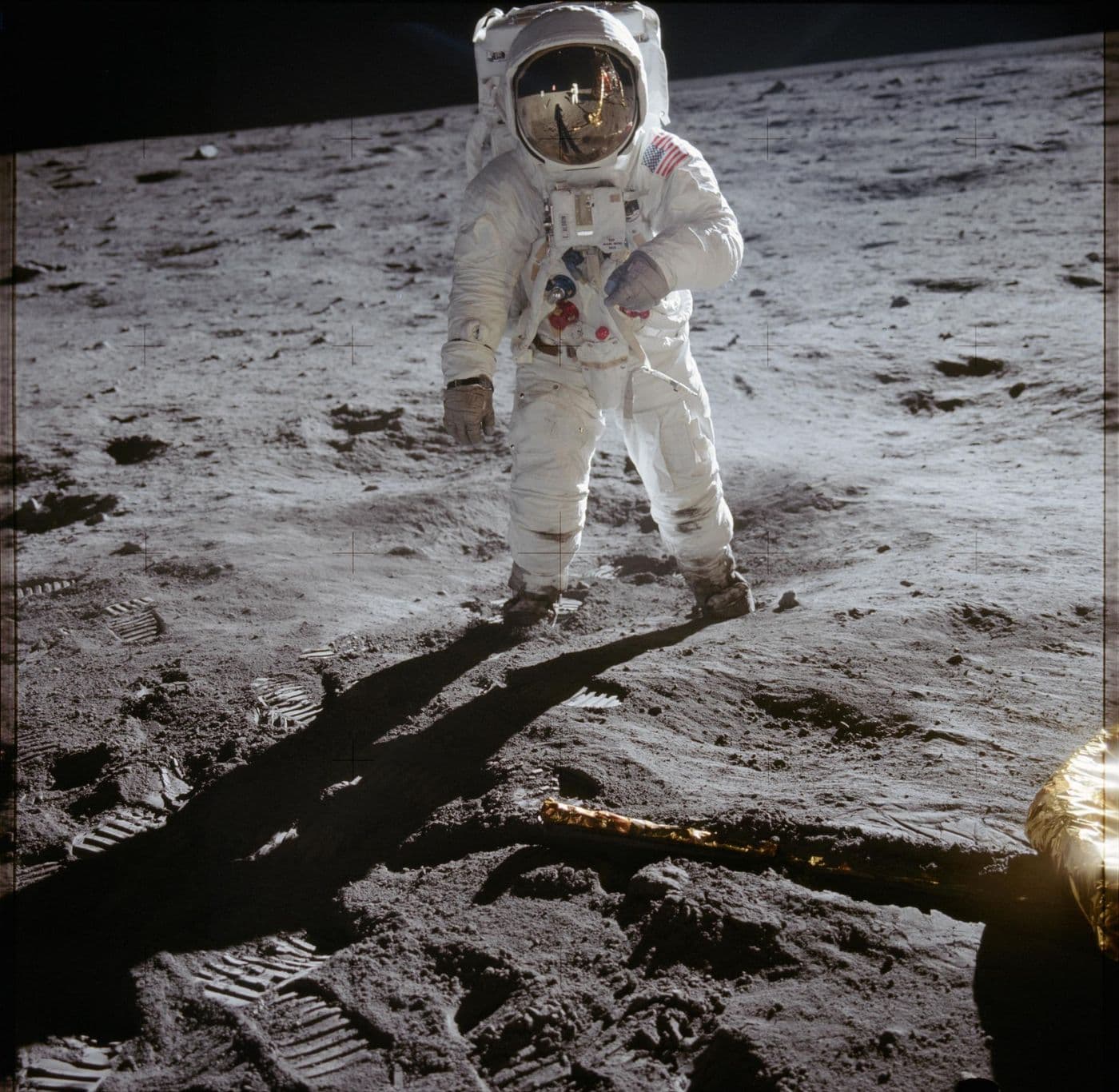
Two-stage lunar module built by Grumman — the first crewed spacecraft designed exclusively for flight in vacuum. It had no need to be aerodynamic, hence its angular, spiderlike shape.
The descent stage carried an engine with continuously throttleable thrust — the first of its kind — and four landing legs with dish-shaped footpads. The ascent stage, with a cabin for two astronauts, used hypergolic propellants that ignite on contact alone: simplicity was the guarantee that the engine would fire on the first try.
Lunar module Eagle in numbers
- HEIGHT
- 7,0 m
- MASS
- 15 103 kg
- CREW
- 2
- DESCENT ENGINE THRUST
- 45 kN (regul.)
- TIME ON THE SURFACE
- 21 h 36 min
- MANUFACTURER
- Grumman
Gallery
Follow us
Follow us on social media
New plates, trivia and behind-the-scenes updates as soon as they are ready.
Facts
- Lunar Module Eagle had no seats at all — Armstrong and Aldrin stood throughout the landing and the launch from the Moon, strapped to the cabin floor.
- The module’s structure was lightened to the point that in places its walls were thinner than two layers of aluminium foil.
- Eagle’s descent stage remained on the Moon after liftoff — it still stands there today as a remnant of the first crewed landing on another celestial body.
Sources & further reading
- NSSDCA Master Catalog (NASA) — record of the Apollo 11 Lunar Module.
- Wikipedia: Lunar Module — base structure of the article, CC-BY-SA 4.0.
- NASA History Office — Apollo Program.
Spaceflightpedia. (n.d.). Lunar Module Eagle. Retrieved 9 October 2026, from https://spaceflightpedia.com/article/lm-eagle
article text — CC-BY-SA · ◉ NASA photography — public domain · ✦ AI illustration — marked, generated from sources