- Date
- 1977–9999
- Mission
- Voyager 1
#NASA#Voyager#interstellar
- 01A day still to come
- 02A once-in-175-years opportunity
- 03Anatomy of Voyager
- 04Ten bays, three computers
- 05Electricity from fading heat
- 06Number two launched first
- 07Jupiter, Saturn and the Titan decision
- 08The twin’s journey to the ice giants
- 09Beyond the heliosphere
- 10Keeping a 1977 machine alive
- 11A message for a possible finder
- 12Article on the timeline
- 13Check yourself
- 14Sources
- 15Connections
A day still to come
Voyager 1 is expected to reach a striking milestone on 18 November 2026: a radio signal from Earth will take roughly a full day to reach it. A reply will need another day. The exact moment shifts with the positions of Earth and the spacecraft; the probe is not crossing a physical boundary.
Launched 49 years ago, Voyager 1 is the most distant human-made object and still returns measurements from beyond the heliosphere. Its twin, Voyager 2, flies in a different direction and remains the only spacecraft to have visited Uranus and Neptune.
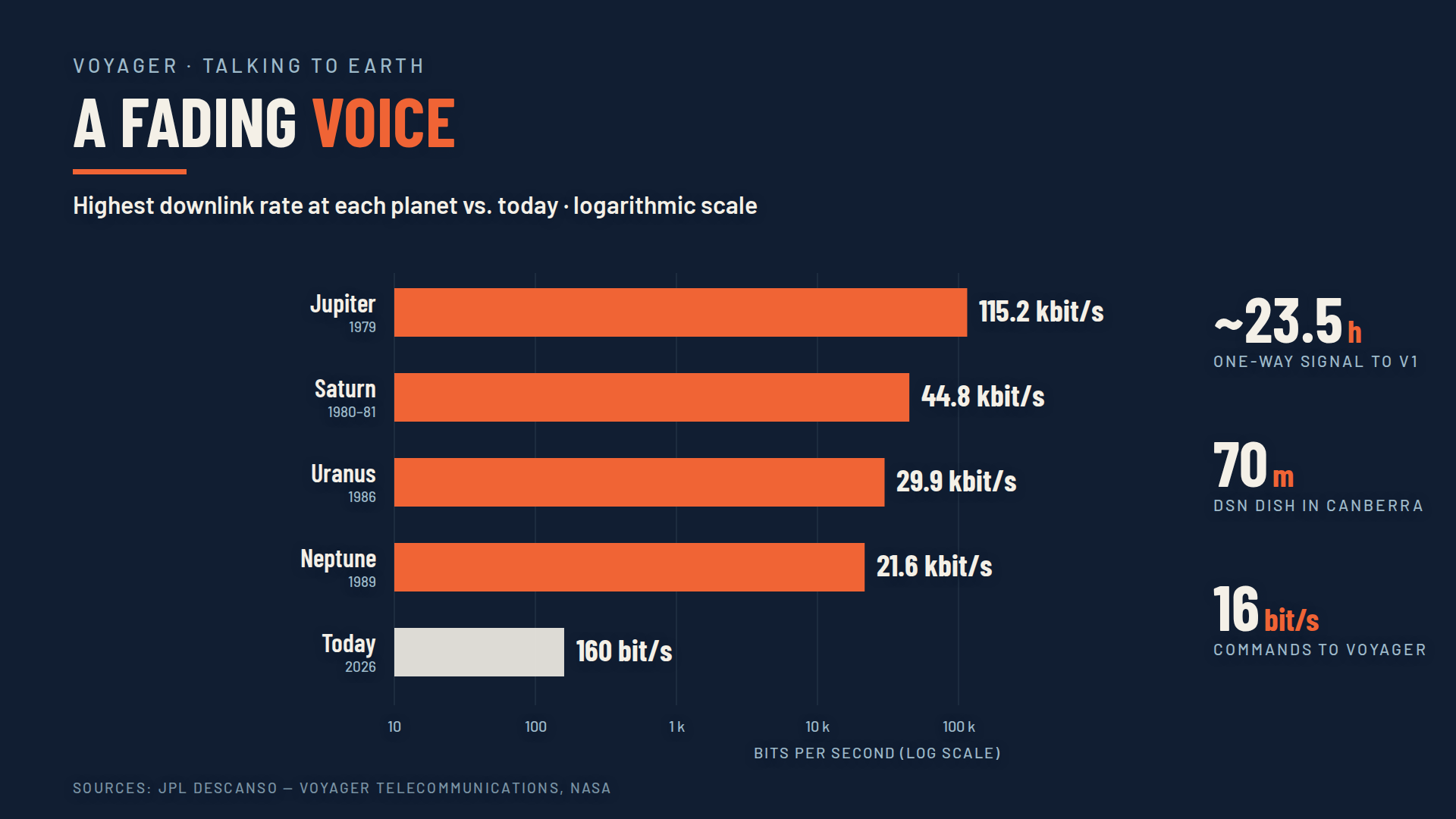
Talking across billions of kilometres
One light-day
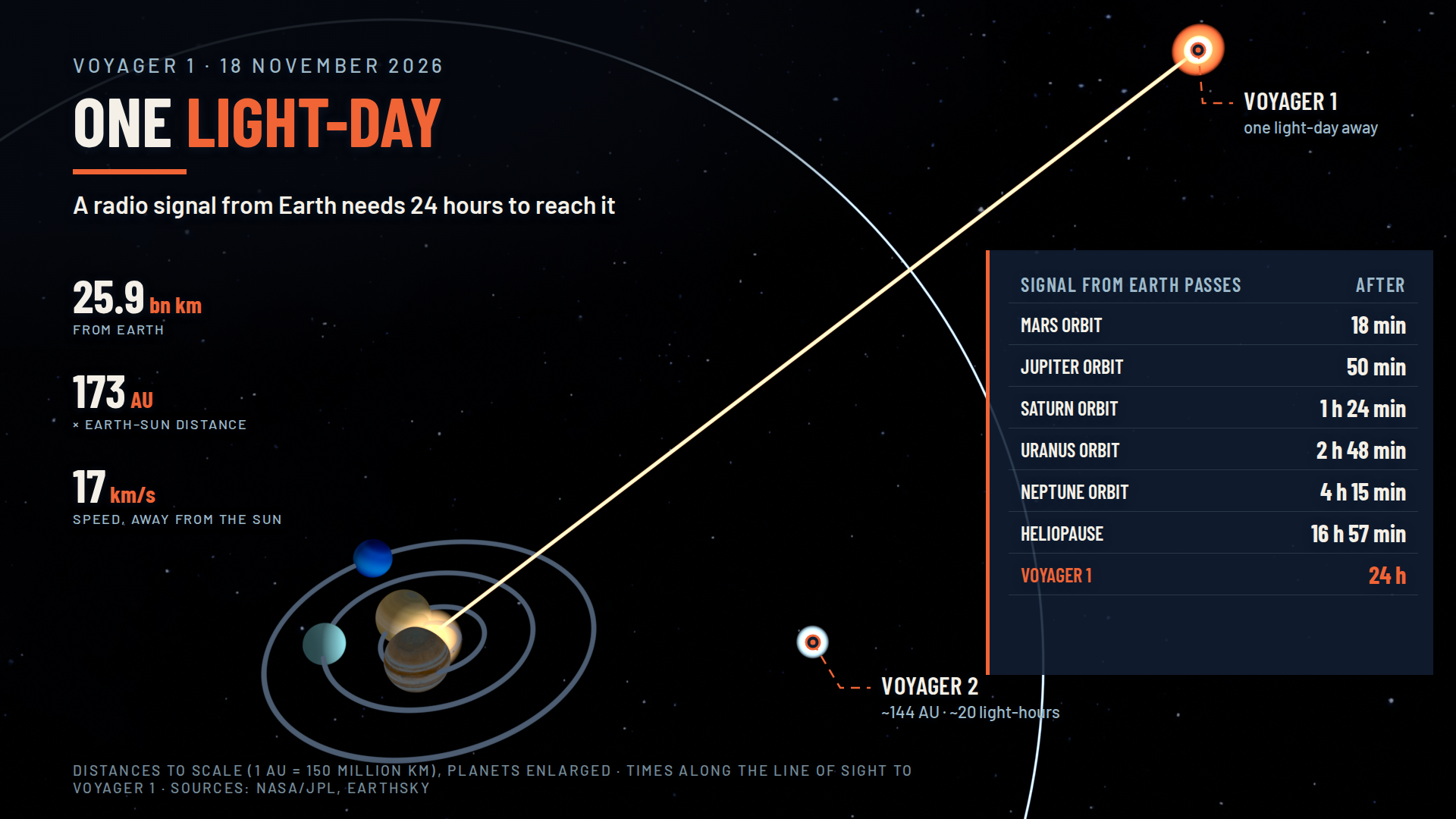
Video: Voyager 1 And one light-day
A once-in-175-years opportunity
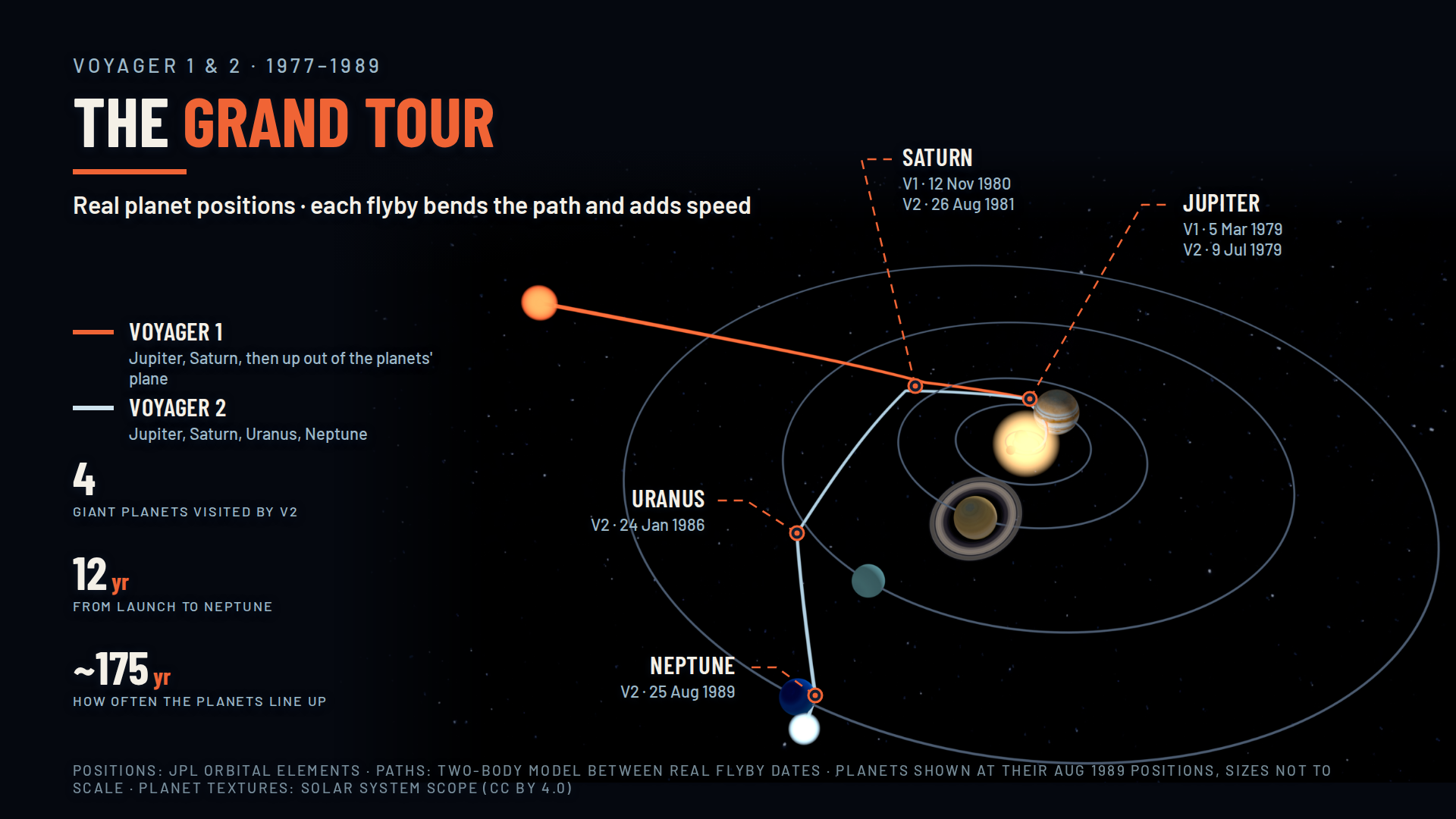
In 1965, JPL’s Gary Flandro showed that the outer planets’ late-1970s alignment could let one spacecraft visit several worlds. A planetary flyby bends its path and, in the heliocentric frame, transfers some of the planet’s orbital energy to it. A comparable alignment recurs roughly once in 175 years.
The original Grand Tour was too costly. NASA approved two probes for Jupiter and Saturn, but the engineers preserved Voyager 2’s option to continue. The twins shared a spacecraft design, not a trajectory.
The machine at scale
The Grand Tour of both probes
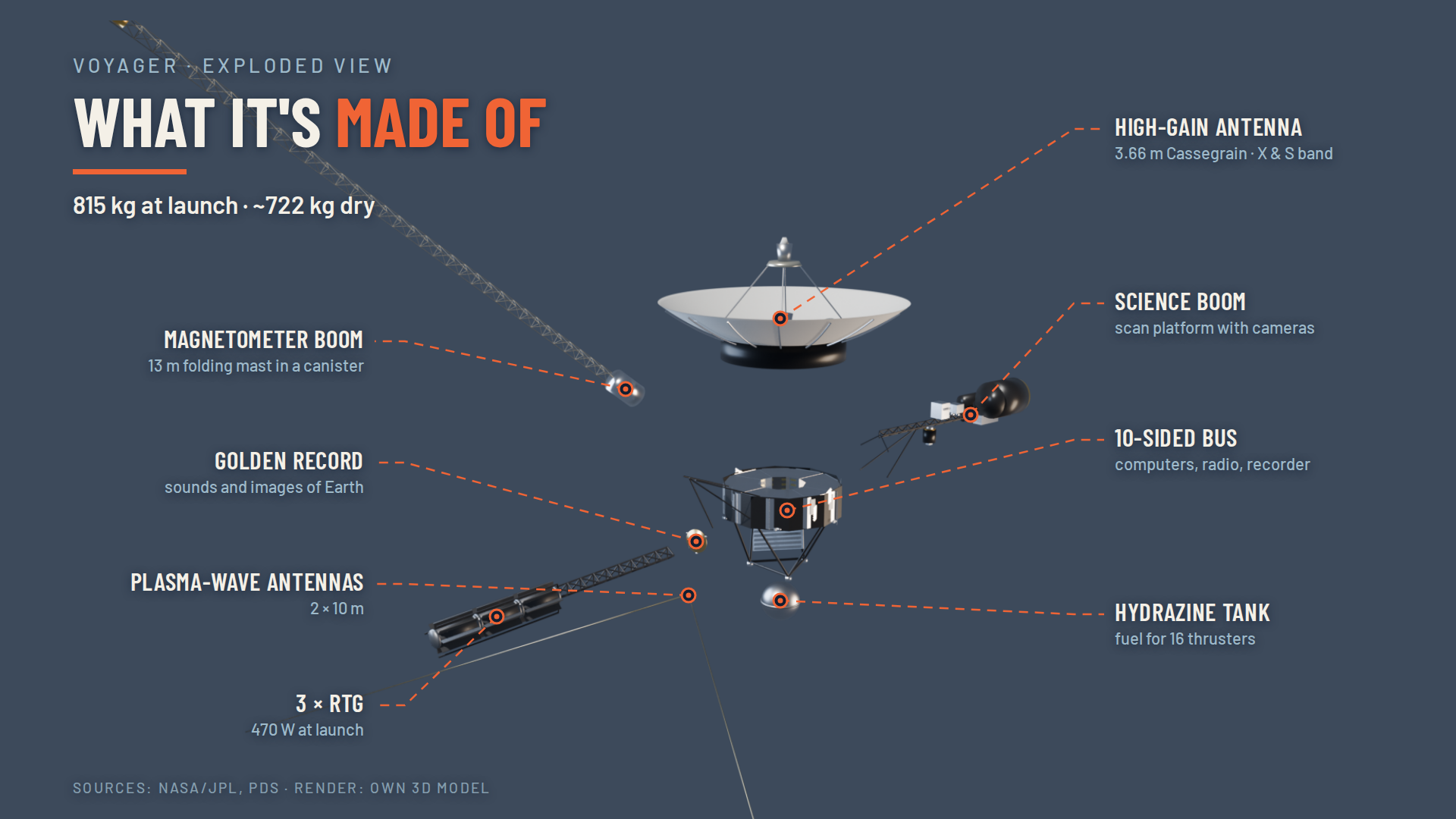
Anatomy of Voyager
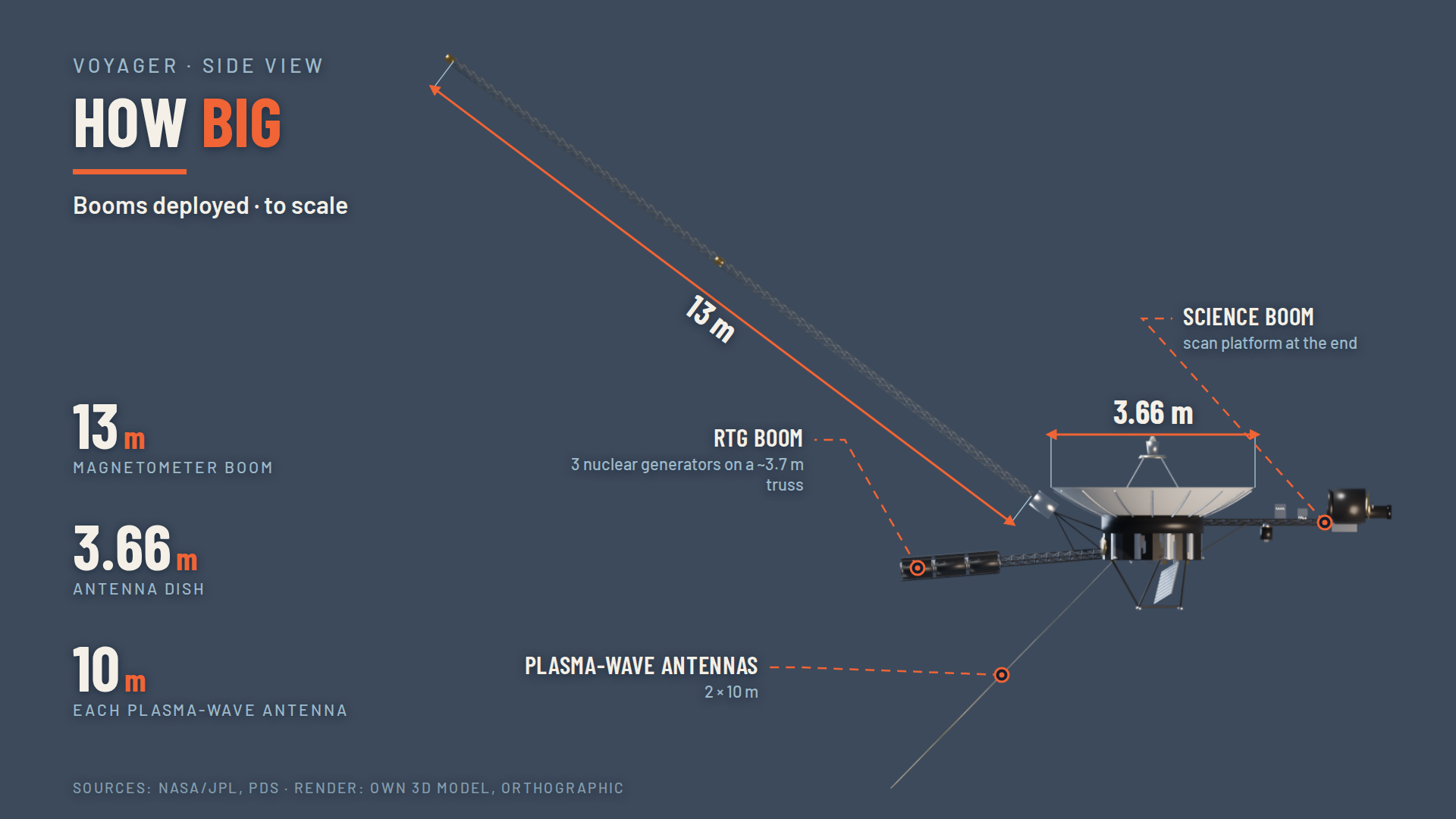
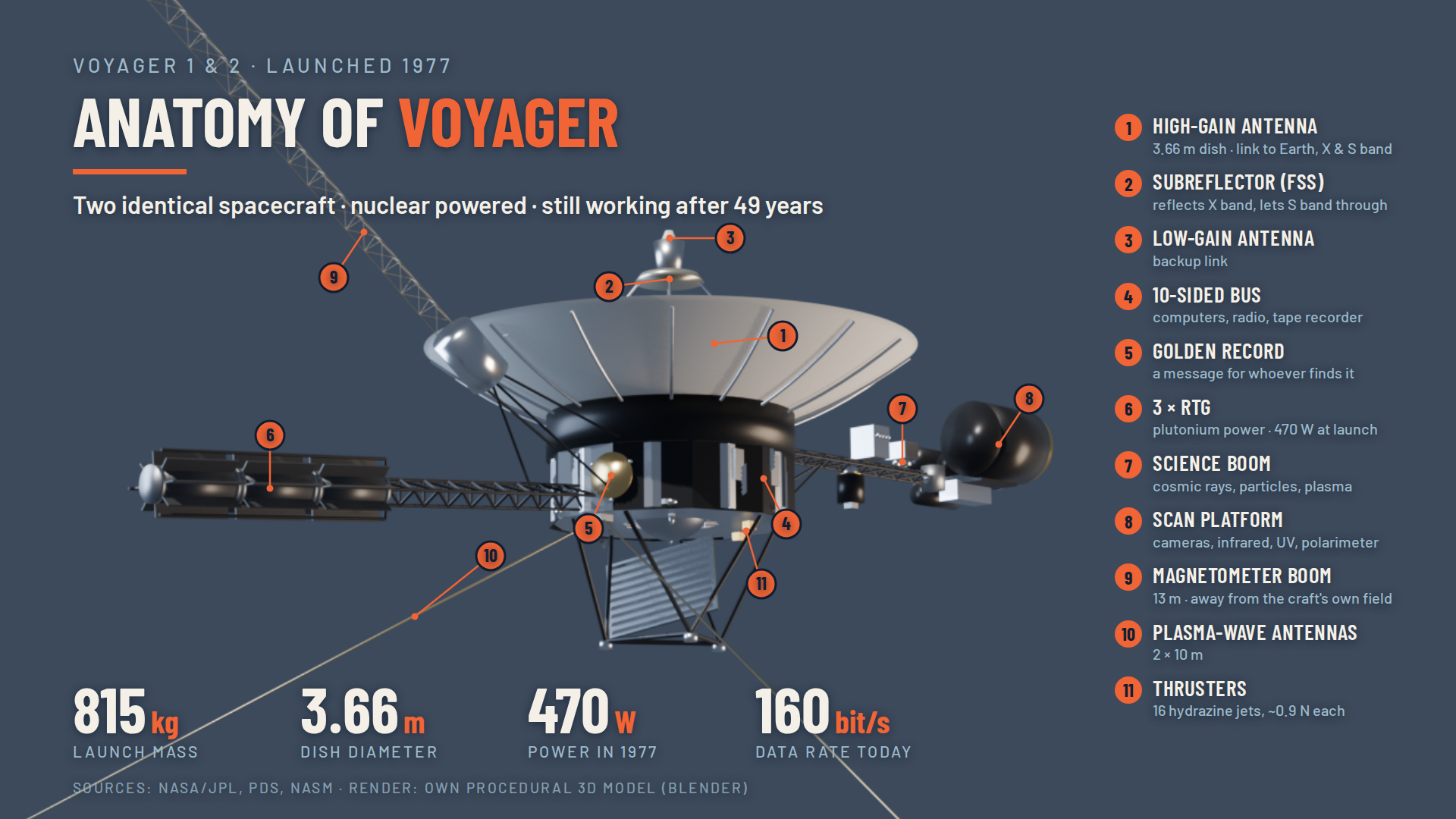
A ten-sided aluminium bus houses the electronics. A 3.66-metre dish dominates the spacecraft and must remain accurately pointed towards Earth. Separate booms carry three radioisotope generators, a science platform and a magnetometer as far as 13 metres from the bus.
Behind the seemingly simple shape are three computer systems for commands, science data and attitude control. Their combined memory amounts to only tens of kilobytes. After nearly half a century, every bit and every watt matters.
Anatomy of Voyager
Ten bays, three computers
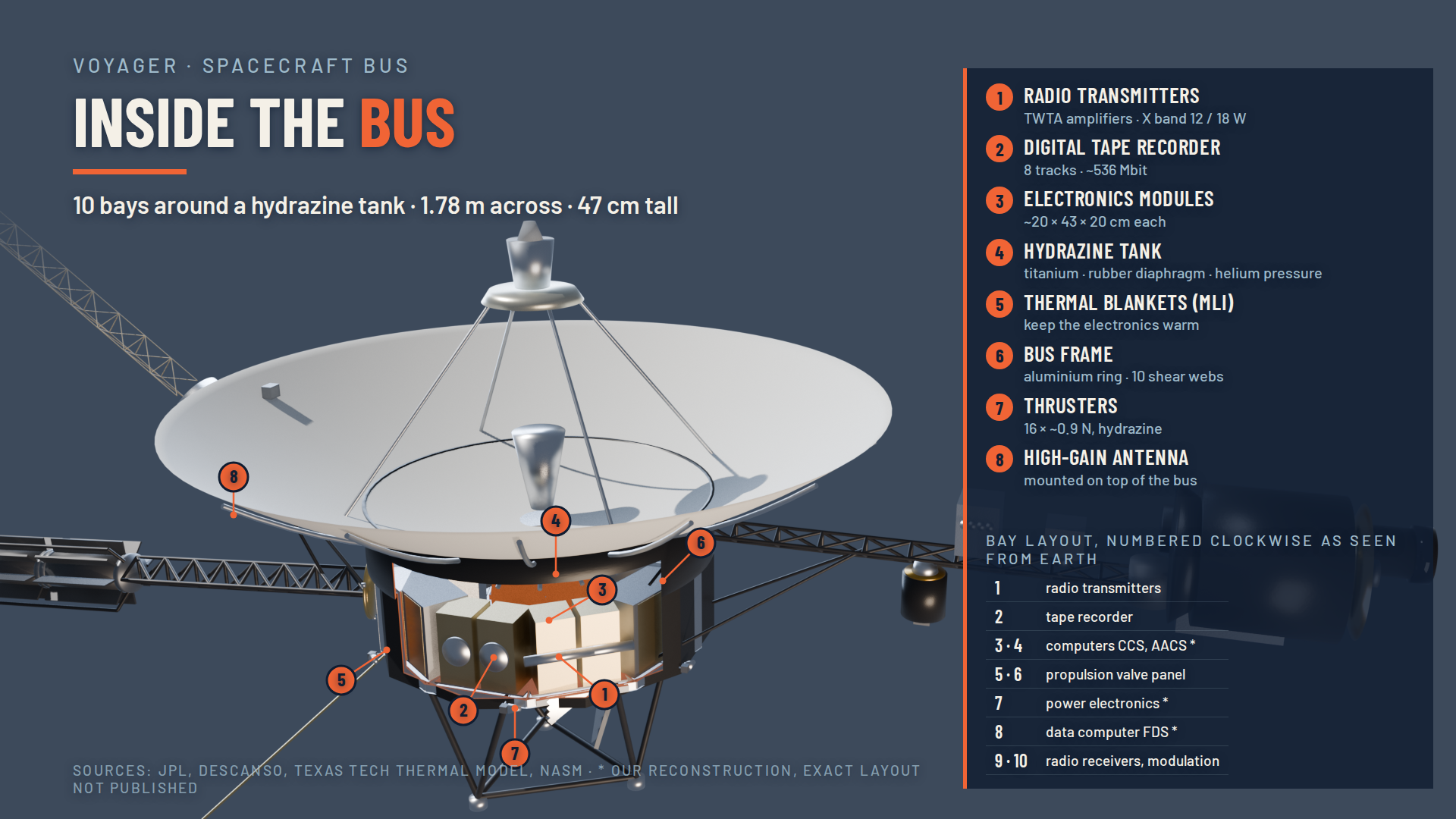
Ten bays around the bus protect the electronics. The CCS executes commands, the FDS prepares telemetry, and the AACS controls the pointing of the antenna and instruments. An eight-track tape recorder stored data for later transmission when a direct Earth link was unavailable.
The cutaway draws on the known arrangement and public photographs. A complete map of every internal bay is not publicly documented, so unlabeled modules in the reconstruction are schematic.
Inside the spacecraft bus
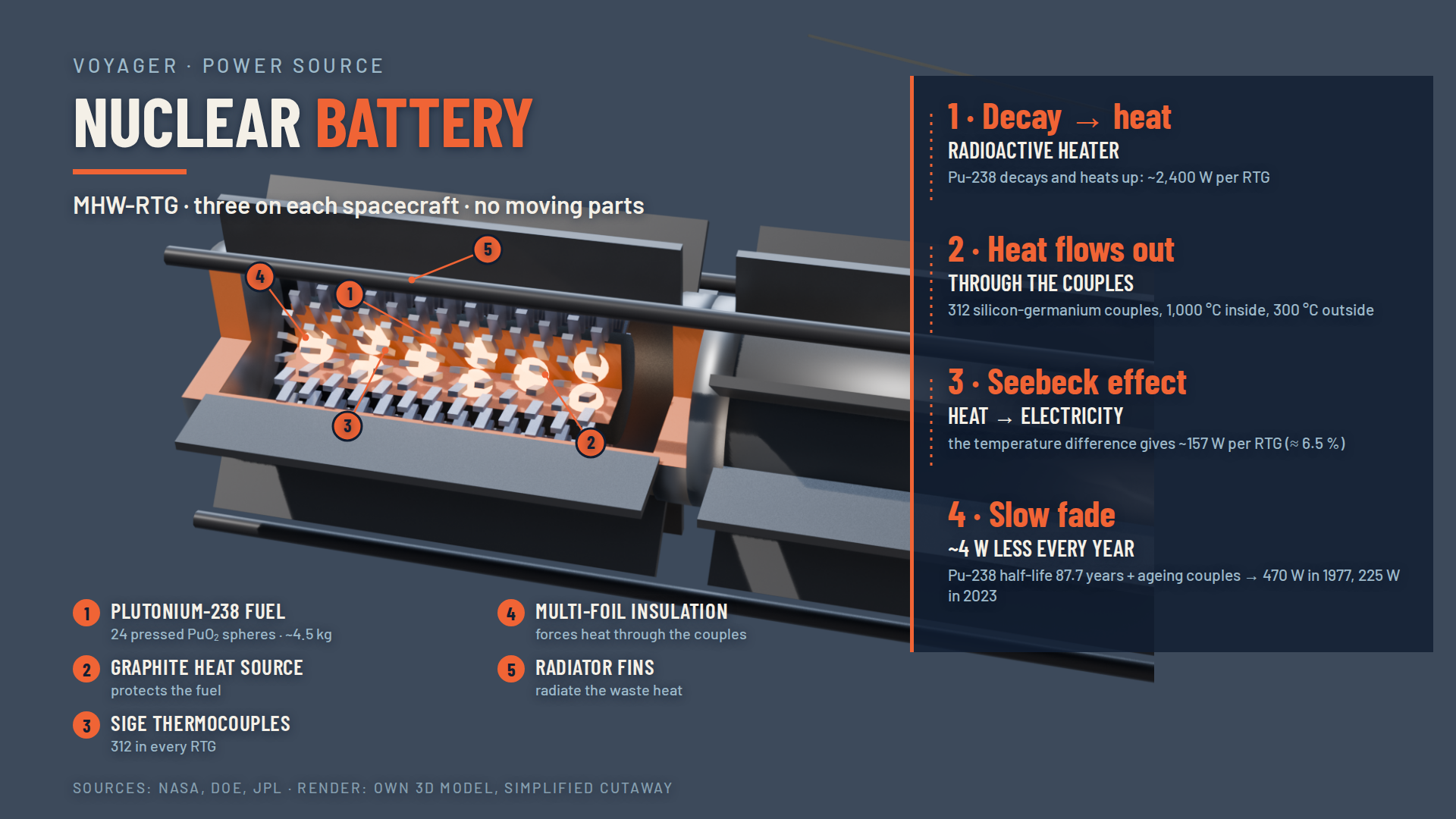
Electricity from fading heat
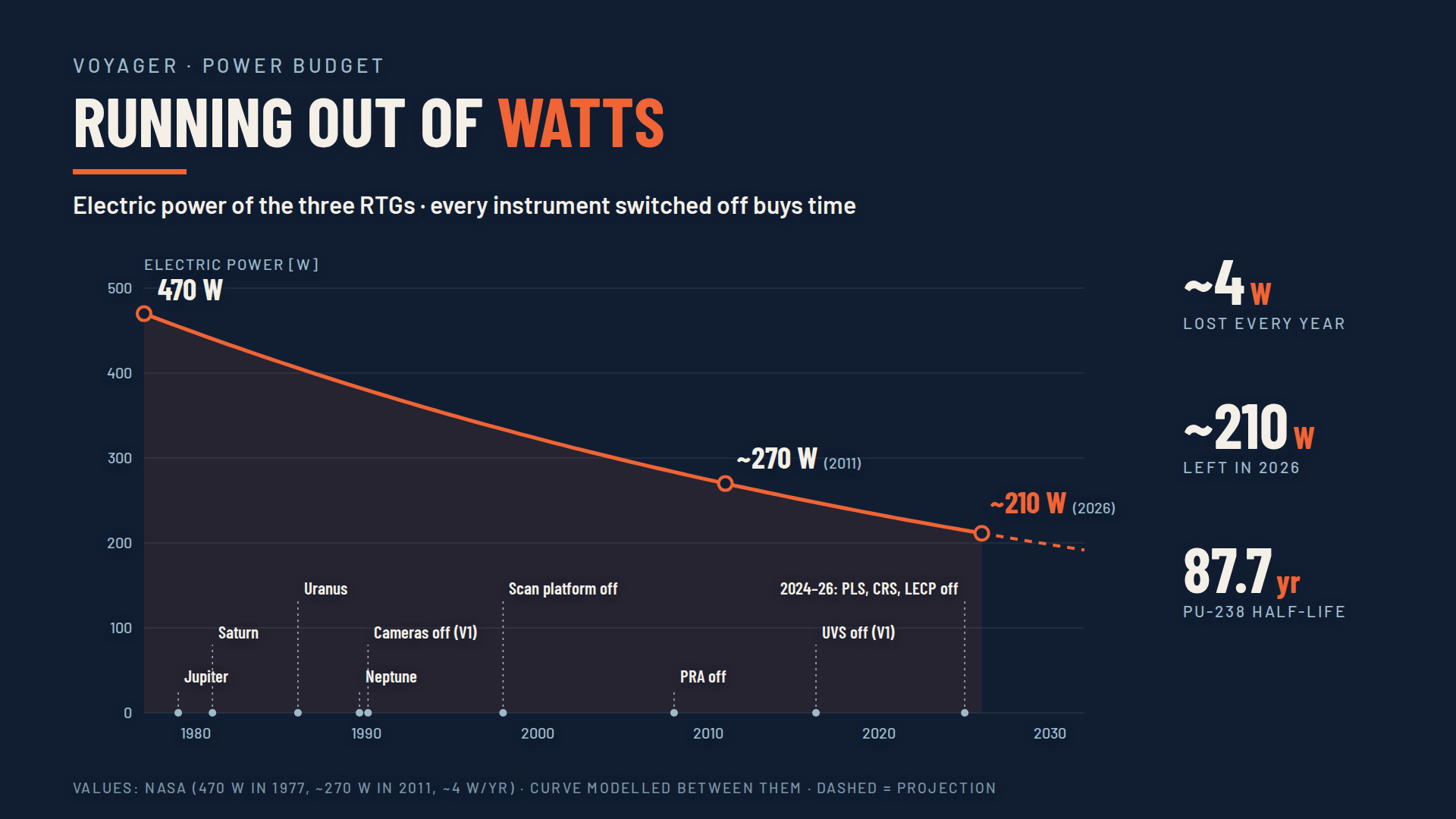
Solar panels would not provide enough power at the outer planets. Each Voyager therefore carries three radioisotope thermoelectric generators. Decaying plutonium-238 produces heat that thermocouples convert into electricity. At launch they supplied roughly 470 W of electrical power.
Output declines gradually, by roughly four watts a year. The ground team therefore switches off instruments and finds savings in heaters. The 1977 figure is not the spacecraft’s current power.
How a radioisotope generator works
Number two launched first
Voyager 2 launched on a Titan IIIE–Centaur rocket on 20 August 1977. Voyager 1 followed on 5 September. The latter took a shorter, faster path, overtook its twin by December 1977 and reached Jupiter first.
Follow us
Follow us on social media
New plates, trivia and behind-the-scenes updates as soon as they are ready.
After launch, the booms deployed and the instruments were readied for work. The probes were built for several years of exploration; the following decades depended on design margins and continuous work by the ground team.
Voyager assembled
Jupiter, Saturn and the Titan decision
Voyager 1 flew past Jupiter in March 1979. Its pictures revealed complex storms and a faint ring. Linda Morabito identified a volcanic plume above the moon Io: the first observed active volcanism beyond Earth. Voyager 2 arrived in July and imaged Europa’s cracked ice in greater detail.
At Saturn in November 1980, Voyager 1 aimed for a close Titan flyby. It could study the moon’s atmosphere, but the encounter also bent its path far above the plane of the planets. Voyager 2 passed Saturn in August 1981 and continued to Uranus and Neptune.
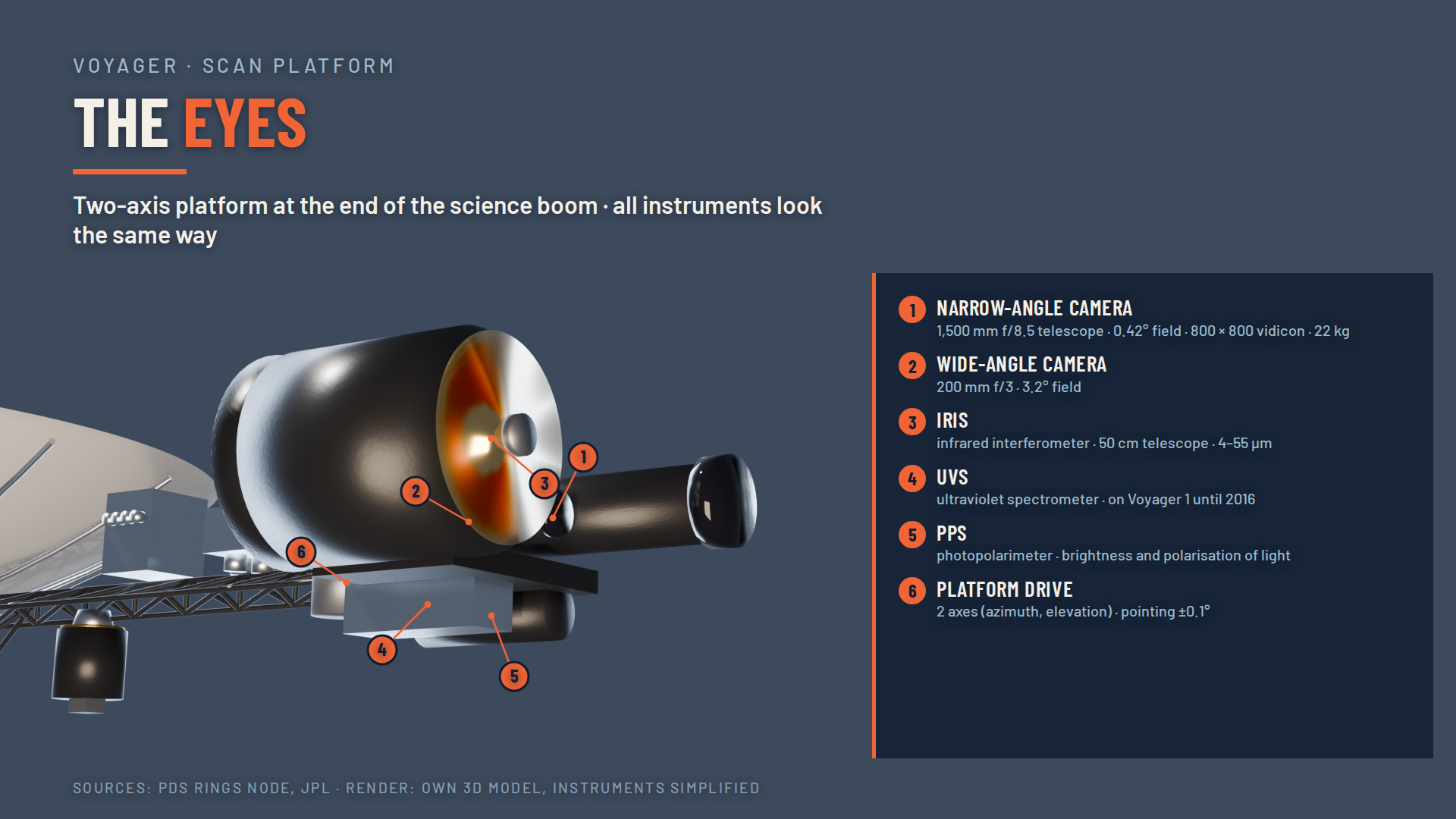
Cameras and spectrometers on the platform
The twin’s journey to the ice giants
Voyager 2 reached Uranus on 24 January 1986 and Neptune on 25 August 1989. It remains the only spacecraft to have visited both planets at close range. At Uranus it found more moons and imaged Miranda; at Neptune it observed fast winds, the Great Dark Spot and plumes on Triton.
Meanwhile, on 14 February 1990, Voyager 1 took a distant portrait of the Solar System. Earth is barely a point in the famous Pale Blue Dot frame. The cameras were then switched off; the probes are no longer planetary photographers.
Beyond the heliosphere
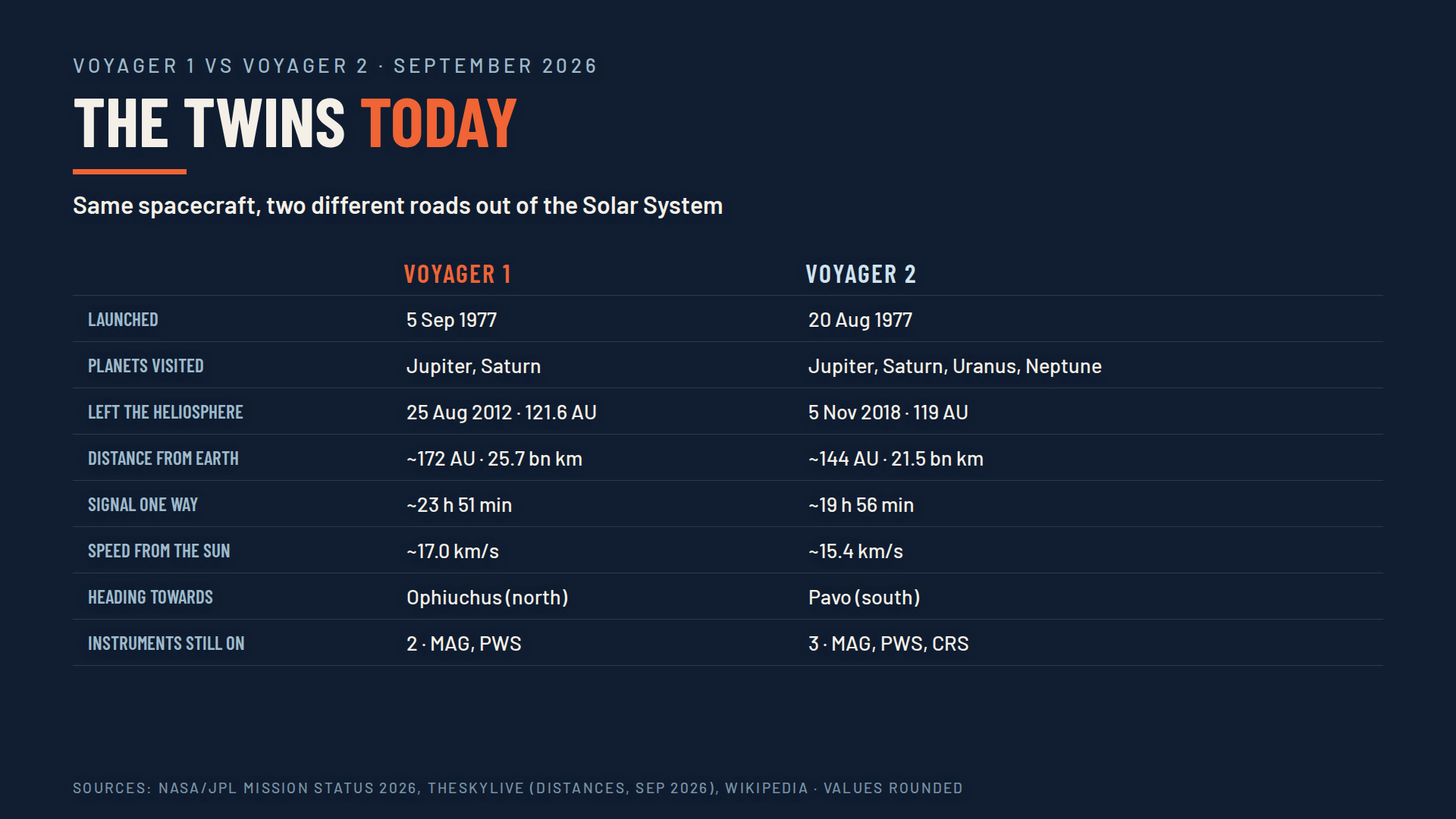
Voyager 1 crossed the heliopause on 25 August 2012 and Voyager 2 on 5 November 2018. The heliopause marks the edge of the region dominated by the solar wind. It is neither the end of the Solar System nor a departure beyond the Oort Cloud. The probes measure particles, magnetic fields and plasma waves in local interstellar space.
Voyager 2 had a working plasma instrument at the crossing, providing a direct comparison on both sides. The two routes allow scientists to compare the heliosphere in different directions.
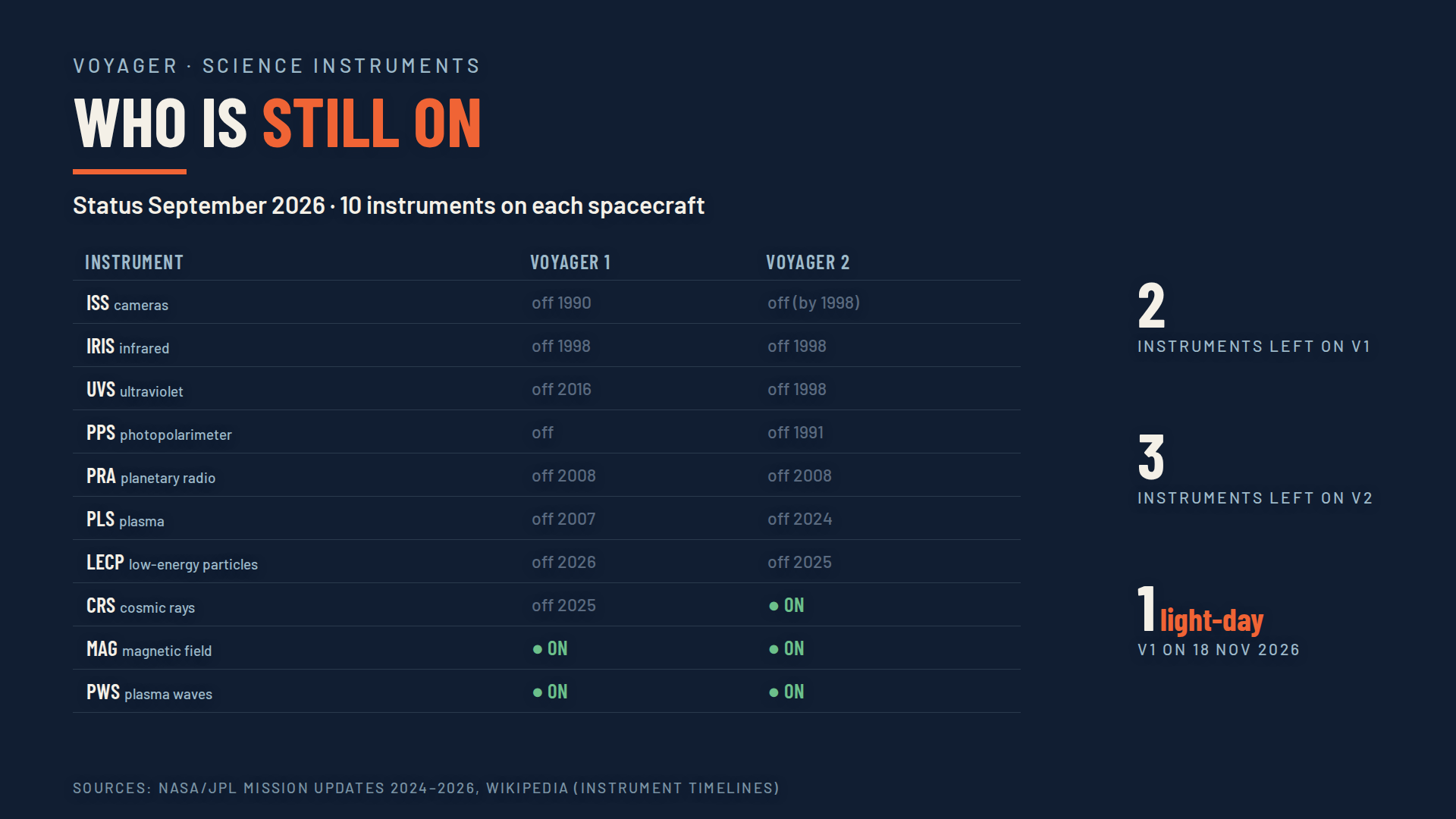
Which instruments still work
The twins today
Keeping a 1977 machine alive
In 2023, Voyager 1’s FDS computer stopped returning intelligible data. In 2024 engineers traced the fault to a memory chip and moved its code to other parts of memory. Engineering and then science data returned across tens of billions of kilometres.
In April 2026 the team switched off Voyager 1’s low-energy charged-particle detector, LECP. As of September 2026, its magnetometer (MAG) and plasma-wave receiver (PWS) remain. Voyager 2 also runs its cosmic-ray detector (CRS). NASA continues to plan power-saving changes; planned steps are not presented here as completed.
The power budget
A message for a possible finder
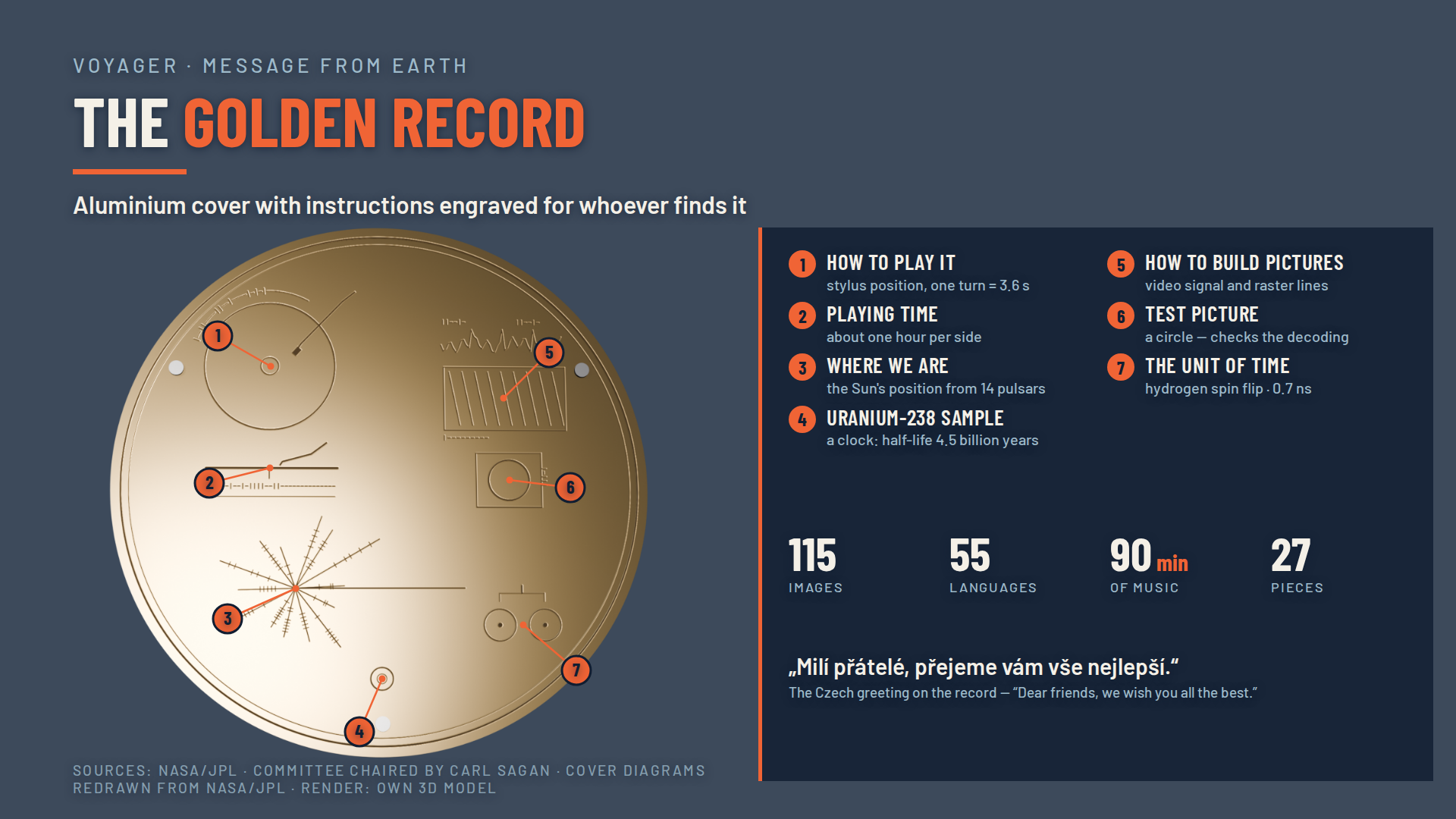
Both probes carry a gold-plated copper record with sounds of Earth, music, 115 images and greetings in 55 languages. Carl Sagan chaired the selection committee. The cover bears playback instructions, a pulsar map locating the Sun and a scale based on hydrogen.
One greeting is in Czech: “Dear friends, we wish you all the best.” The record is not a message transmitted by radio; it is a physical object for anyone who might one day find it. Long after contact ends, both probes will continue around the Galaxy.
The Golden Record
Article on the timeline
Check yourself
How can a probe launched in 1977 still talk to us?
Answer in your own words — everything you need is in the article above.
Sources & further reading
- NASA: joint mission history and planetary flybys.
- NASA: spacecraft design, antenna, power and instruments.
- NASA: the light-day distance and Voyager 1 milestone.
- NASA: LECP shutdown and remaining Voyager 1 instruments.
- NASA: FDS memory-chip fault and relocation of code.
- NASA: power savings and continued Voyager 2 science.
- JPL DESCANSO: technical description of radio communications.
- NASA/JPL: Golden Record contents and greetings.
Spaceflightpedia. (n.d.). Voyager 1 — beyond the heliosphere. Retrieved 9 October 2026, from https://spaceflightpedia.com/article/voyager-1
article text — CC-BY-SA · ◉ NASA photography — public domain · ✦ AI illustration — marked, generated from sources