- Date
- 12–14 April 1981
- Launcher
- Space Shuttle
- Mission
- STS-1
#NASA#USA#Raketoplán#Space Shuttle#Columbia
- 01The first flight without an orbital rehearsal
- 02Crew
- 03Why NASA built the Shuttle
- 04Columbia: a spacecraft with wings
- 05Two pilots and thousands of tiles
- 06A white tank and two boosters
- 07The long road to Pad 39A
- 08Forty milliseconds that delayed launch
- 09From ignition to orbit
- 10Damage the crew could not see
- 11Two days of tests above Earth
- 12A fiery return and an unpowered landing
- 13What the first mission proved and exposed
- 14Mission timeline
- 15Sts-1 at a glance
- 16Gallery
- 17Related articles
- 18Article on the timeline
- 19Sources
- 20Connections
The first flight without an orbital rehearsal
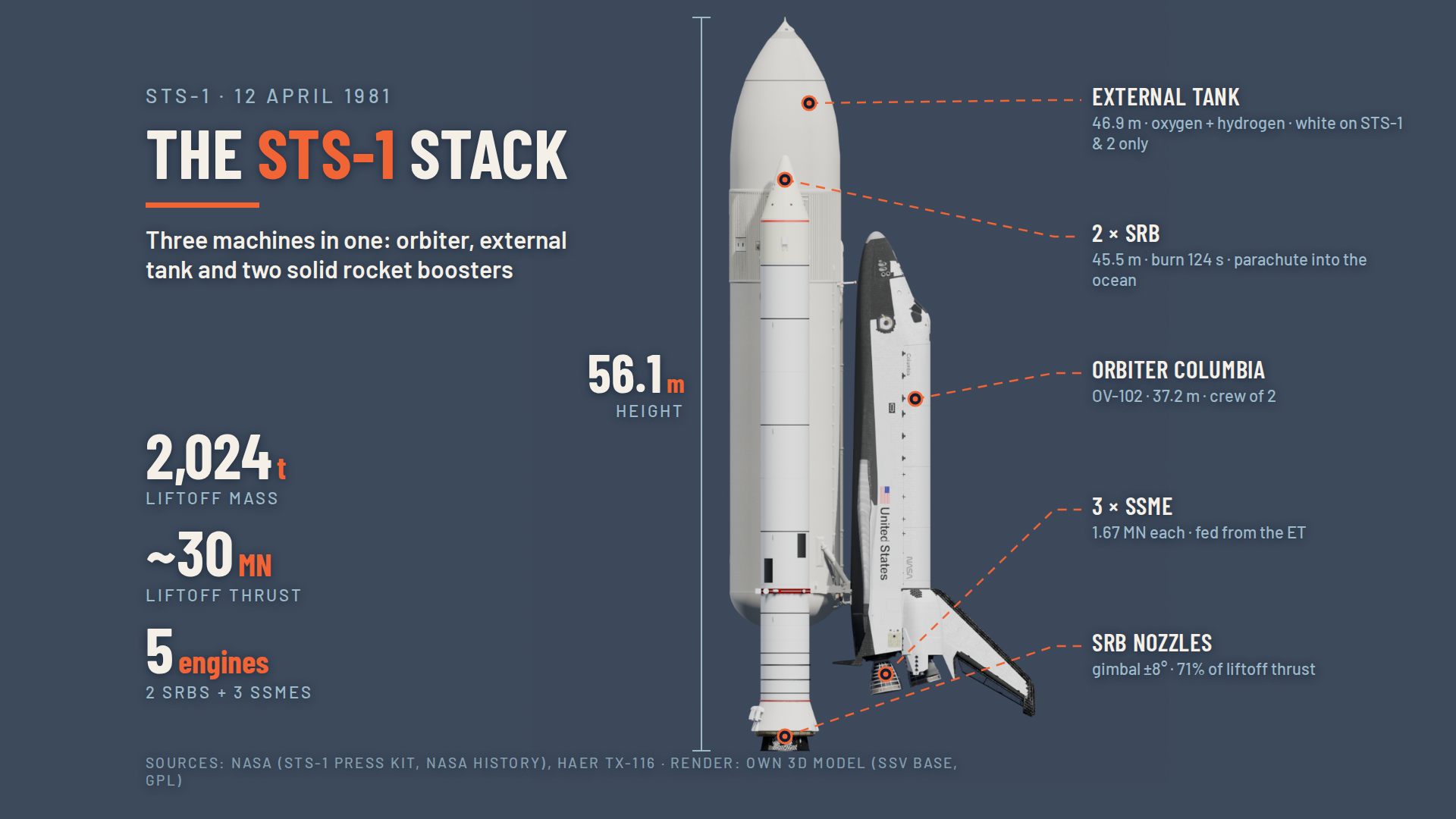
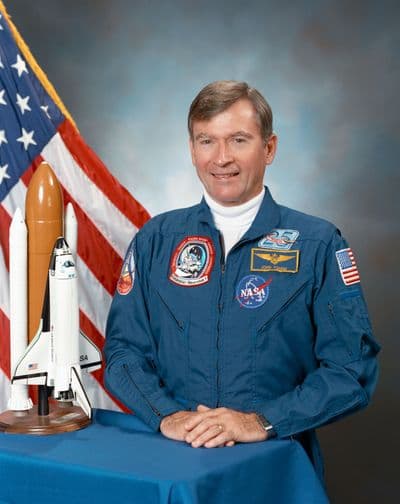
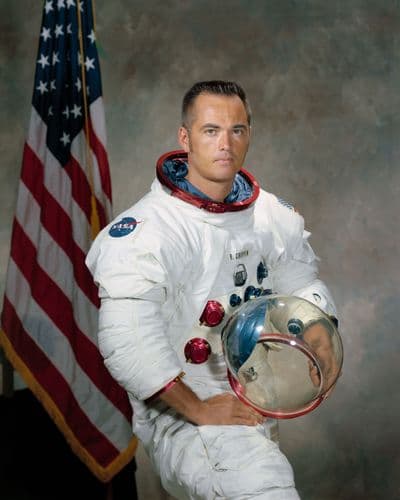
On 12 April 1981, John Young and Robert Crippen sat in Columbia on Pad 39A. Beneath them stood a roughly two-thousand-tonne launch stack; ahead lay orbit. The orbiter had never been to space, even without a crew. STS-1 was therefore no routine transport mission. It was the first full test of the Shuttle from launch through landing.
In 1977 the prototype Enterprise had proved that an orbiter could glide to a landing after release from a Boeing 747. It had no engines or heat shield for orbital flight. Columbia had to test the parts of the mission that ground trials and simulations could never combine into one complete flight.
The STS-1 launch stack
Crew
Why NASA built the Shuttle
After Apollo, NASA sought a spacecraft that could return, be serviced and fly again. The orbiter would launch like a rocket, operate in orbit like a spacecraft and land as a glider. Reuse was an attractive goal, but it meant combining cryogenic engines, a large payload bay, a heat shield and precise control through reentry.
STS-1 began flight testing of that system; it did not mark the start of routine service. Instruments recorded the vehicle’s loads and behaviour in conditions that could only partly be reproduced on Earth.
How the Shuttle worked
Columbia: a spacecraft with wings
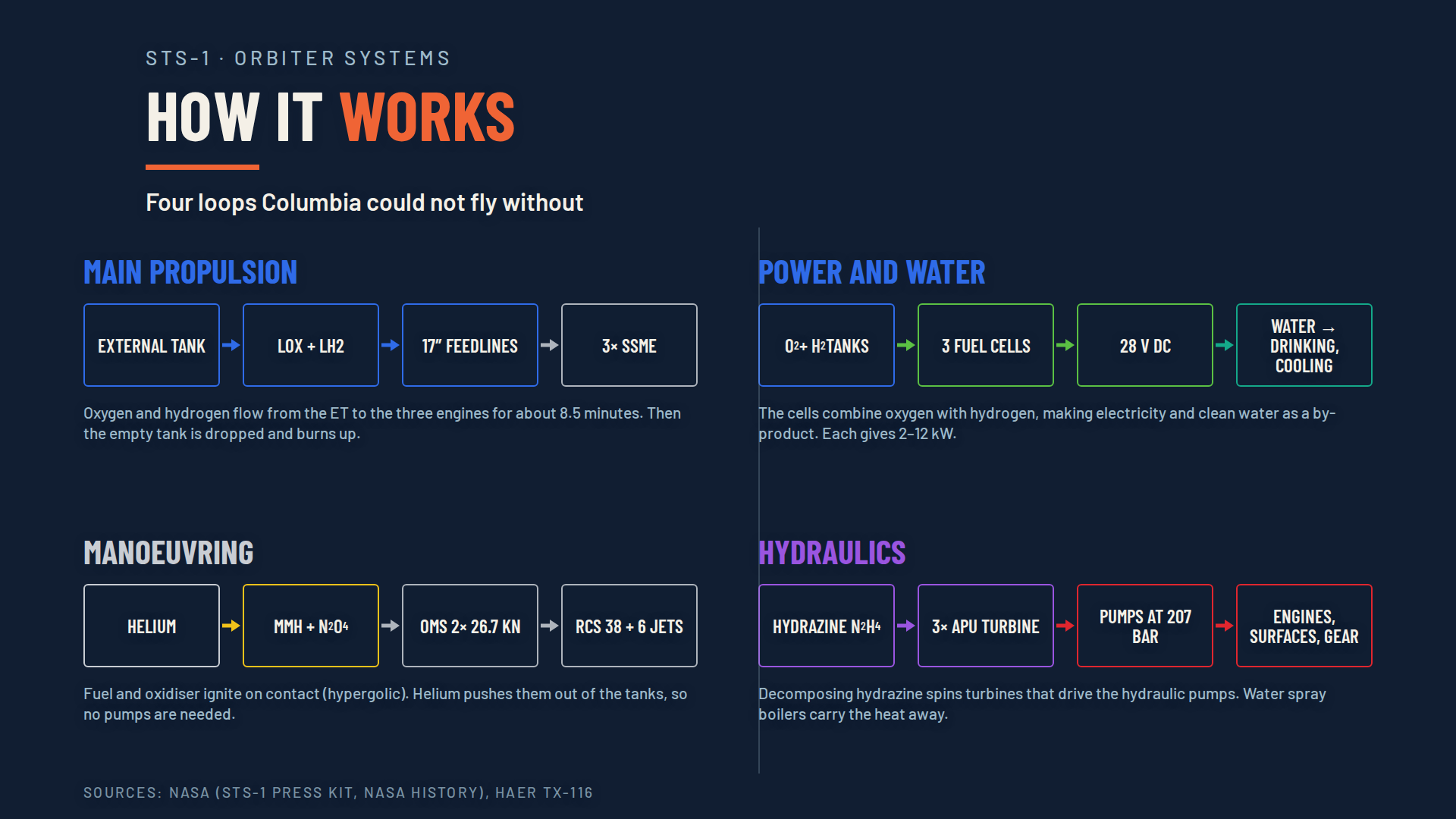
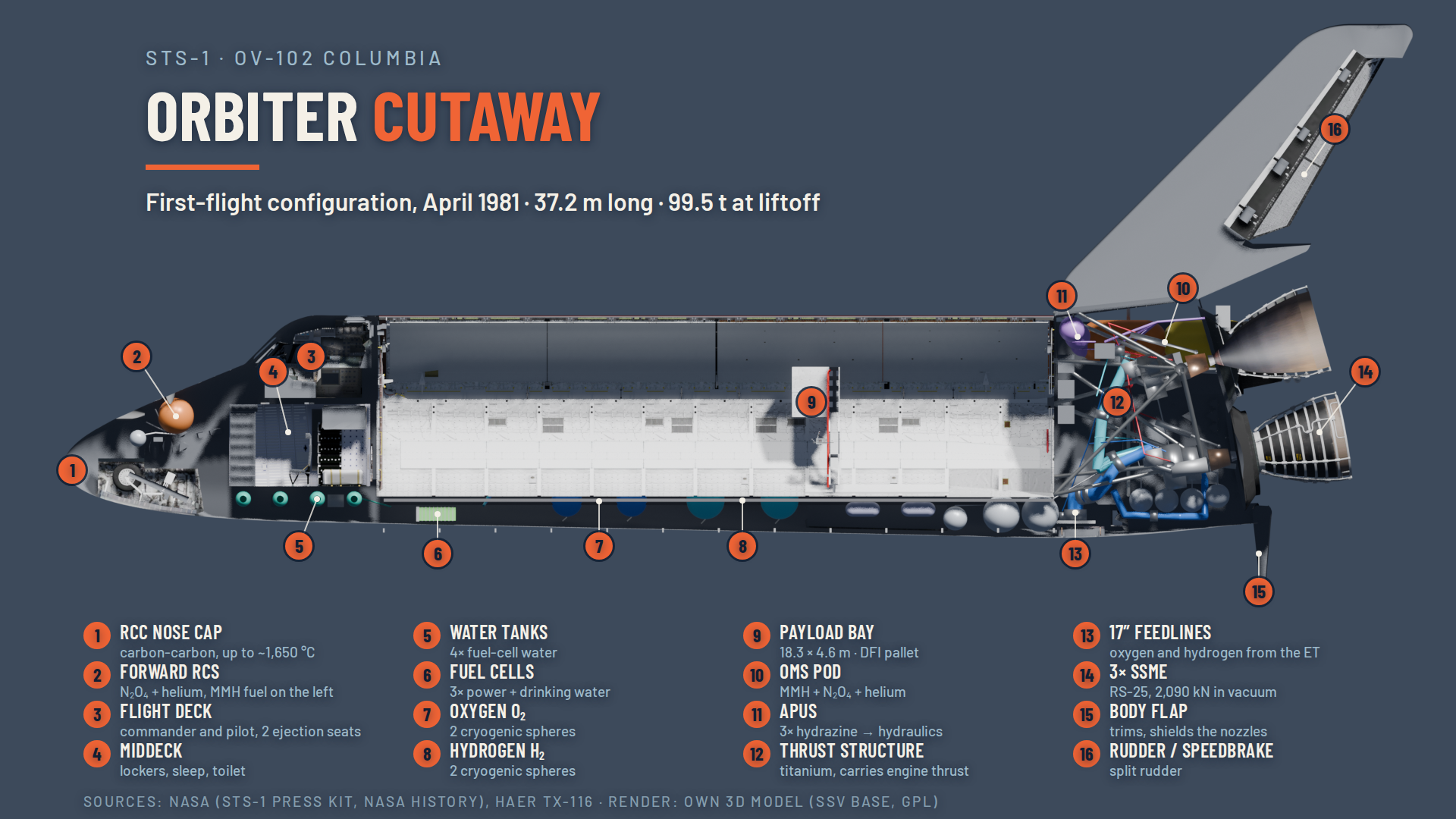
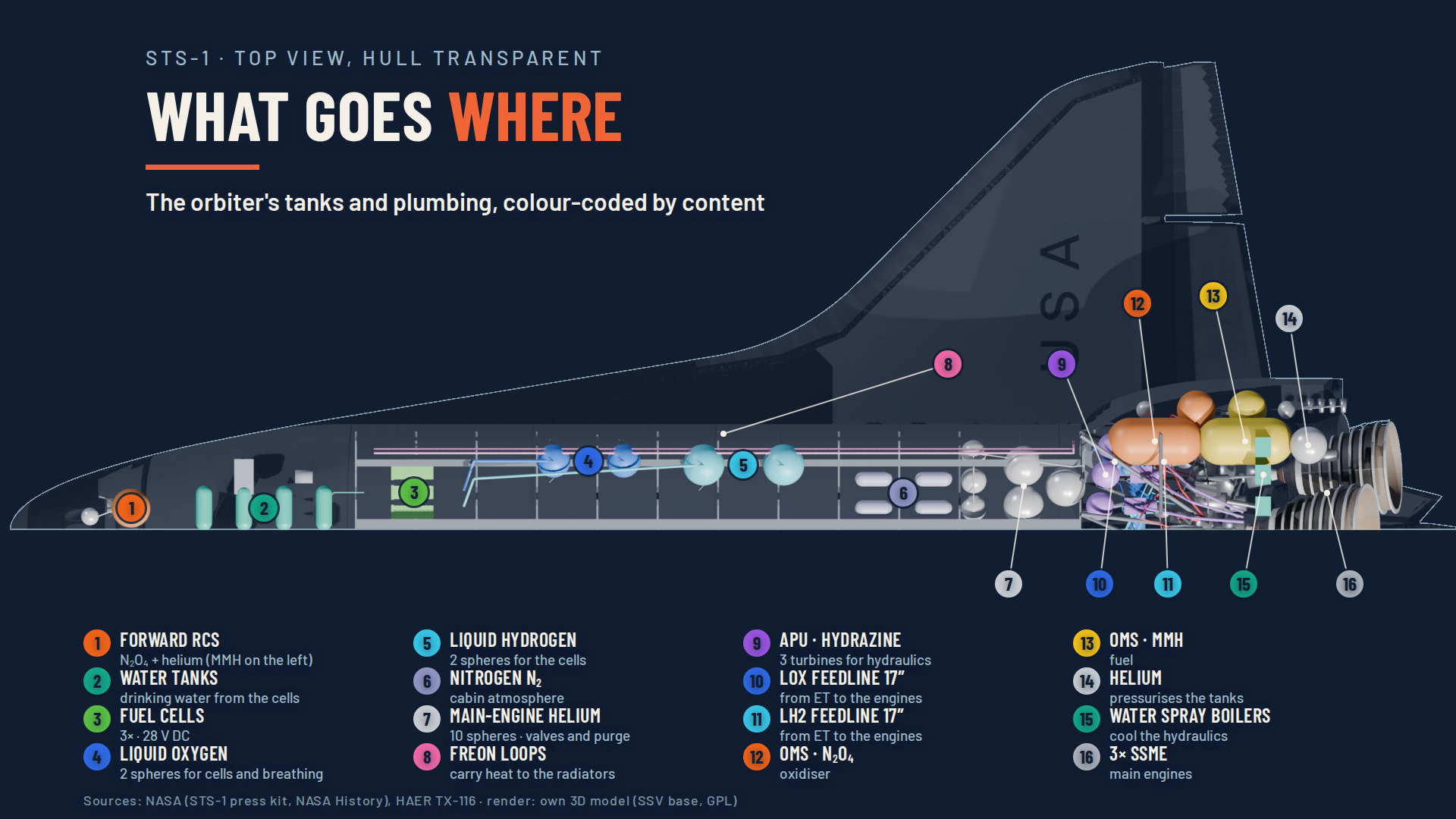
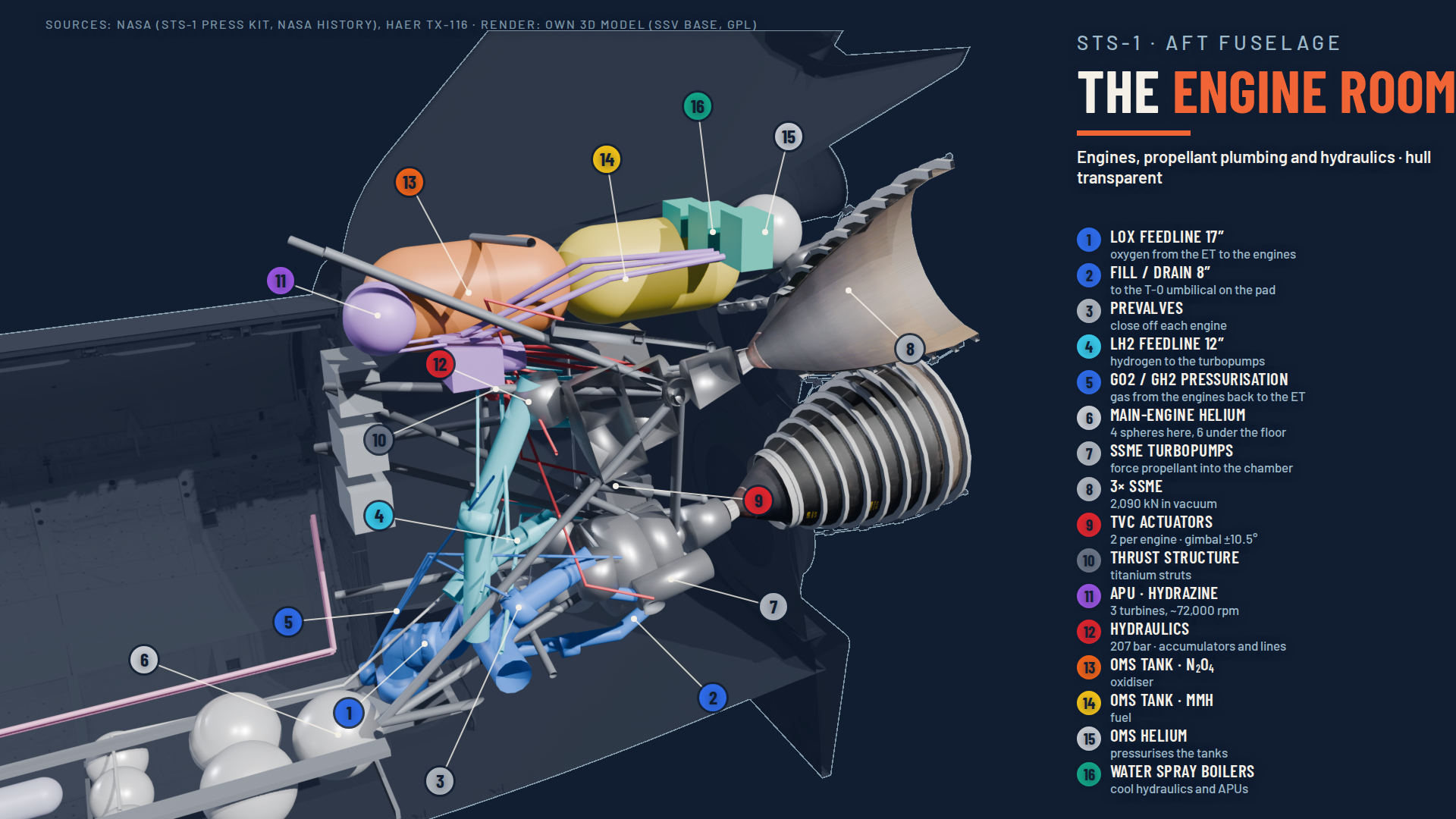
The orbiter carried the crew, payload bay, three main engines and orbital manoeuvring systems. Its main engines burned liquid oxygen and hydrogen supplied by the external tank. Smaller engines in the aft pods adjusted the orbit, while manoeuvring thrusters controlled attitude. Once the tank was discarded, the orbiter flew on alone.
STS-1 did not carry a routine commercial payload. The bay was devoted to testing, including instruments that recorded flight data. Its doors carried radiators needed to reject heat; opening them in orbit was one of the crew’s first critical tasks.
Inside the Columbia orbiter
Where everything is
Aft fuselage and engines
Two pilots and thousands of tiles
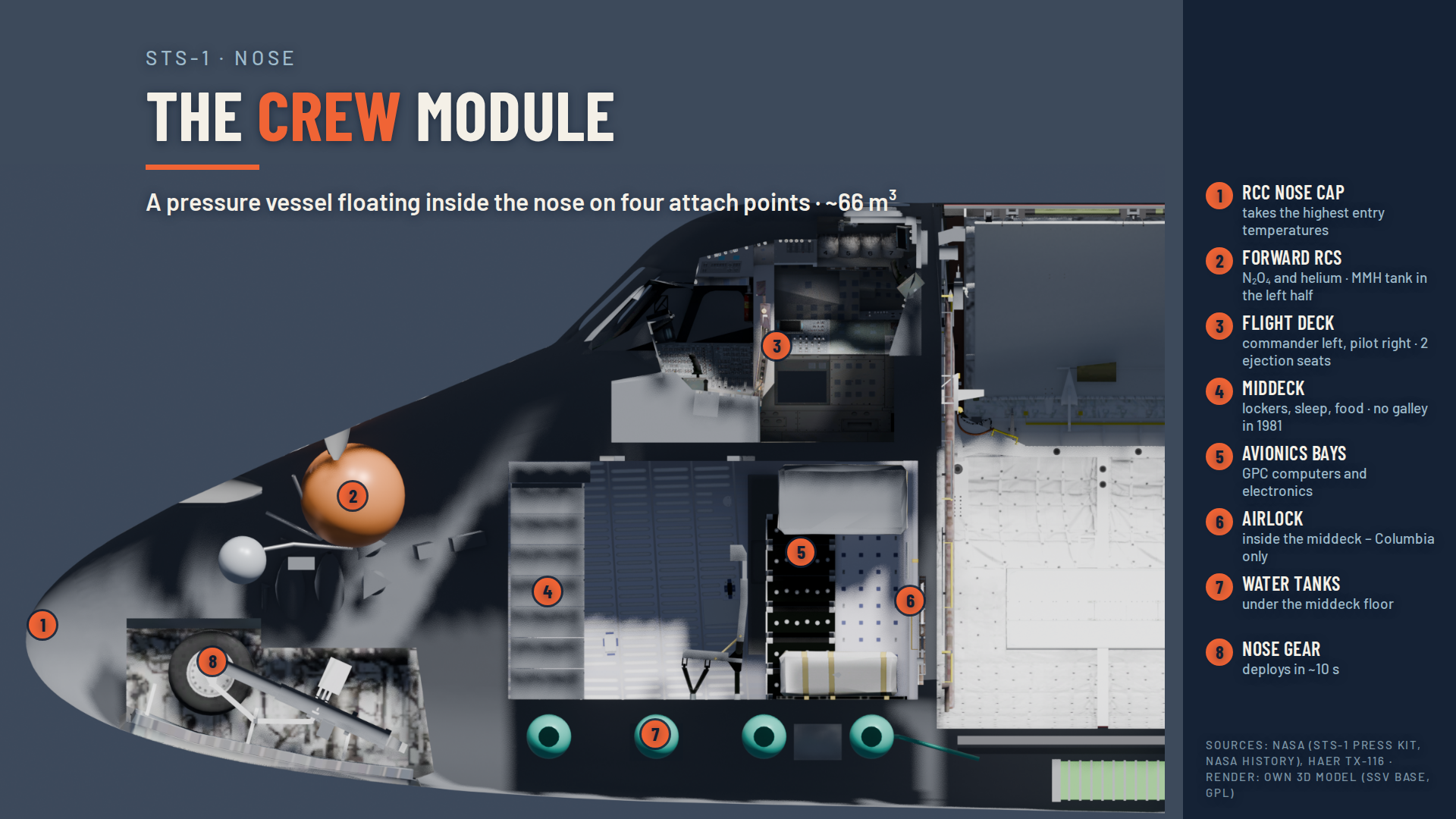
Commander John Young had already flown Gemini and Apollo missions, including a Moon landing on Apollo 16. Pilot Robert Crippen was making his first spaceflight. Both sat in ejection seats and wore pressure suits, although those provisions could not offer a simple escape from every phase of the mission.
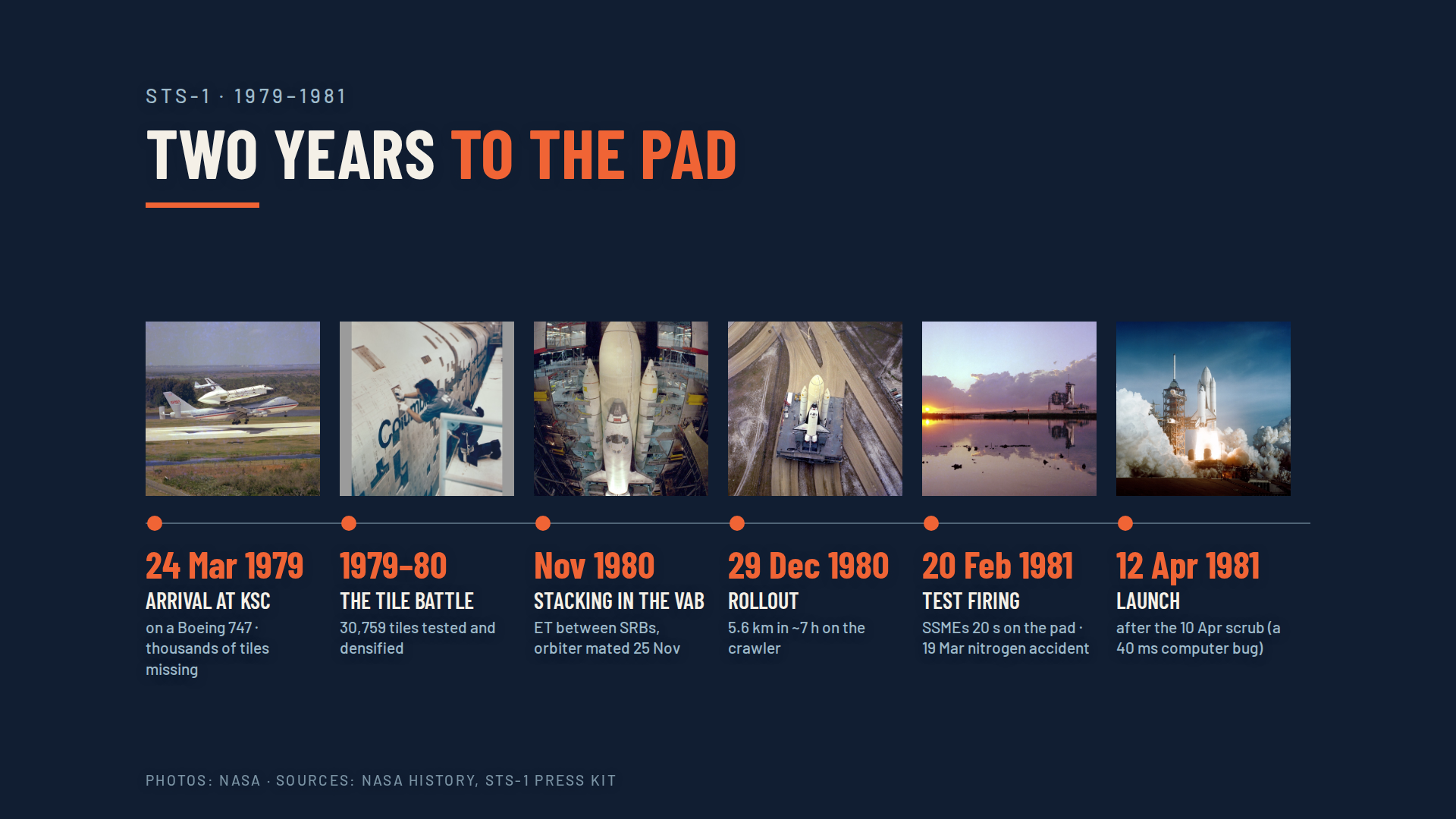
The thermal protection tiles were a major obstacle to Columbia’s preparation. When the orbiter arrived in Florida in March 1979, thousands still had to be fitted. Technicians checked individual bonds and reinforced or replaced many tiles. Their reliability would determine whether the vehicle could survive its return from orbit.
The crew cabin
A white tank and two boosters
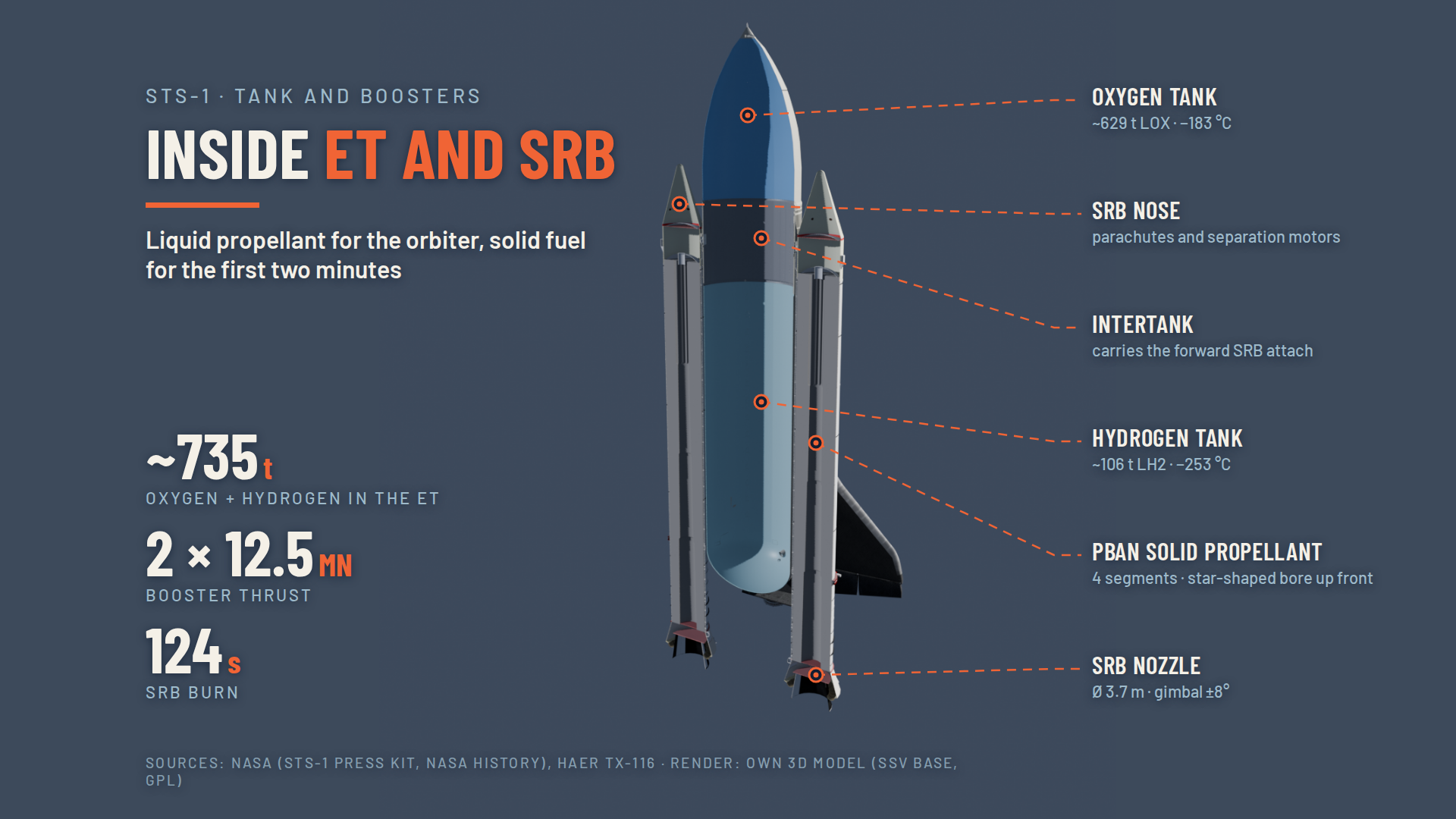
Two solid rocket boosters supplied most of the thrust at liftoff. After about two minutes they separated and descended by parachute into the Atlantic for recovery. The external tank fed the main engines and was the only large component of the launch stack not recovered for reuse.
The STS-1 tank was painted white. The second mission also used a white tank. From STS-3 onward NASA left the foam insulation unpainted to save weight. Footage showing a later orange tank cannot depict the first launch.
External tank and solid boosters
The long road to Pad 39A
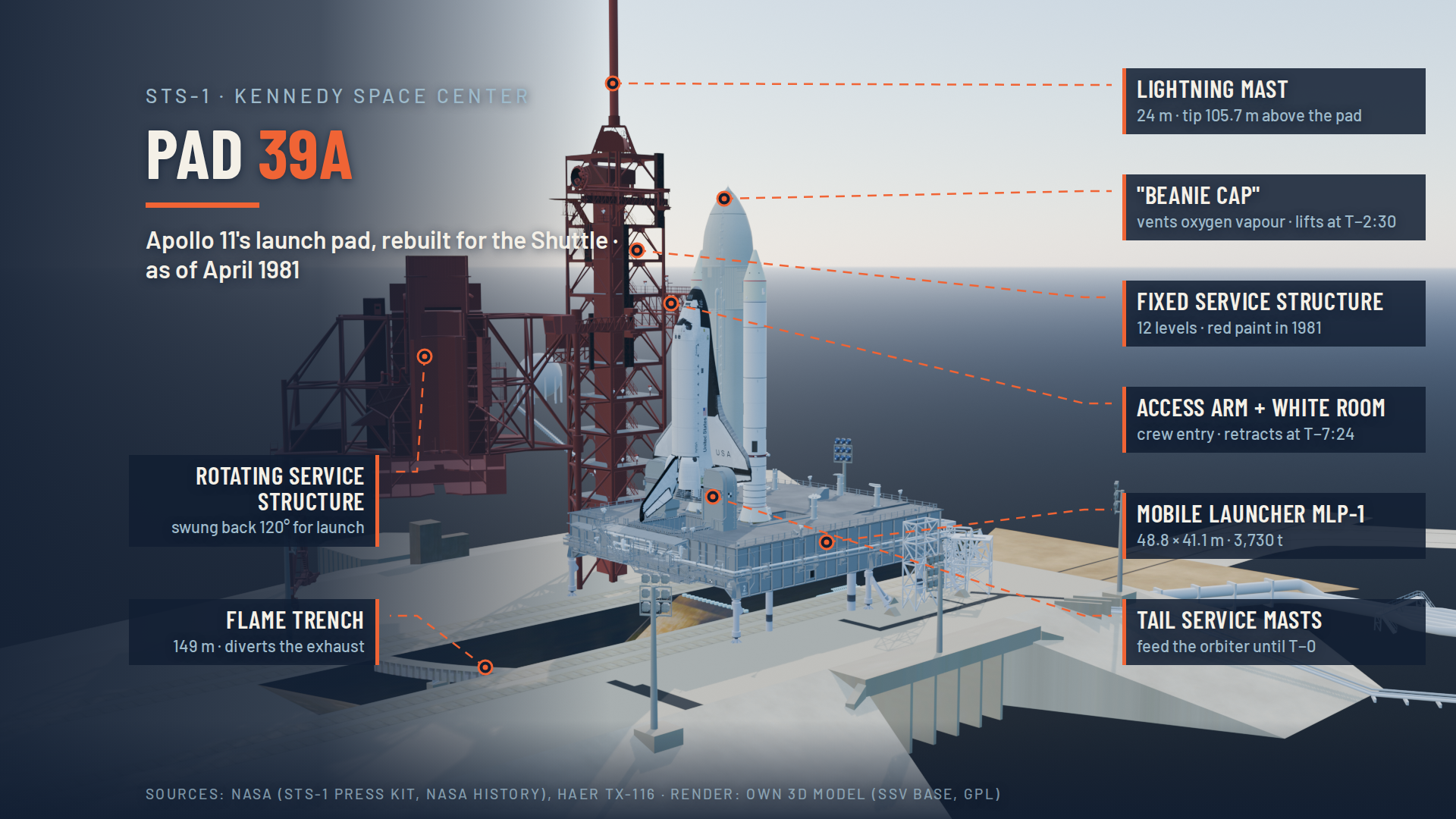
Columbia arrived at Kennedy Space Center in March 1979. Completing the heat shield and working through demanding main-engine tests pushed the first launch well beyond earlier plans. A crawler carried the assembled stack to Pad 39A on 29 December 1980, the pad from which Apollo 11 had launched. In February 1981, all three main engines fired briefly while the vehicle remained on the pad.
Preparation also brought tragedy. After a March countdown test, workers entered an orbiter compartment filled with nitrogen. Two died and a third suffered permanent injury. The event shows that the hazards of spaceflight begin well before liftoff.
Pad 39A in 1981
Columbia’s journey to the pad
Forty milliseconds that delayed launch
The first attempt on 10 April 1981 was scrubbed minutes before liftoff. The four primary flight computers and the backup system were out of step by about 40 milliseconds. The crew returned two days later after engineers addressed the timing problem and checked the system again.
Follow us
Follow us on social media
New plates, trivia and behind-the-scenes updates as soon as they are ready.
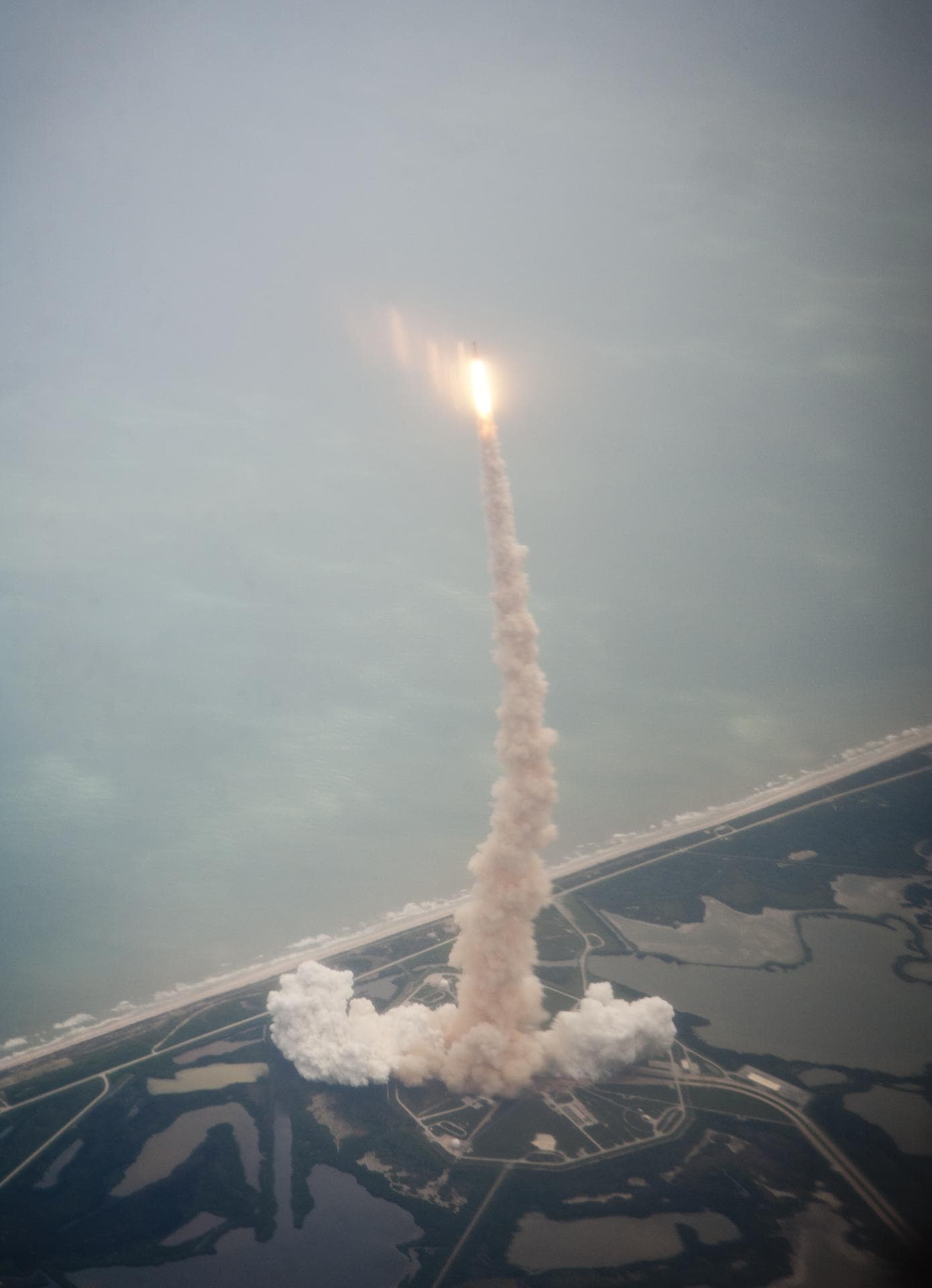
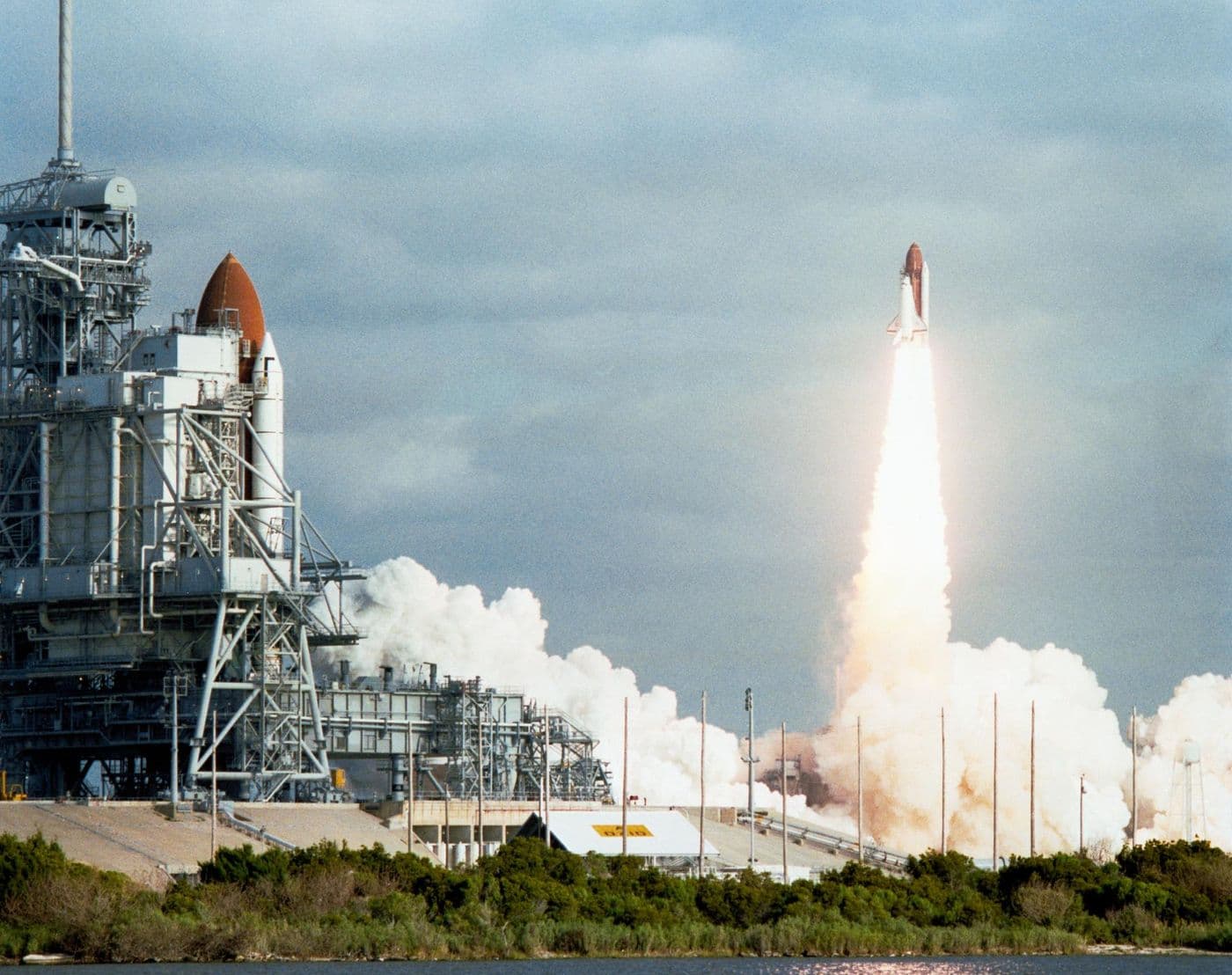
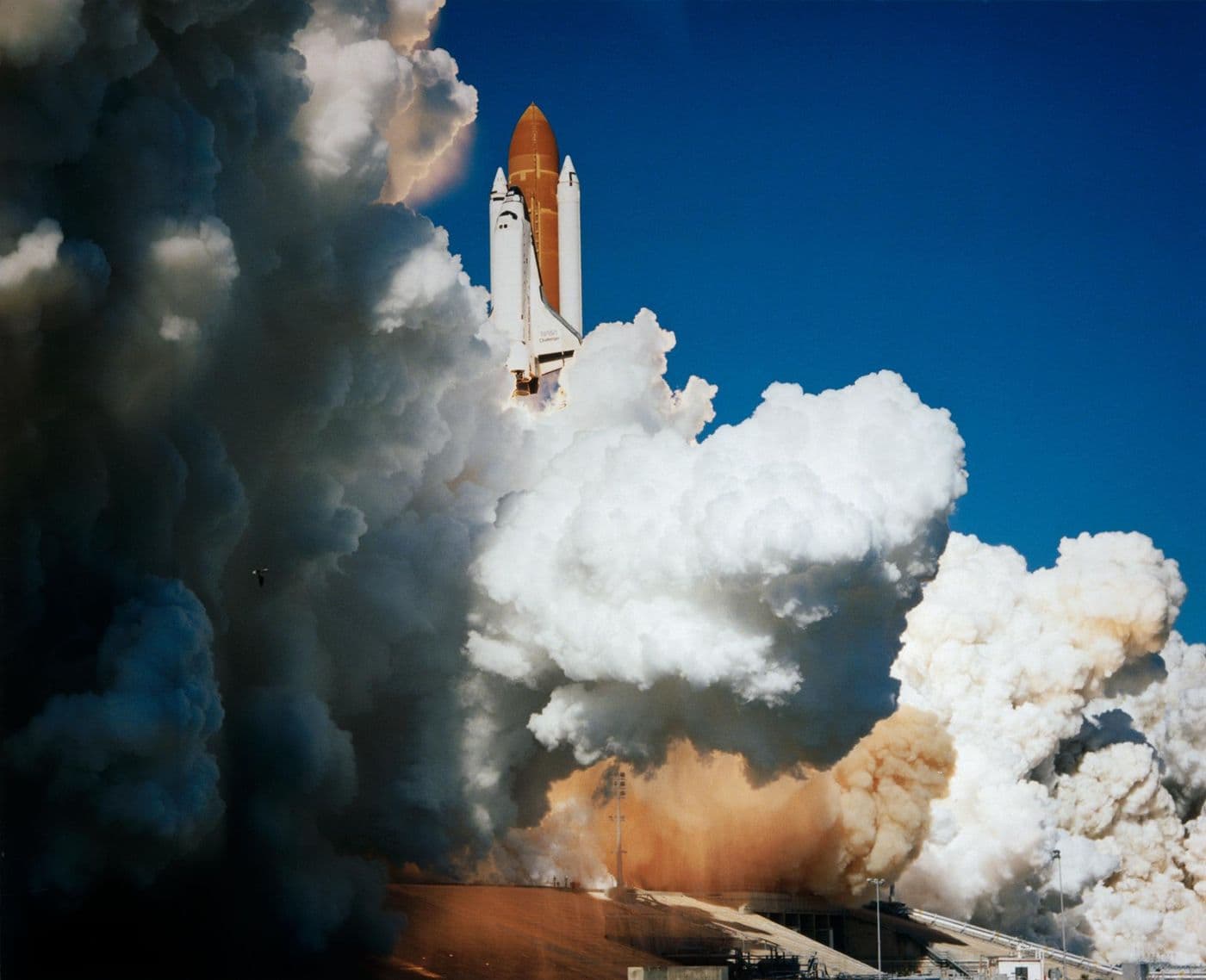
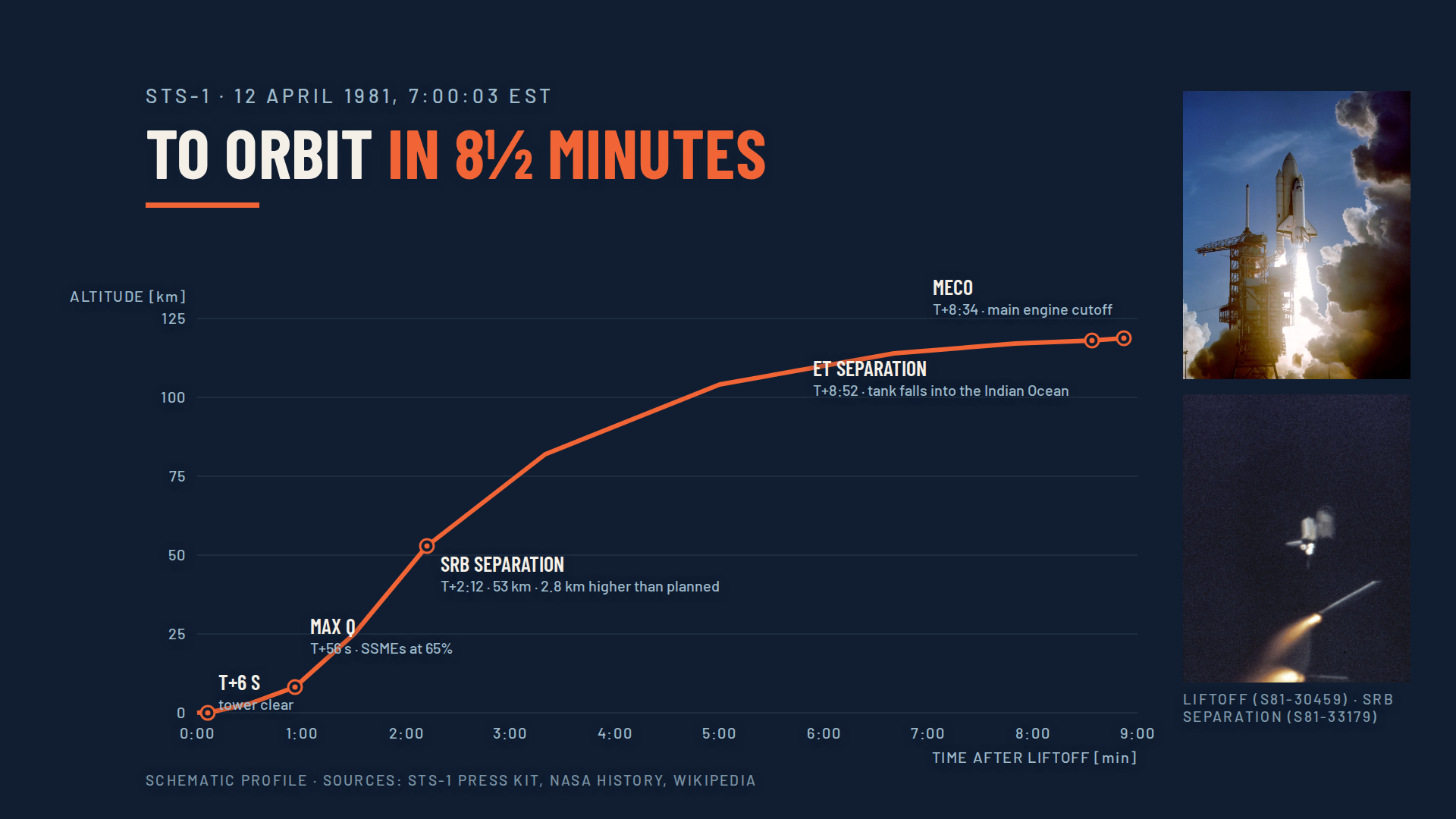
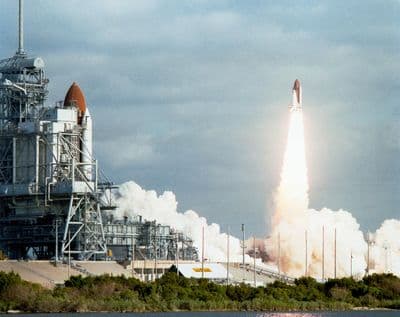
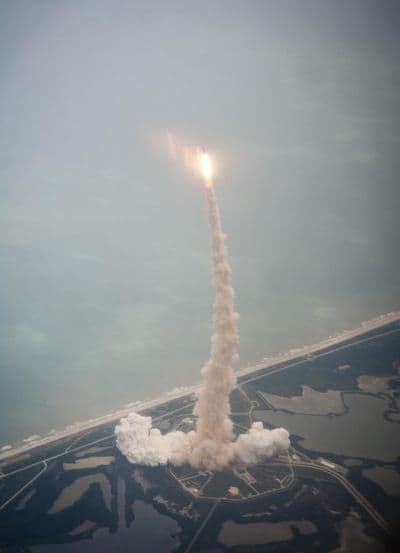
Columbia lifted off on 12 April 1981 at 12:00:03 UTC, exactly twenty years after Yuri Gagarin became the first human in space. Crowds gathered along Florida’s coast, while controllers focused on measuring the flight of a vehicle that had never before reached space.
From ignition to orbit
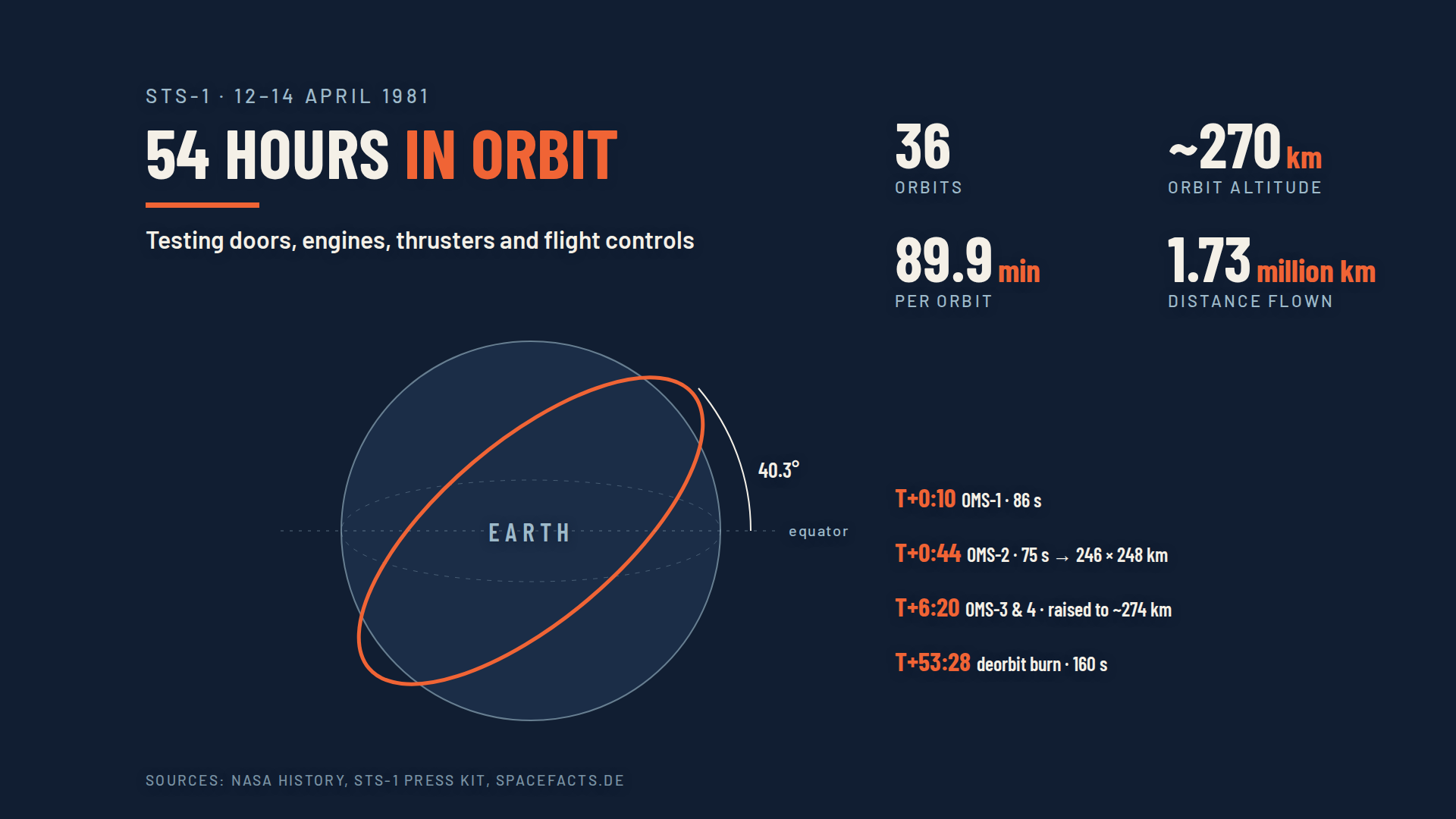
After liftoff, the stack rolled to its planned orientation. The boosters separated around T+2:12. The three main engines continued until roughly T+8:34; the empty tank separated shortly afterward. Columbia’s OMS engines then adjusted its path. The orbit was inclined about 40.3° and, after manoeuvres, lay near 270 kilometres altitude.
STS-1 was a simultaneous test of a rocket, a spacecraft and a landing aircraft. Reaching orbit alone was not enough: the crew and ground teams had to follow every stage through to the return.
The ascent sequence
Damage the crew could not see
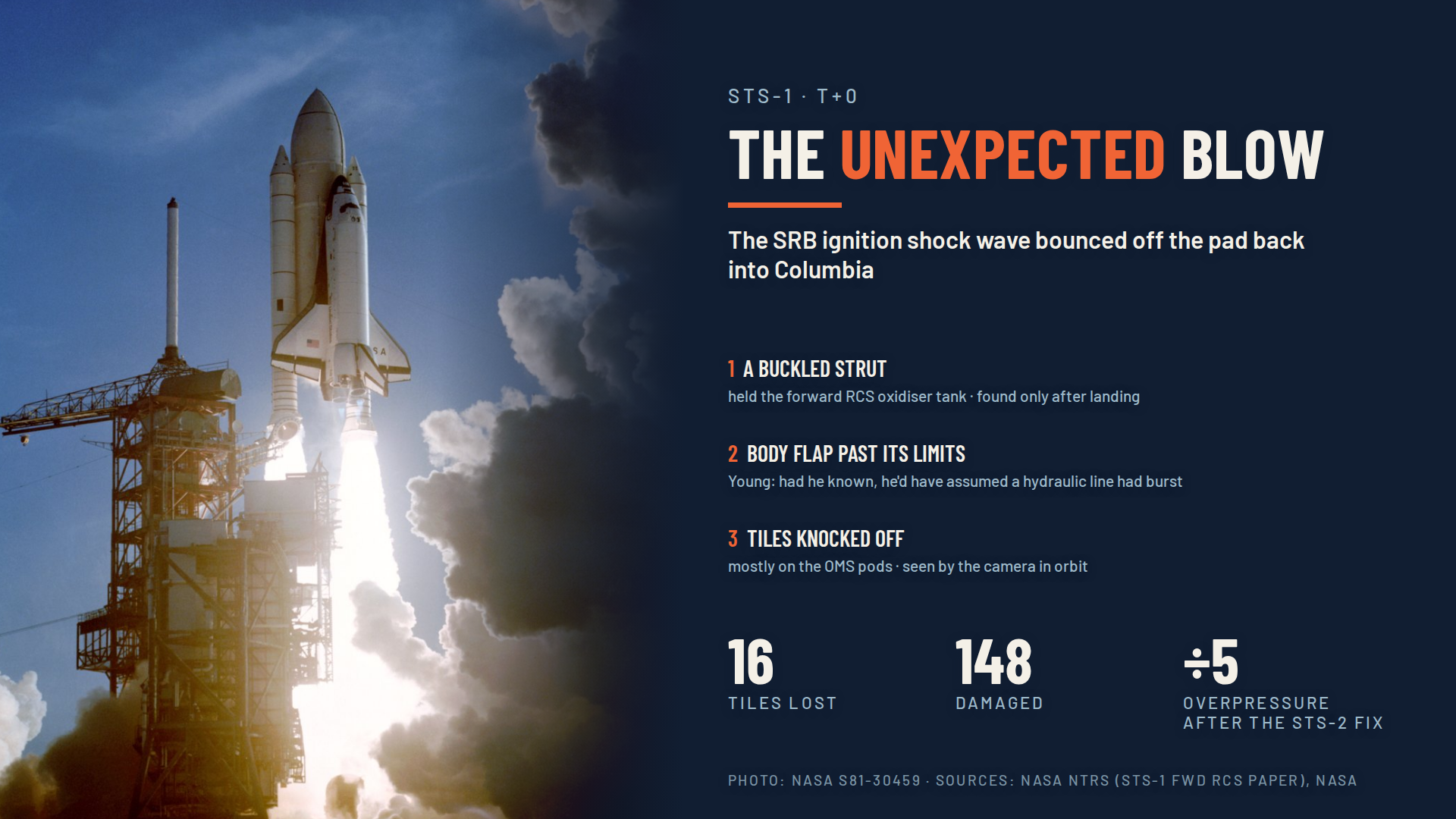
Booster ignition produced a stronger launch-pad pressure wave than expected. The reflected impulse loaded Columbia, pushed its aft body flap and damaged a forward strut. The full extent could only be established after landing. Postflight findings counted 16 missing thermal tiles and another 148 damaged.
Before the next flight NASA changed the water system that suppressed acoustic and pressure loads at launch. STS-1 produced a concrete design lesson even where the crew could not identify the problem in flight.
The launch pressure wave
Two days of tests above Earth
In orbit Young and Crippen opened the payload bay doors and exposed the radiators. They tested attitude thrusters, OMS engines, flight controls and other systems. A camera also revealed missing tiles on the OMS pods. The crew could not directly inspect the underside, which would face the greatest heating during reentry.
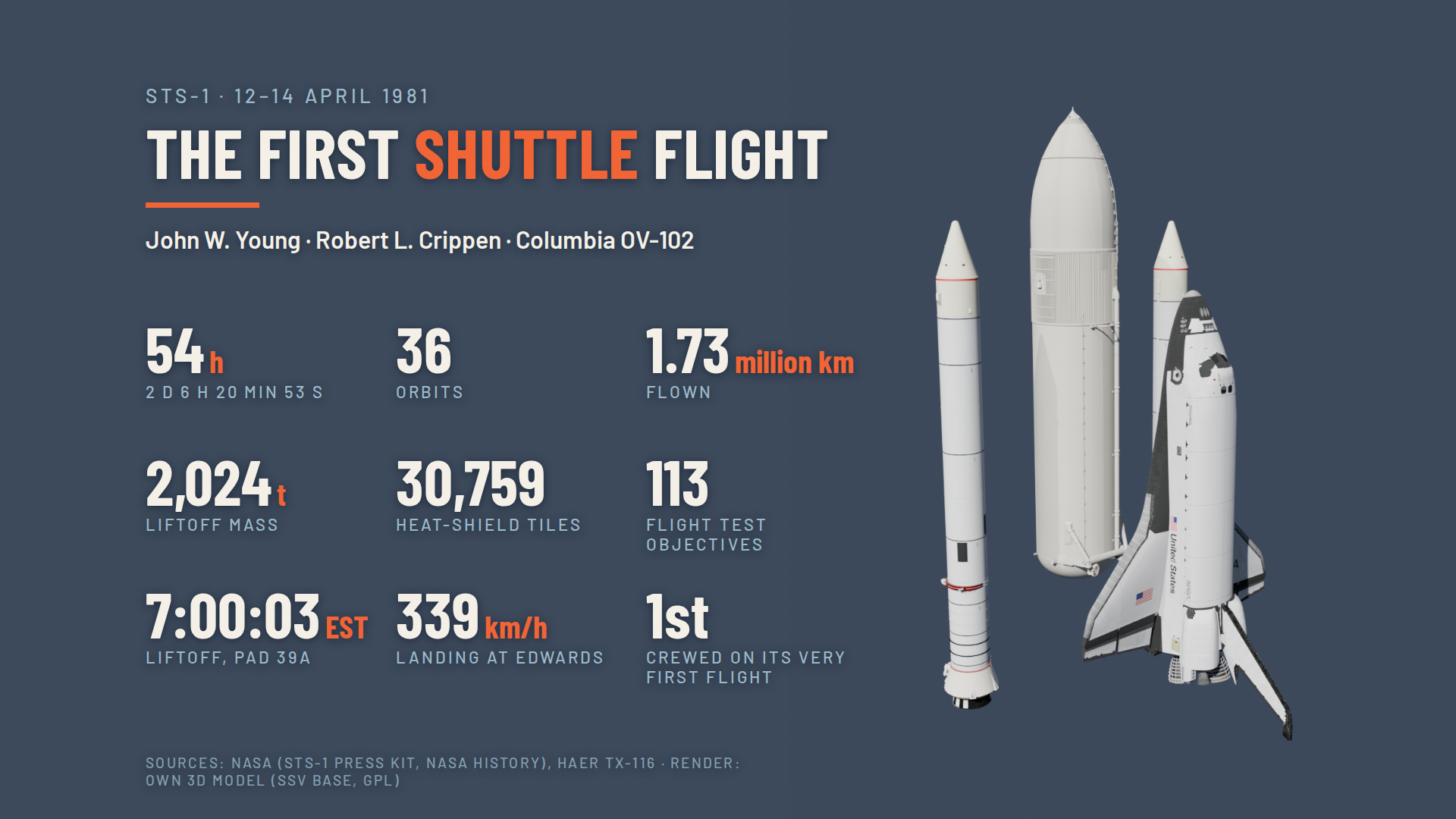
The mission lasted just over 54 hours, and NASA records 36 Earth orbits. Some summaries list 37 because landing occurred during the following circuit; this article uses NASA’s count of 36 throughout. The flight’s primary goal was to prove that the vehicle could launch, operate in space and return safely.
The mission in orbit
A fiery return and an unpowered landing
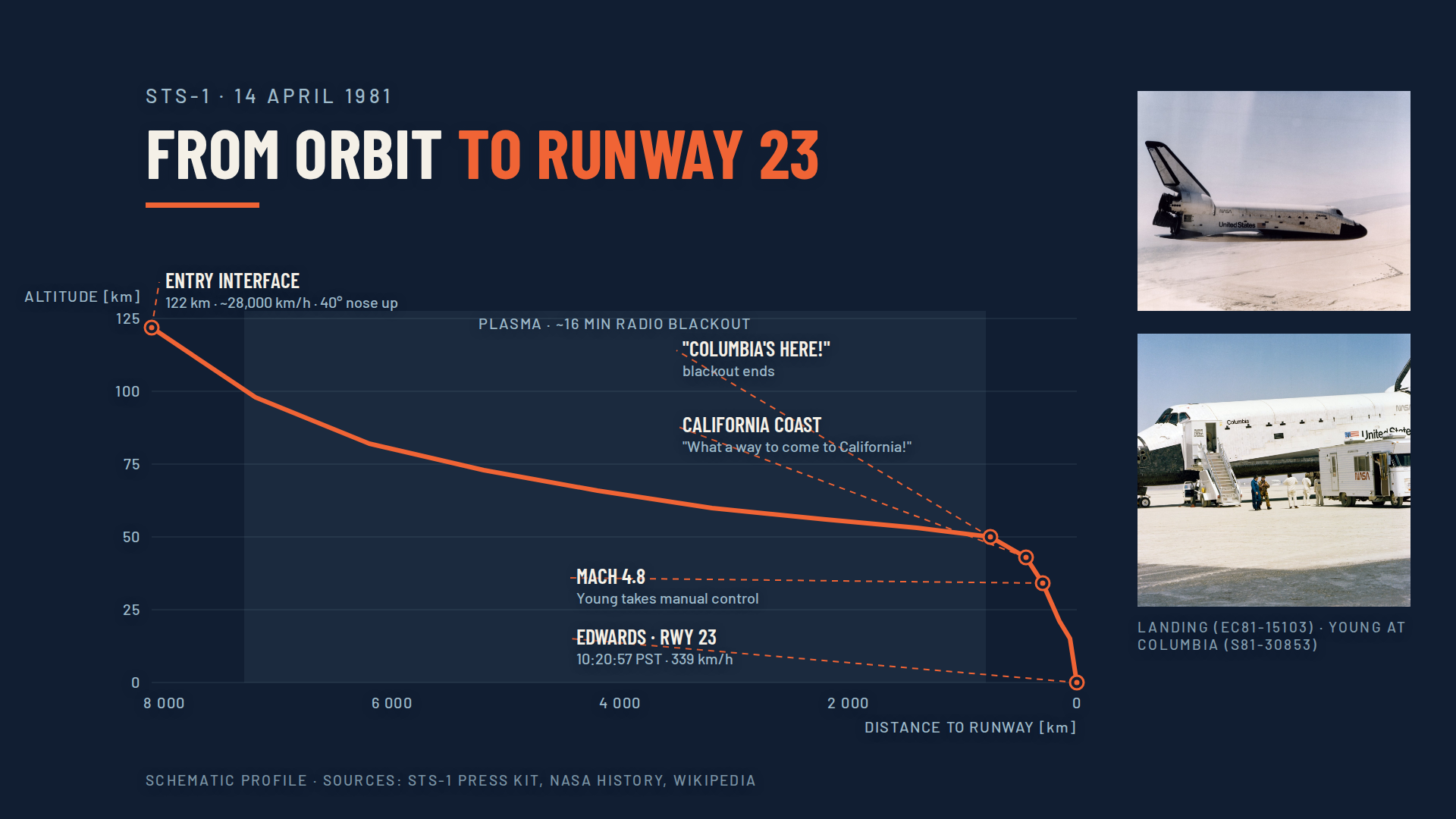
During the thirty-sixth orbit the OMS engines slowed Columbia and sent it toward the atmosphere. The orbiter entered at an angle of attack near 40°, placing protected surfaces into the hot airflow. Plasma formed around the vehicle and radio contact was lost for part of the descent. The aft body flap required more deflection than engineers had predicted, valuable data for later flights.
Young took manual control while still supersonic. With no chance for a powered go-around, he guided the glider to Runway 23 on Rogers Dry Lake at Edwards Air Force Base. Columbia touched down on 14 April 1981 at 18:20:57 UTC at about 340 km/h. The Shuttle’s first complete flight had lasted 2 days, 6 hours, 20 minutes and 53 seconds.
Reentry and landing
What the first mission proved and exposed
STS-1 showed that a Shuttle could take a crew to orbit and bring it back to a runway. Postflight inspection also exposed damaged tiles, the effects of the launch pressure wave and unexpected reentry behaviour. Its success did not establish that the system was risk-free; it started a series of flight tests and changes.
Columbia flew again on STS-2 in November 1981, becoming the first crewed spacecraft to return to orbit. The Shuttle programme eventually completed 135 missions. STS-1 remains the moment when the ambitious idea of a reusable spacecraft first met the full reality of flight.
STS-1 by the numbers
Mission timeline
Select a phase to read what happened. Every chapter has its own detailed page.
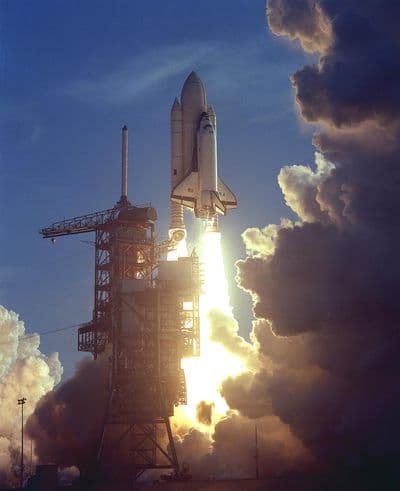
The first shuttle launch
Columbia lifted off from Launch Complex 39A as the first complete crewed Space Shuttle stack.
Read the chapterTesting systems in orbit
Young and Crippen opened the payload bay doors, tested Columbia’s systems and completed 36 Earth orbits during the mission.
Read the chapter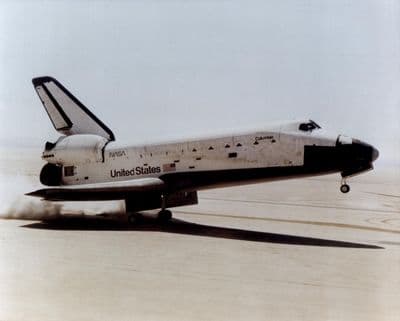
Returning as a glider
After two days and six hours Columbia entered the atmosphere and headed for the runway at Edwards.
Read the chapterSts-1 at a glance
- Launch: 12 April 1981, 12:00:03 UTC, Pad 39A.
- Crew: John W. Young and Robert L. Crippen.
- Flight: 2 days, 6 hours, 20 minutes, 53 seconds; 36 orbits.
- Landing: 14 April 1981, Edwards Air Force Base, Runway 23.
Gallery
Related articles
Article on the timeline
Young and Crippen flew Columbia on the first orbital flight of a reusable Space Shuttle.
Open the entry →Sources & further reading
- Mission chronology, crew, objectives and outcome.
- History of the preparations, first flight and technical results.
- Detailed launch, orbital and landing chronology.
- The 10 April scrub and onboard computer timing mismatch.
- Countdown demonstration and the fatal nitrogen-compartment accident.
- Contemporary flight plan, hardware and test objectives.
- Preparation of Columbia’s thermal protection tiles.
- Analysis of the launch pressure wave and its consequences.
- Official count of 36 orbits and crew data.
Spaceflightpedia. (n.d.). STS-1: Columbia’s first flight. Retrieved 9 October 2026, from https://spaceflightpedia.com/article/sts-1
article text — CC-BY-SA · ◉ NASA photography — public domain · ✦ AI illustration — marked, generated from sources