- Date
- 25 December 2021
- Launcher
- Ariane
- Mission
- James Webb Space Telescope
#NASA#ESA#CSA#space telescope#infrared astronomy#Sun–Earth L2#Ariane 5
Mission timeline
Select a phase to read what happened. Every chapter has its own detailed page.
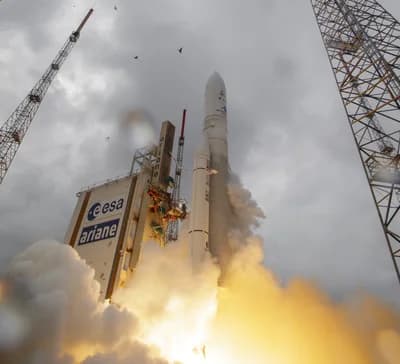
Launch on Ariane 5
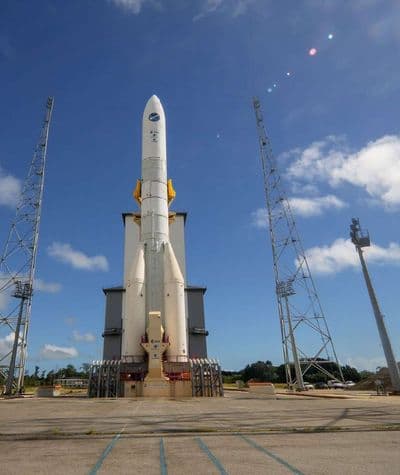
Webb left Kourou on Christmas Day 2021 aboard an Ariane 5 provided by ESA.
Read the chapter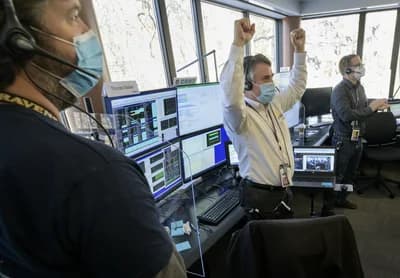
Unfolding in space
During the first two weeks after launch the folded observatory was transformed into its operating configuration.
Read the chapter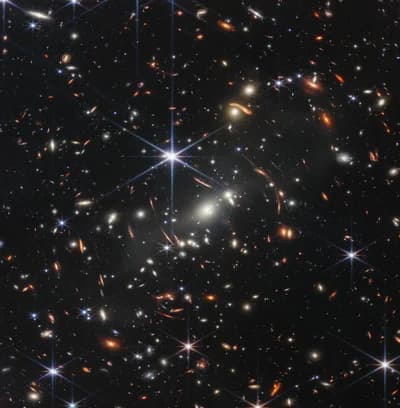
First images
After commissioning, Webb's first full-colour images and spectra were released in July 2022.
Read the chapterOverview and partnership
The James Webb Space Telescope (JWST, or Webb) is a space observatory optimised for infrared light. The mission is led by NASA in an international partnership with the European Space Agency (ESA) and the Canadian Space Agency (CSA) [1, 6]. Observing in the infrared allows Webb to detect light from the earliest stars and galaxies, which has been redshifted into the near- and mid-infrared part of the spectrum [1].
ESA provided the launch vehicle and launch services, the Near-Infrared Spectrograph (NIRSpec), and – together with a consortium of European countries – the Mid-Infrared Instrument (MIRI). The CSA provided the Fine Guidance Sensor/Near-Infrared Imager and Slitless Spectrograph (FGS/NIRISS) [1]. Science and flight operations are run from the Science and Operations Center at the Space Telescope Science Institute (STScI) in Baltimore, Maryland [1].
Mirror and sunshield
Webb's primary mirror is approximately 6.5 m (21.3 ft) across, about 2.75 times the diameter of Hubble's mirror and roughly six times its collecting area [1]. It consists of 18 thin, lightweight beryllium segments held in shape and position by actuators on a stiff backing frame; the mirrors are coated with gold to optimise their reflectivity in the infrared [1]. Because the mirror is too large to fit inside a rocket fairing, it was folded for launch and deployed in space [1, 3].
The largest structure of the observatory is a five-layer sunshield made of Kapton membranes, roughly the size of a tennis court [1, 3]. It shields the telescope from the Sun, Earth and Moon, so that the near-infrared instruments can cool passively to about 39 K (−234 °C); MIRI is cooled further to about 7 K (−266 °C) by a helium cryocooler [1].
Instruments and orbit
The observatory carries four science instruments: the Near-Infrared Camera (NIRCam), NIRSpec, MIRI and FGS/NIRISS [1]. NIRCam was built by the University of Arizona with Lockheed Martin [1].
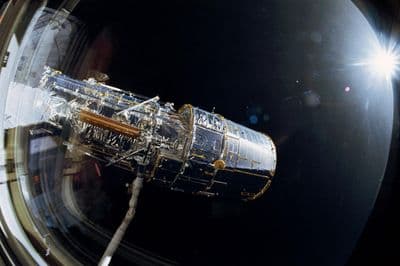
Unlike Hubble, which orbits about 600 km above Earth, Webb operates around the second Sun–Earth Lagrange point (L2), about 1.5 million km from Earth [1]. Webb does not sit at L2 itself but circles it in a large loop, and the location allows the sunshield to block the Sun, Earth and Moon at all times; the journey there took about a month [1]. At that distance the telescope is beyond the reach of servicing missions, a trade-off studied and accepted early in the project [1].
Launch and deployment
Webb lifted off on an Ariane 5 from Europe's Spaceport in Kourou, French Guiana, at 12:20 UTC (7:20 a.m. EST) on 25 December 2021 [2, 3]. The observatory separated from the rocket about 27 minutes after launch at an altitude of roughly 1,400 km and unfolded its solar array about 30 minutes after launch [2]. The first mid-course correction, 12.5 hours after launch, fired the main thruster for 64 minutes and added about 20 m/s [3].
Over roughly two weeks the observatory went through nearly 50 major deployments [3]. Sunshield deployment began on 28 December; on 4 January 2022 the fifth layer was tensioned, a sequence that used 139 of Webb's 178 release mechanisms, 70 hinge assemblies, eight deployment motors, about 400 pulleys and 90 cables [3, 4]. The secondary mirror and the two primary-mirror wings followed, and on 8 January 2022 Webb was fully deployed [3]. A 297-second burn on 24 January 2022 placed the telescope into its halo orbit around L2 [5].
Commissioning and science
After about six months of mirror alignment and instrument calibration, commissioning was completed on 10 July 2022; NASA reported that the instruments' sensitivity was substantially better than predicted before launch [3]. On 11 July 2022 the first full-colour image, Webb's First Deep Field of the galaxy cluster SMACS 0723, was presented, and the full set of first images followed on 12 July [6]. Webb was designed for at least five years of operation with a goal of ten; because of the accurate launch and efficient course corrections, NASA estimates enough propellant for more than 20 years of science operations [1, 3].
Early results include what NASA described as the first clear evidence of carbon dioxide in the atmosphere of an exoplanet, the hot gas giant WASP-39 b, measured with NIRSpec [7]. In May 2024 the JADES team reported a spectroscopic redshift of 14.32 for the galaxy JADES-GS-z14-0, corresponding to less than 300 million years after the Big Bang; at the time of the announcement it was the most distant known galaxy [8]. Such records are provisional and continue to be revised as observations accumulate.
Follow us
Follow us on social media
New plates, trivia and behind-the-scenes updates as soon as they are ready.
Mission in numbers
- primary mirror diameter
- 6,5 m (18 segmentů)
- distance from Earth (L2 region)
- asi 1,5 milionu km
- estimated propellant lifetime
- přes 20 let
Did you know?
- Webb's mirrors are coated with gold to improve their reflectivity in the infrared; NASA estimates the total amount of gold at about the mass of a golf ball [1].
- Unfolding and tensioning the sunshield used 139 of the observatory's 178 release mechanisms and 90 cables totalling roughly a quarter of a mile (about 400 m) [4].
- The final course correction on 24 January 2022 changed Webb's speed by only about 1.6 m/s – roughly walking pace [5].
- Webb's First Deep Field was assembled from 12.5 hours of exposures and covers a patch of sky about the size of a grain of sand held at arm's length [6].
Gallery
Related articles
Sources & further reading
- NASA Science: Webb FAQs. Accessed 13 October 2026.
- NASA Science: NASA's Webb Telescope Launches to See First Galaxies, Distant Worlds (25 Dec 2021). Accessed 13 October 2026.
- K. A. Parrish, C. Starr (NASA GSFC): Launching and Deploying the James Webb Space Telescope, IAC-22-B6.3.1 (NASA NTRS 20220013198). Accessed 13 October 2026.
- NASA: Sunshield Successfully Deploys on NASA's Next Flagship Telescope (4 Jan 2022). Accessed 13 October 2026.
- NASA Webb blog: Orbital Insertion Burn a Success, Webb Arrives at L2 (24 Jan 2022). Accessed 13 October 2026.
- NASA Science: NASA's Webb Delivers Deepest Infrared Image of Universe Yet (July 2022). Accessed 13 October 2026.
- NASA Science: NASA's Webb Detects Carbon Dioxide in Exoplanet Atmosphere (Aug 2022). Accessed 13 October 2026.
- NASA Webb blog: NASA's James Webb Space Telescope Finds Most Distant Known Galaxy (30 May 2024). Accessed 13 October 2026.
Spaceflightpedia. (n.d.). James Webb Space Telescope. Retrieved 13 October 2026, from https://spaceflightpedia.com/article/james-webb
article text — CC-BY-SA · ◉ NASA photography — public domain · ✦ AI illustration — marked, generated from sources