- Date
- 2004–2016
- Launcher
- Ariane
- Mission
- Rosetta
#comet#ESA#67P/Churyumov–Gerasimenko#Philae#lander
Mission timeline
Select a phase to read what happened. Every chapter has its own detailed page.
Launch and ten-year cruise
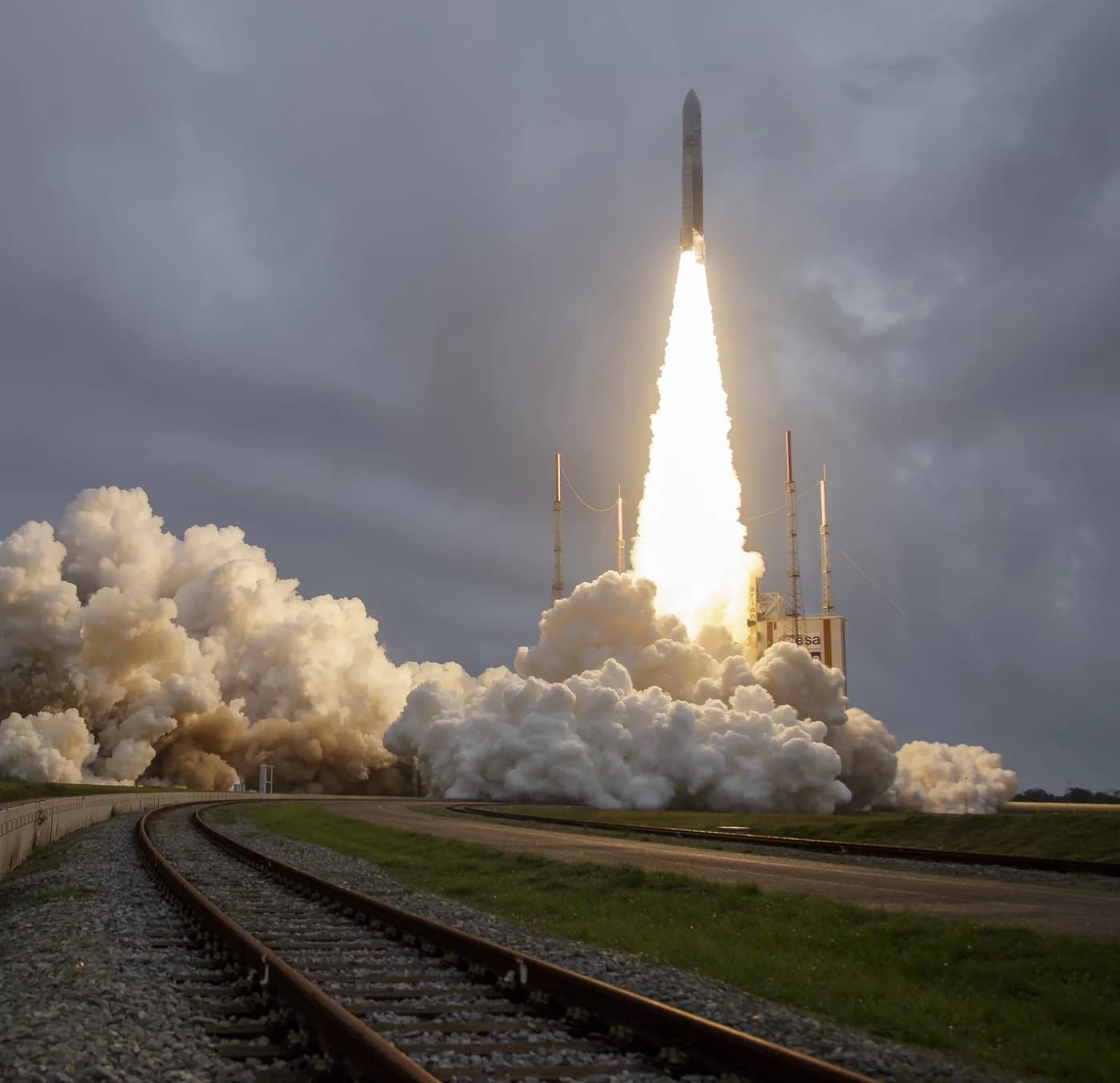
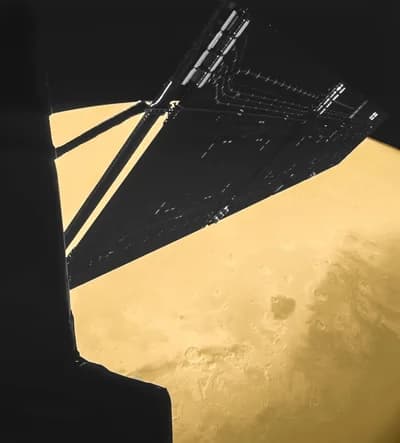
An Ariane 5 sent Rosetta on a decade-long path that looped past Earth three times and Mars once.
Read the chapter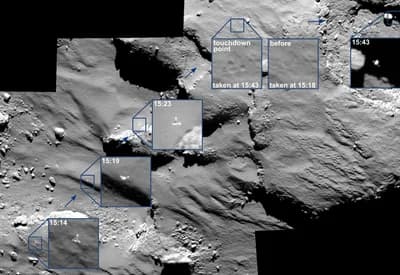
Arrival and the Philae landing
After orbiting the comet from August 2014, Rosetta released Philae for the first landing on a comet nucleus.
Read the chapter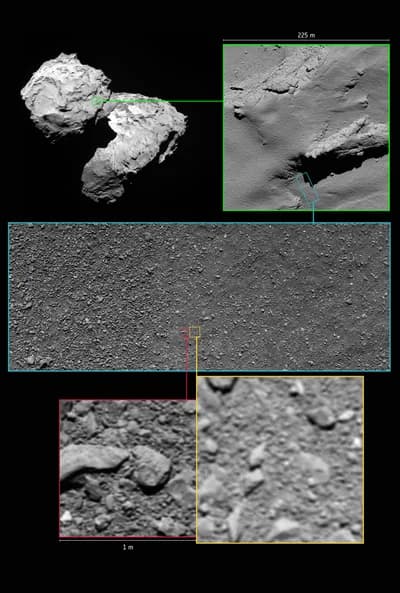
Perihelion and controlled impact
Rosetta escorted the comet past the Sun and ended its mission by descending onto the nucleus.
Read the chapterOrigins and goals
Rosetta was a mission of the European Space Agency (ESA), approved in November 1993, to rendezvous with a comet, follow it around the Sun and place a lander on its nucleus [2]. It was named after the Rosetta Stone, which led to the decipherment of Egyptian hieroglyphs; the lander Philae took its name from an island where an obelisk helped in that decipherment [1].
The original target was comet 46P/Wirtanen, with launch planned for January 2003. When the launch was postponed, that target had to be abandoned and the mission was redirected to comet 67P/Churyumov–Gerasimenko, a body about 4 km across with an orbital period of roughly 6.5 years [2]. ESA puts the total cost of the mission at close to 1.4 billion euros, of which the Philae lander accounted for about 220 million [2].
Spacecraft and lander
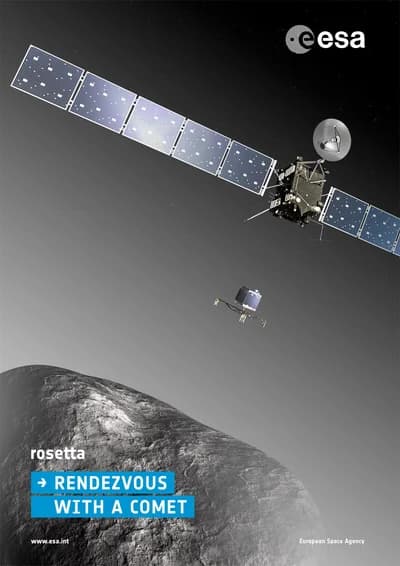
The orbiter was a box of 2.8 × 2.1 × 2.0 m with two 14 m solar wings that spanned 32 m tip to tip and had a combined area of 64 m² [1, 2]. At launch the whole spacecraft weighed about 3,000 kg; the orbiter accounted for 2,900 kg, including 1,670 kg of propellant and a 165 kg science payload of 11 instruments [1, 2].
Philae had a mass of 100 kg and carried 10 instruments [1]. The lander was provided by a consortium led by DLR, MPS, CNES and ASI, and NASA also contributed to the mission [7].
A ten-year journey
Rosetta lifted off from Kourou in French Guiana at 07:17:51 UTC on 2 March 2004 on Ariane 5 flight 158; the upper stage released the spacecraft on its interplanetary path at 09:32:36 UTC [3]. To gain enough energy to reach the comet, it used four planetary gravity assists – at Earth on 4 March 2005, at Mars on 25 February 2007 and at Earth again on 13 November 2007 and 13 November 2009 [1]. On the way it flew past the asteroids Steins on 5 September 2008 and Lutetia on 10 July 2010 [1].
On the most distant leg of the trajectory, up to about 800 million km from the Sun, there was too little sunlight to power the spacecraft normally, so Rosetta was put into hibernation on 8 June 2011 [1, 2]. After 31 months it woke up on 20 January 2014, with the signal confirmed at 18:18 GMT [2].
At the comet and the Philae landing
Rosetta arrived at comet 67P on 6 August 2014 and became the first spacecraft to orbit a comet [1, 7]. On 12 November 2014 it delivered Philae to the surface [1]. The landing did not go as planned: the harpoons that were to anchor the lander did not fire, and Philae touched the surface at 15:34, 17:25 and 17:32 GMT (comet time), bouncing twice; the first bounce alone lasted about 1 hour 50 minutes and carried it roughly 1 km [4]. It finally came to rest in a shadowed spot with little sunlight [4, 5].
Running on its primary battery, Philae worked for nearly 57 hours and completed its main planned sequence of surface measurements, including the final block of experiments, before falling silent and going into hibernation [5]. The landing is therefore usually described as a partial success, while the mission as a whole met its goals. The lander was not located until 2 September 2016, when Rosetta’s OSIRIS camera imaged it from 2.7 km, wedged into a dark crevice in the Abydos region [6].
Science results and the end of the mission
Rosetta followed the comet through its closest approach to the Sun on 13 August 2015, at 186 million km, and onwards [1, 2]. The data indicate that the comet’s two lobes formed separately and joined in a low-speed collision early in the history of the Solar System. Instruments detected molecular oxygen and nitrogen, water whose composition differs from that of Earth’s oceans, numerous organic compounds, the amino acid glycine and phosphorus [7]. Together the results suggest that comets are ancient leftovers from the formation of the Solar System [7].
Because the comet and the spacecraft were heading away from the Sun again, ESA chose to end the mission with a controlled descent. After a final manoeuvre at 20:50 GMT on 29 September 2016 from an altitude of about 19 km, Rosetta touched down at 10:39:34 UTC on 30 September in the Ma’at region, only 33 m from its target point; the site was named Sais [7, 8]. The loss of signal was confirmed at ESA’s control centre in Darmstadt at 11:19:37 GMT, after 786 days of operations at the comet and a journey of nearly 8 billion km [7, 8].
Follow us
Follow us on social media
New plates, trivia and behind-the-scenes updates as soon as they are ready.
Mission in numbers
- operations at the comet
- 786 dní
- distance travelled since launch
- téměř 8 miliard km
- Philae’s operations on the surface
- téměř 57 hodin
Did you know?
- Rosetta was the first mission to rendezvous with a comet and escort it around the Sun, the first to deploy a lander to a comet’s surface and the first to end with a controlled impact on a comet [7].
- Rosetta’s final resting place was named Sais, after the Egyptian town where the Rosetta Stone is thought to have originally been located [8].
- During the landing, radio signals between Philae and Earth, relayed via Rosetta, took more than 28 minutes to arrive [4].
- The lost lander was finally identified less than a month before the end of the mission, in OSIRIS images taken from 2.7 km on 2 September 2016 [6, 8].
Gallery
Related articles
Sources & further reading
- ESA: Rosetta factsheet. Accessed 13 October 2026.
- ESA: Rosetta – Frequently asked questions. Accessed 13 October 2026.
- ESA Science & Technology: Rosetta status report no. 1 – Rosetta in good health. Accessed 13 October 2026.
- ESA: Three touchdowns for Rosetta’s lander. Accessed 13 October 2026.
- ESA Science & Technology: Pioneering Philae completes main mission before hibernation. Accessed 13 October 2026.
- ESA Science & Technology: Philae found. Accessed 13 October 2026.
- ESA: Mission complete – Rosetta’s journey ends in daring descent to comet. Accessed 13 October 2026.
- ESA Science & Technology: Rosetta’s last words – science descending to a comet. Accessed 13 October 2026.
Spaceflightpedia. (n.d.). Rosetta. Retrieved 13 October 2026, from https://spaceflightpedia.com/article/rosetta
article text — CC-BY-SA · ◉ NASA photography — public domain · ✦ AI illustration — marked, generated from sources