#planetární sondy#navigace#Voyager
A gravity assist uses a close planetary flyby, not a planet’s atmosphere or engines. In the planet’s frame, a spacecraft arrives, bends its path, and departs; relative to the Sun, it can exchange a small amount of orbital energy with the moving planet. The result is a change in speed and direction without consuming large amounts of propellant.
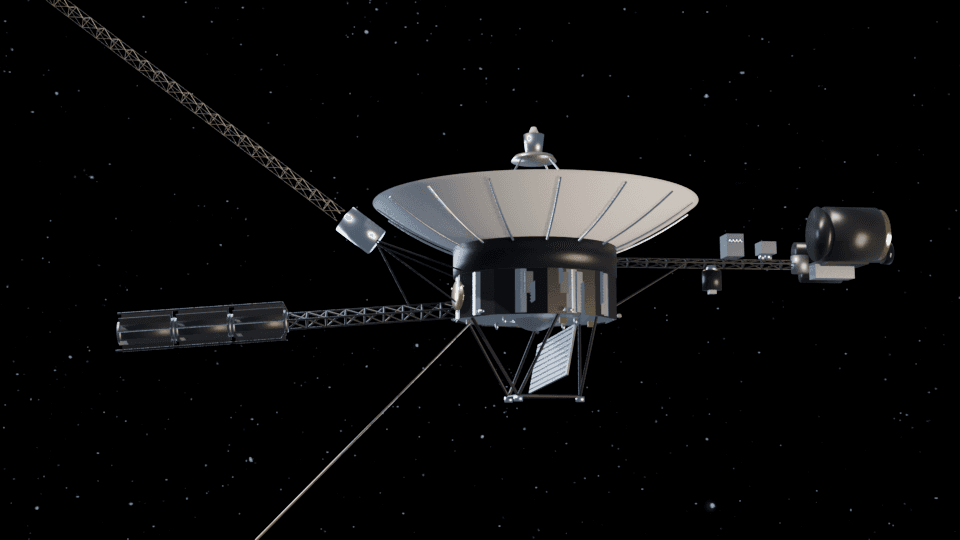
The Voyager probes used Jupiter and Saturn as successive gravitational slingshots. Similar manoeuvres have allowed interplanetary missions to visit multiple targets, reach distant planets, or enter trajectories that a direct launch from Earth could not achieve.
Key facts
- A gravity assist does not violate conservation of energy; energy is exchanged with the planet.
- The flyby altitude and side determine the resulting trajectory change.
- Gravity assists enabled Voyager 2 to visit all four giant planets.
Sources & further reading
Spaceflightpedia. (n.d.). Gravity Assist. Retrieved 9 October 2026, from https://spaceflightpedia.com/article/gravitacni-manevr
article text — CC-BY-SA · ◉ NASA photography — public domain · ✦ AI illustration — marked, generated from sources