- Date
- 30 July 2020
- Body
- Mars
- Mission
- Perseverance
#Mars#NASA#rover#Ingenuity#Jezero
Mission timeline
Select a phase to read what happened. Every chapter has its own detailed page.
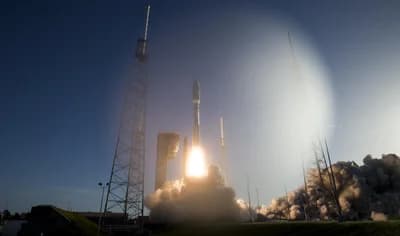
Launch and cruise
Mars 2020 left Cape Canaveral on an Atlas V 541 at the start of a seven-month journey to Mars.
Read the chapter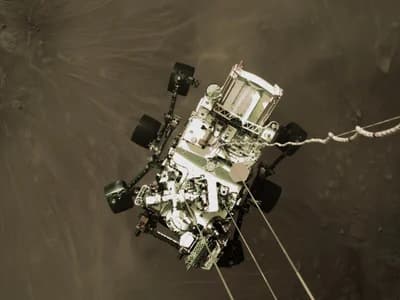
Landing in Jezero Crater
After about seven minutes of autonomous entry, descent and landing, Perseverance touched down in Jezero Crater.
Read the chapter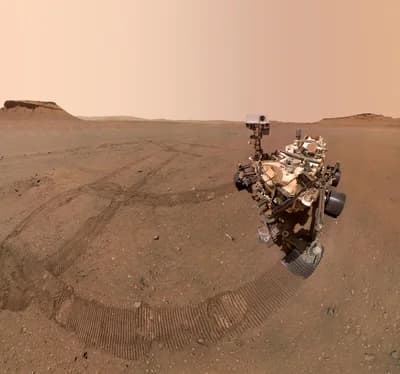
Samples, Ingenuity and the search for life
On the surface the rover has collected rock cores for possible return to Earth while two technology demonstrations proved new capabilities.
Read the chapterMission and objectives
Mars 2020 is a NASA mission within the Mars Exploration Program whose rover, Perseverance, searches for signs of ancient microbial life, studies the geology of its landing site and collects cores of rock and regolith for possible pickup by a future mission that would bring them to Earth [1, 2]. The car-sized rover has a mass of 1,026 kg, carries seven primary science instruments and is powered by a Multi-Mission Radioisotope Thermoelectric Generator (MMRTG) supplied by the US Department of Energy [4].
Its sample caching system was the first of its kind sent into space [4]. Two technology demonstrations aimed at future exploration travelled with the rover: the MOXIE experiment for producing oxygen from the carbon dioxide atmosphere, and the Ingenuity helicopter, which carried no science instruments and was intended purely as a flight test [2]. The prime surface mission was planned to last one Mars year, about 687 Earth days [3].
Launch and cruise
Perseverance launched on 30 July 2020 at 7:50 a.m. EDT (11:50 UTC) aboard a United Launch Alliance Atlas V 541 rocket from Space Launch Complex 41 at Cape Canaveral, Florida [2, 3]. The Centaur upper stage first placed the spacecraft into a parking orbit and then fired a second time to send it towards Mars [2].
Shortly after separation the spacecraft entered safe mode, probably because part of it was colder than expected while in Earth's shadow; temperatures returned to normal and the team restored a nominal configuration [2]. The interplanetary cruise lasted 203 days and covered 472 million km [4].
Landing in Jezero Crater
On 18 February 2021 the spacecraft entered the Martian atmosphere at about 19,500 km/h and, roughly seven minutes later, the rover was standing on the surface; mission control at JPL confirmed touchdown at 3:55 p.m. EST (20:55 UTC) [3, 4]. The descent used a heat shield, a 21.5 m supersonic parachute and a rocket-powered descent stage that lowered the rover on nylon cords 7.6 m below it in a "sky crane" manoeuvre [3].
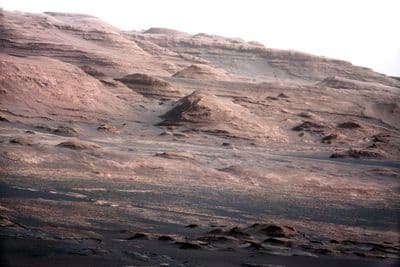
A new Terrain-Relative Navigation system compared camera images with onboard maps and selected a safe reachable landing point; the landing ellipse was about ten times smaller in area than Curiosity's in 2012 [3]. Jezero Crater, some 45 km wide, lies on the western edge of the Isidis Planitia basin just north of the Martian equator; about 3.5 billion years ago it held a lake fed by a river delta [4].
Samples, Ingenuity and MOXIE
Perseverance collects rock cores in pairs; one sample from each pair taken by early 2023 was placed in a depot in the "Three Forks" area of Jezero, the first sample depot on another world [5]. The tenth and final tube was dropped on 29 January 2023; the depot holds eight rock and regolith samples, one atmospheric sample and one witness tube, spaced 5–15 m apart as a backup set to the samples kept inside the rover [5]. In July 2024 the rover cored the rock "Cheyava Falls"; after peer review, results published in Nature in September 2025 described potential biosignatures in this "Sapphire Canyon" sample, which require further study before any conclusion about life can be drawn [1].
Ingenuity made the first powered, controlled flight on another planet on 19 April 2021 [1, 6]. Planned for up to five flights within 30 sols, it flew 72 times from 48 airfields during an extended mission lasting almost 1,000 sols; after its 72nd flight on 18 January 2024 images showed a damaged rotor blade, and NASA announced the end of its mission on 25 January 2024 [2, 6]. MOXIE produced a total of 122 g of oxygen, up to 12 g per hour at a purity of 98 % or better; its 16th run took place on 7 August 2023 [7].
Status as of October 2026
On 11 October 2026, sol 2,006 of the mission, Perseverance's odometer reached 45.22 km, exceeding the 45.16 km driven by Opportunity between 2004 and 2018 and making it the farthest-travelled vehicle on the surface of another world [8]. More than 90 % of the distance was driven with the AutoNav autonomous navigation system; the original mission requirement was no more than about 20 km of driving [8].
By then the rover had collected 29 rock and regolith samples from the crater floor, the delta and the crater rim, where it is studying impact-generated rocks about 4 billion years old [8]. NASA approved the mission's first extension, which began in October 2026 and is to continue exploration of the crater rim until roughly the end of 2028 [8]. Bringing the samples to Earth would require a separate future mission [1].
Follow us
Follow us on social media
New plates, trivia and behind-the-scenes updates as soon as they are ready.
Mission in numbers
- flight time to Mars
- 203 dní
- distance driven (as of 11 Oct 2026)
- 45,22 km
- Ingenuity helicopter flights
- 72
Did you know?
- Perseverance's Sample Caching System was the first system of its kind sent into space [4].
- The Three Forks depot, completed on 29 January 2023, is the first sample depot on another world [5].
- Ingenuity was designed for no more than five test flights but completed 72 [2, 6].
- On 11 October 2026 Perseverance broke Opportunity's off-world driving record, covering in about five and a half years a distance that took Opportunity almost 15 [8].
Gallery
Related articles
Sources & further reading
- NASA Science: Mars 2020 Perseverance – mission overview. Accessed 13 October 2026.
- NASA: NASA, ULA Launch Mars 2020 Perseverance Rover Mission to Red Planet (30 July 2020). Accessed 13 October 2026.
- NASA/JPL: Mars 2020 Perseverance Landing Press Kit – Mission Overview. Accessed 13 October 2026.
- NASA: Touchdown! NASA's Mars Perseverance Rover Safely Lands on Red Planet (18 February 2021). Accessed 13 October 2026.
- NASA: NASA's Perseverance Rover Completes Mars Sample Depot (30 January 2023). Accessed 13 October 2026.
- NASA: After Three Years on Mars, NASA's Ingenuity Helicopter Mission Ends (25 January 2024). Accessed 13 October 2026.
- NASA: NASA's Oxygen-Generating Experiment MOXIE Completes Mars Mission (6 September 2023). Accessed 13 October 2026.
- NASA Science: NASA's Perseverance Sets Off-World Record for Total Distance Driven (12 October 2026). Accessed 13 October 2026.
Spaceflightpedia. (n.d.). Perseverance. Retrieved 13 October 2026, from https://spaceflightpedia.com/article/perseverance
article text — CC-BY-SA · ◉ NASA photography — public domain · ✦ AI illustration — marked, generated from sources