- Launcher
- HLVM3
- Mission
- Gaganyaan-1
#Gaganyaan#India#uncrewed
- 01Overview
- 02Planned mission sequence
- 03Launch date and current status
- 04Why an uncrewed flight comes first
- 05HLVM3: adapting a launcher for human spaceflight
- 06Two modules with different jobs
- 07The October 2026 milestone: separating the modules
- 08Vyommitra is not an astronaut crew
- 09Return does not end when the parachutes open
- 10How to judge the eventual flight
- 11When will Gaganyaan-1 launch?
- 12Will astronauts fly on G1?
- 13Is G1 the same mission as TV-D1?
- 14Sources
- 15Connections
Gaganyaan-1, also designated G1 or HLVM3-G1/OM-1, is the first planned uncrewed orbital mission of India's Gaganyaan human-spaceflight programme. Its purpose is to exercise the chain from launch and orbital operations to atmospheric return and recovery at sea before astronauts rely on the system. G1 is a test flight without a human crew, not India's first astronaut launch.
Planned mission sequence
Select a phase to read what happened. Every chapter has its own detailed page.
Planned phase: launch and ascent
HLVM3 is intended to lift the uncrewed orbital module from Sriharikota and place it on a low Earth orbit.
Read the chapterPlanned phase: operations in orbit
The joined capsule and service module are intended to operate as an integrated spacecraft during the orbital phase.
Read the chapter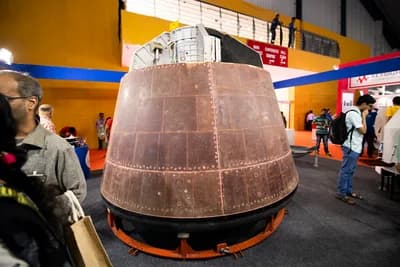
Planned phase: separation and atmospheric entry
The capsule must separate from the service module before it passes through Earth's atmosphere as the returning vehicle.
Read the chapterPlanned phase: splashdown and recovery
Parachute descent, splashdown and recovery are part of the mission demonstration rather than an optional step after the main flight.
Read the chapterLaunch date and current status
Status checked on 17 October 2026: the mission remains in preparation. On 16 October, ISRO reported successful crew-module/service-module separation tests and continued to target G1 for 2026. An Indian Department of Space statement of 6 August specified the fourth quarter of 2026 as the target period. That is a planning window, not a confirmed launch date; no flight result is assigned here.
Why an uncrewed flight comes first
Ground tests can qualify individual components, but an orbital mission brings launch loads, separation events, navigation, propulsion and return procedures together. G1 is intended to expose interactions that are difficult to reproduce completely on the ground. Its value lies in measured performance across the flight, not merely in reaching space. The broader programme describes a human mission to roughly 400 km with a short stay; those programme-level goals should not be treated as a final altitude, duration or crew specification for this experimental G1 flight.

Gaganyaan roadmap from escape tests and uncrewed flights to a future crewed mission. Future mission dates are targets.
HLVM3: adapting a launcher for human spaceflight
The launcher is HLVM3, a human-rated derivative of LVM3, launching from Satish Dhawan Space Centre at Sriharikota. Its architecture combines solid boosters, a liquid-propellant core and a cryogenic upper stage. Human rating concerns reliability, redundancy and responses to faults rather than simply lifting a heavier payload. A Crew Escape System provides a means of pulling the capsule clear in designated ascent emergencies. Its purpose is different from the propulsion that normally places the orbital module in orbit.
Two modules with different jobs
The Orbital Module joins the Crew Module, the returning capsule, to a Service Module that supports flight in orbit. The service section supplies propulsion and other supporting systems; the capsule carries navigation and control equipment, thermal protection and descent systems. In January 2025, ISRO reported integrating G1's capsule propulsion system, comprising twelve 100-newton thrusters for three-axis attitude control. After service-module separation, these thrusters help orient the capsule during the return until parachute deployment. The full spacecraft does not return intact to Earth.

Gaganyaan orbital module: return capsule, service module, propulsion and parachutes. Illustrative 3D model. Dimensions and mass refer to the capsule; the service module has separate propulsion.
The October 2026 milestone: separating the modules
On 16 October 2026, ISRO announced a series of separation tests at Vikram Sarabhai Space Centre. The test assembly reproduced the disconnection of the capsule and service module, including their connecting lines. It assessed both the separation sequence and the ability of important capsule equipment to withstand the shocks involved. This matters because the capsule must become an independent return vehicle before atmospheric entry. The announcement is evidence of preparation for G1, not evidence that the orbital mission has already flown.

Separation of the capsule and service module before atmospheric entry. Illustrative 3D model.
Vyommitra is not an astronaut crew
The August 2026 government roadmap identifies the half-humanoid robot Vyommitra as a payload on the first experimental uncrewed mission. Its presence does not make G1 a crewed flight or establish that the robot independently pilots the spacecraft. The mission remains a technology-validation step before people fly. The same roadmap places two further uncrewed missions in the intended crewed-flight configuration after this experimental flight, underlining the difference between an initial demonstration and readiness to carry astronauts.
Follow us
Follow us on social media
New plates, trivia and behind-the-scenes updates as soon as they are ready.

Planned Gaganyaan-1 sequence from launch and orbital tests to reentry and capsule recovery.
Return does not end when the parachutes open
Thermal protection handles the high-speed entry environment; parachutes then slow the capsule for splashdown. In the IADT-02 air-drop test on 10 April 2026, a simulated module of approximately 5.7 tonnes, matching G1's stated test mass, descended using ten parachutes of four types and was recovered with Indian Navy support. This was a test article, not an orbital G1 flight. Recovery also requires locating and securing the capsule and handling its attitude on the water. Safely bringing back hardware supplies evidence that flight telemetry alone cannot provide.

Ten parachutes of four types: from apex-cover removal to main parachutes and splashdown.
How to judge the eventual flight
G1 should be assessed against the objectives announced for its actual flight configuration. Useful questions include whether the launcher delivered the spacecraft as intended, whether orbital systems operated correctly, whether the return sequence was controlled and whether the capsule was recovered in a condition suitable for inspection. Completing one phase does not automatically validate every later phase. Until a flight has taken place and results have been reported, preparation milestones belong in the record as ground or precursor tests, without a success label for G1 itself.

First crewed orbital flights by the USSR, USA and China, and India’s future objective. This compares orbital flights: the first US crewed suborbital flight took place in 1961 (Alan Shepard).
When will Gaganyaan-1 launch?
The August 2026 government target was the fourth quarter of 2026; ISRO still cited 2026 on 16 October. A target period is not a confirmed day and time.
Will astronauts fly on G1?
No. G1 is an uncrewed experimental flight. The announced plan to carry Vyommitra does not change that classification.
Is G1 the same mission as TV-D1?
No. TV-D1 was a test of the escape and recovery chain using a dedicated test vehicle. G1 is intended to exercise an orbital spacecraft mission.

TV-D1 escape-system test in 2023: capsule abort, parachutes and splashdown.
Sources & further reading
- Programme overview, HLVM3, spacecraft modules and safety systems.
- G1 target window, Vyommitra and subsequent uncrewed flights.
- Crew-module/service-module separation tests.
- Launch-vehicle assembly for HLVM3-G1/OM-1.
- G1 capsule propulsion and twelve 100 N thrusters.
- Service-module propulsion qualification.
- IADT-02 air-drop test, parachutes and test mass.
- Escape-system test, distinct from the G1 orbital mission.
- Preparations for capsule recovery at sea.
Spaceflightpedia. (n.d.). Gaganyaan-1. Retrieved 17 October 2026, from https://spaceflightpedia.com/article/gaganyaan-1
article text — CC-BY-SA · ◉ NASA photography — public domain · ✦ AI illustration — marked, generated from sources