- Date
- 4 October 1957
- Launcher
- R-7 / Sputnik
- Mission
- Sputnik 1
#kosmický závod#SSSR#první
- 01The world before the first beep
- 02From flying laboratory to simplest satellite
- 03Inside the polished shell
- 04At the tip of the R-7
- 05The night of 4 October 1957
- 06Ninety-six minutes around Earth
- 07The beep that changed politics
- 08Twenty-two days of signals, 92 days in orbit
- 09Key facts
- 10Article on the timeline
- 11Check yourself
- 12Sources
- 13Connections
The world before the first beep
In 1957 the United States and the Soviet Union were locked in a nuclear arms race. One crucial question was who could deliver a payload across an ocean. The Soviet R-7 was built as an intercontinental ballistic missile. Its successful full-range test on 21 August 1957 also showed that it could place an artificial satellite in orbit.
The International Geophysical Year of 1957–1958 brought scientists together to study, among other things, the upper atmosphere. The United States announced its Vanguard satellite project. Soviet chief designer Sergei Korolev wanted to reach orbit first; the public did not yet know his name.
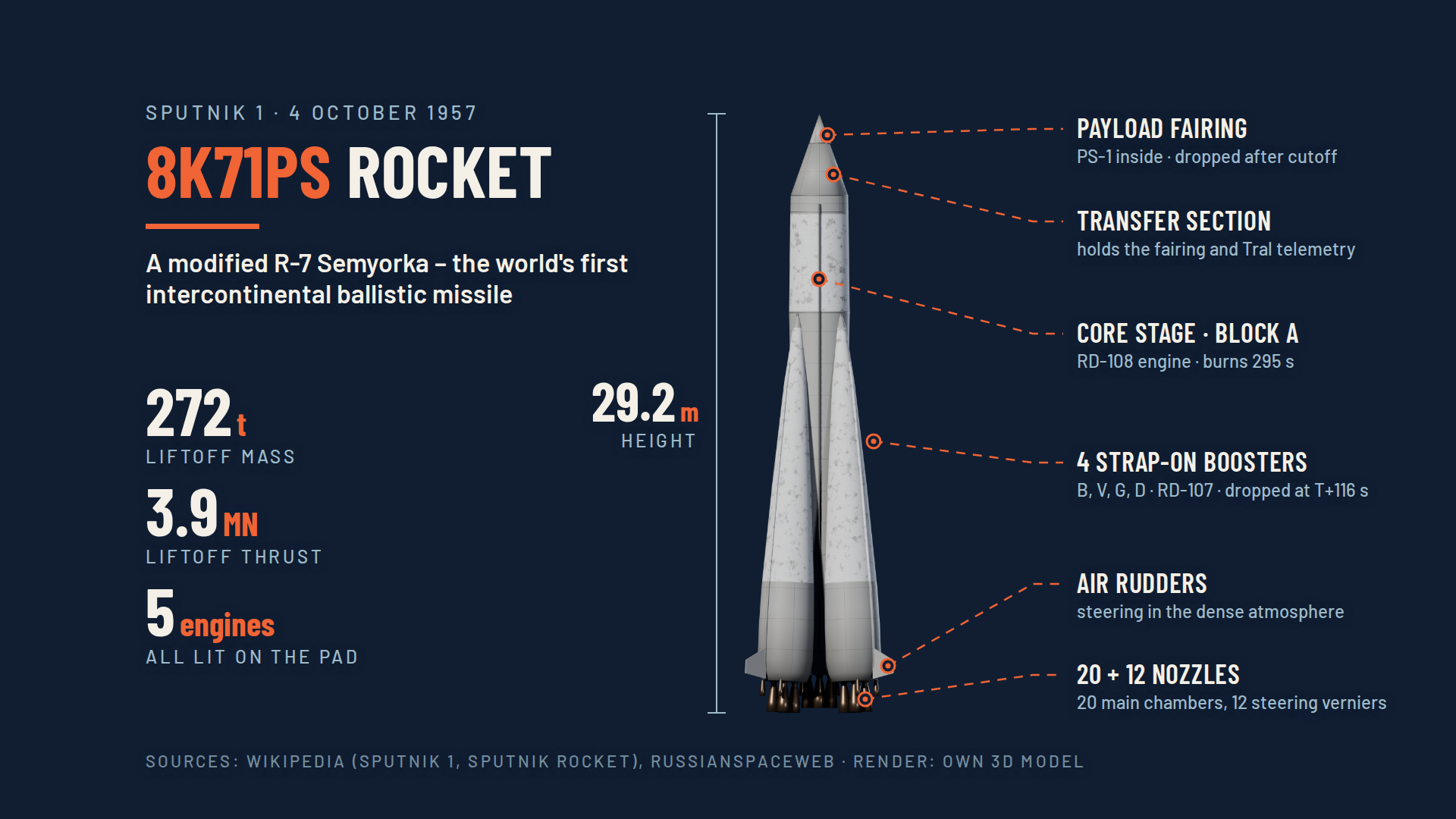
The 8K71PS launcher
From flying laboratory to simplest satellite
The original Object D was intended to be a large flying laboratory. Its development was slipping and rocket performance was limited. Korolev’s team therefore chose the small PS-1, the “simplest satellite”. It carried no camera or suite of scientific instruments. Its main tasks were to demonstrate orbital flight and emit a radio signal that could be tracked.
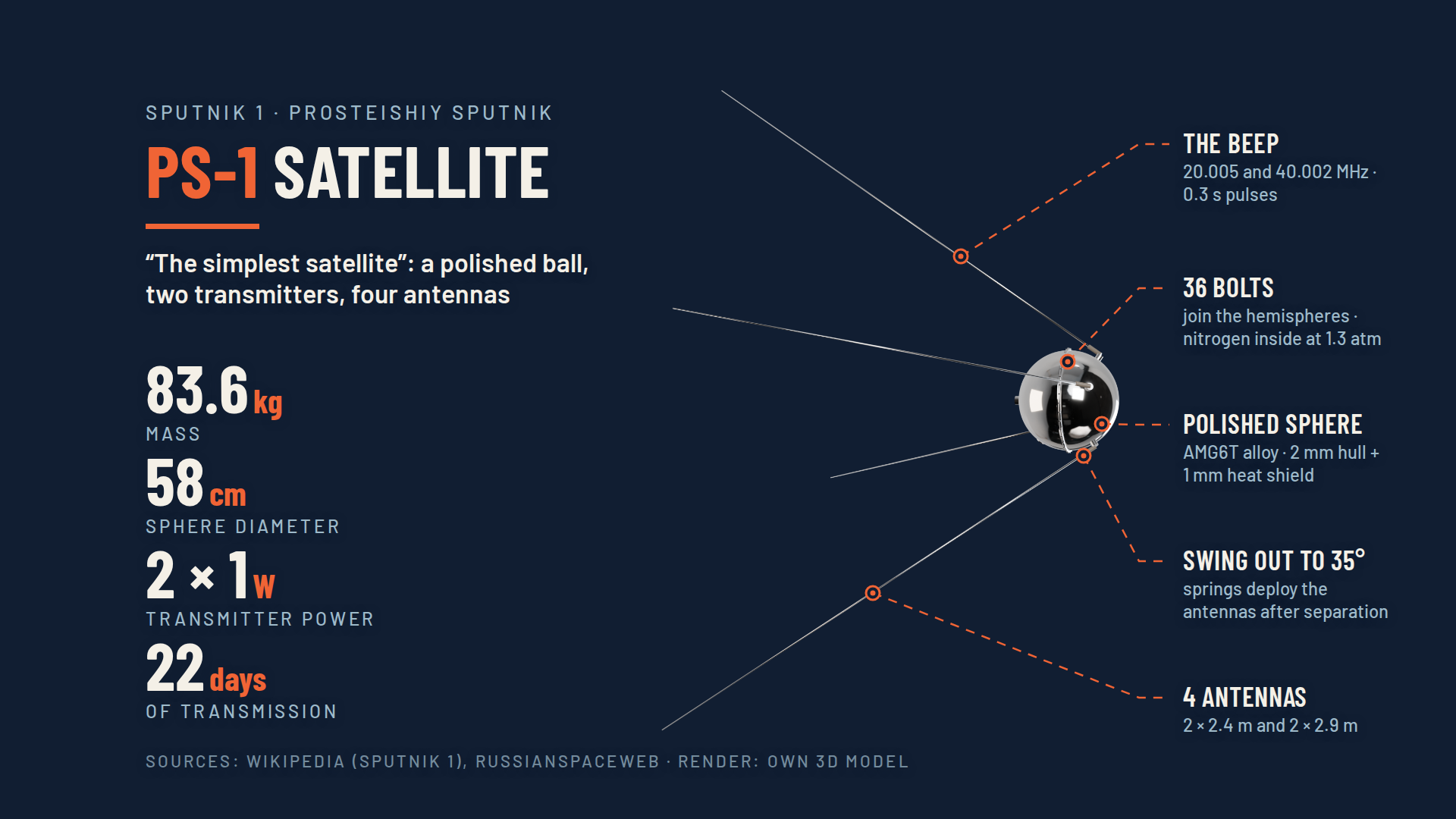
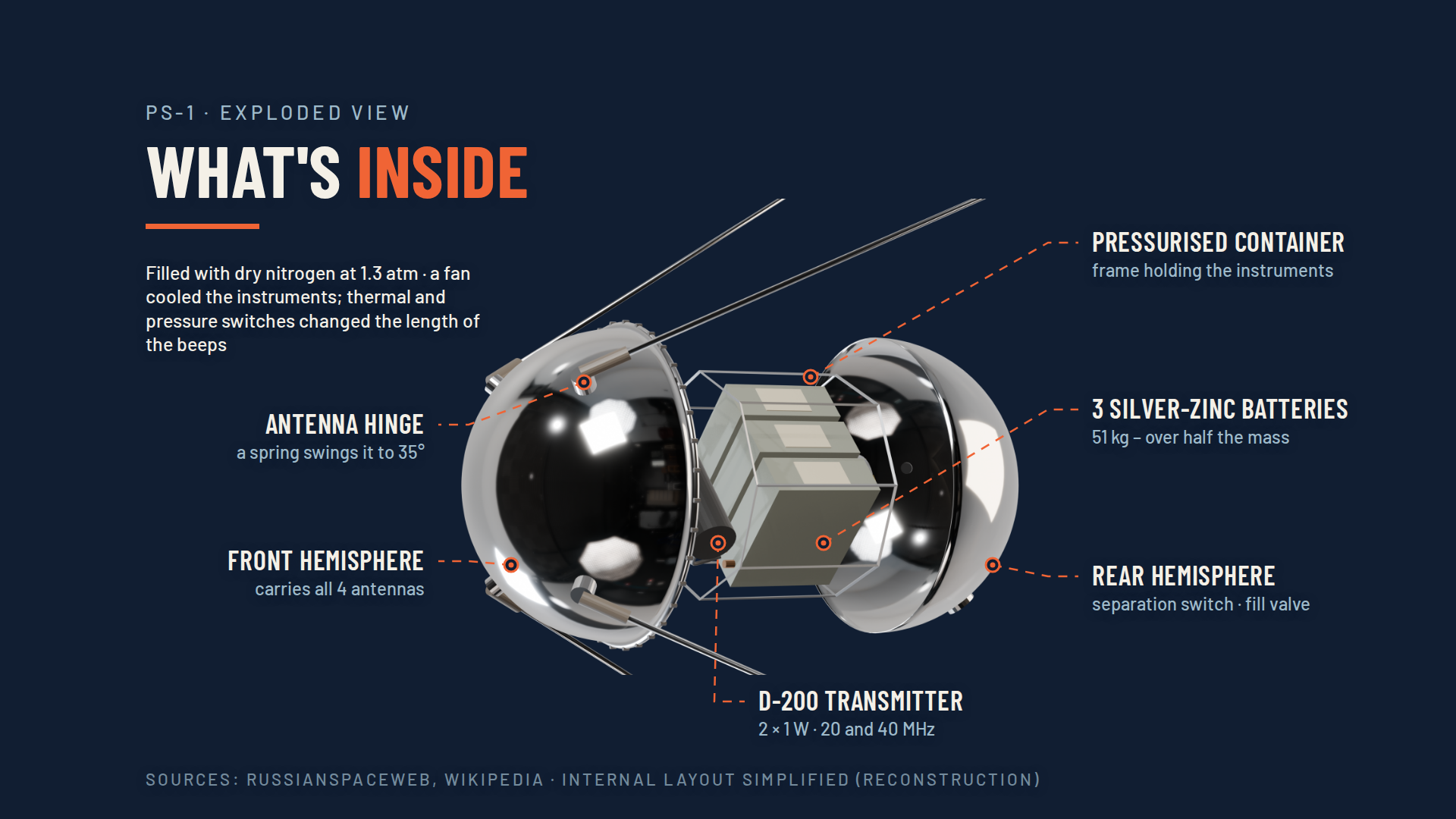
The aluminium-alloy sphere measured 58 cm across and weighed 83.6 kg. Thirty-six bolts joined its two hemispheres. Inside were dry nitrogen, silver-zinc batteries, a fan and two radio transmitters. Four whip antennas made the signal receivable regardless of the satellite’s orientation after separation.
The PS-1 satellite
Inside the polished shell
The transmitters operated at roughly one watt on 20.005 and 40.002 MHz. Their alternating pulses could be received with relatively simple amateur radio equipment. Pulse timing also conveyed information about conditions inside the sphere, especially temperature and pressure. Tracking the orbit and the propagation of radio waves yielded data about the upper atmosphere and ionosphere.
The power supply accounted for most of the satellite’s mass. Its batteries weighed about 51 kg and lasted roughly 22 days. Sputnik was simple in concept, yet required reliable sealing, thermal control and radio communication in conditions no satellite had previously tested.
Inside Sputnik
At the tip of the R-7
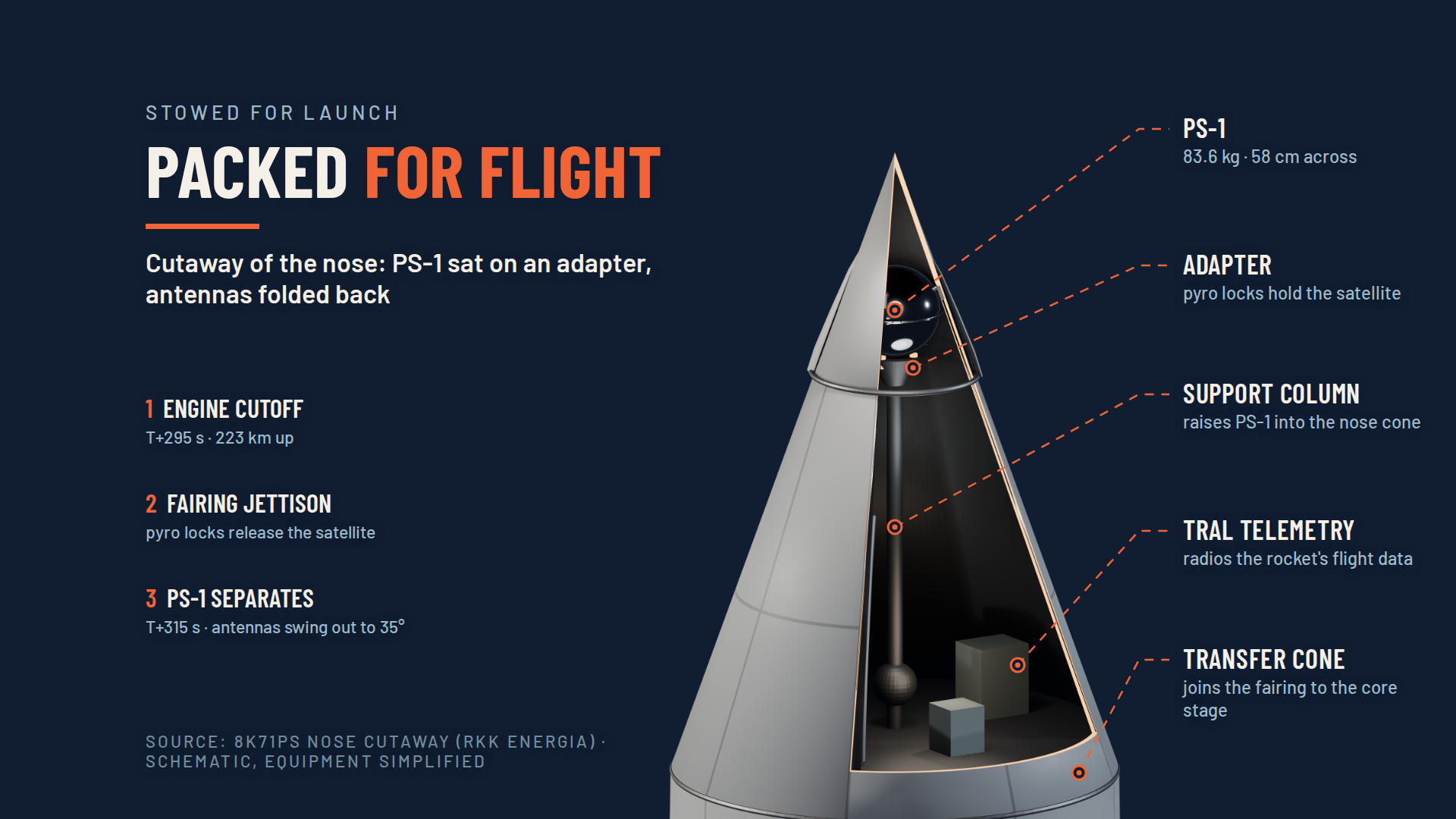
The satellite sat on an adapter at the top of the core stage. A short conical fairing protected it during flight through the dense atmosphere, with its antennas folded along the adapter. The 8K71PS had no third stage. Footage of later R-7 launches should therefore not automatically be presented as Sputnik 1’s actual launch.
Inside the launch vehicle
The night of 4 October 1957
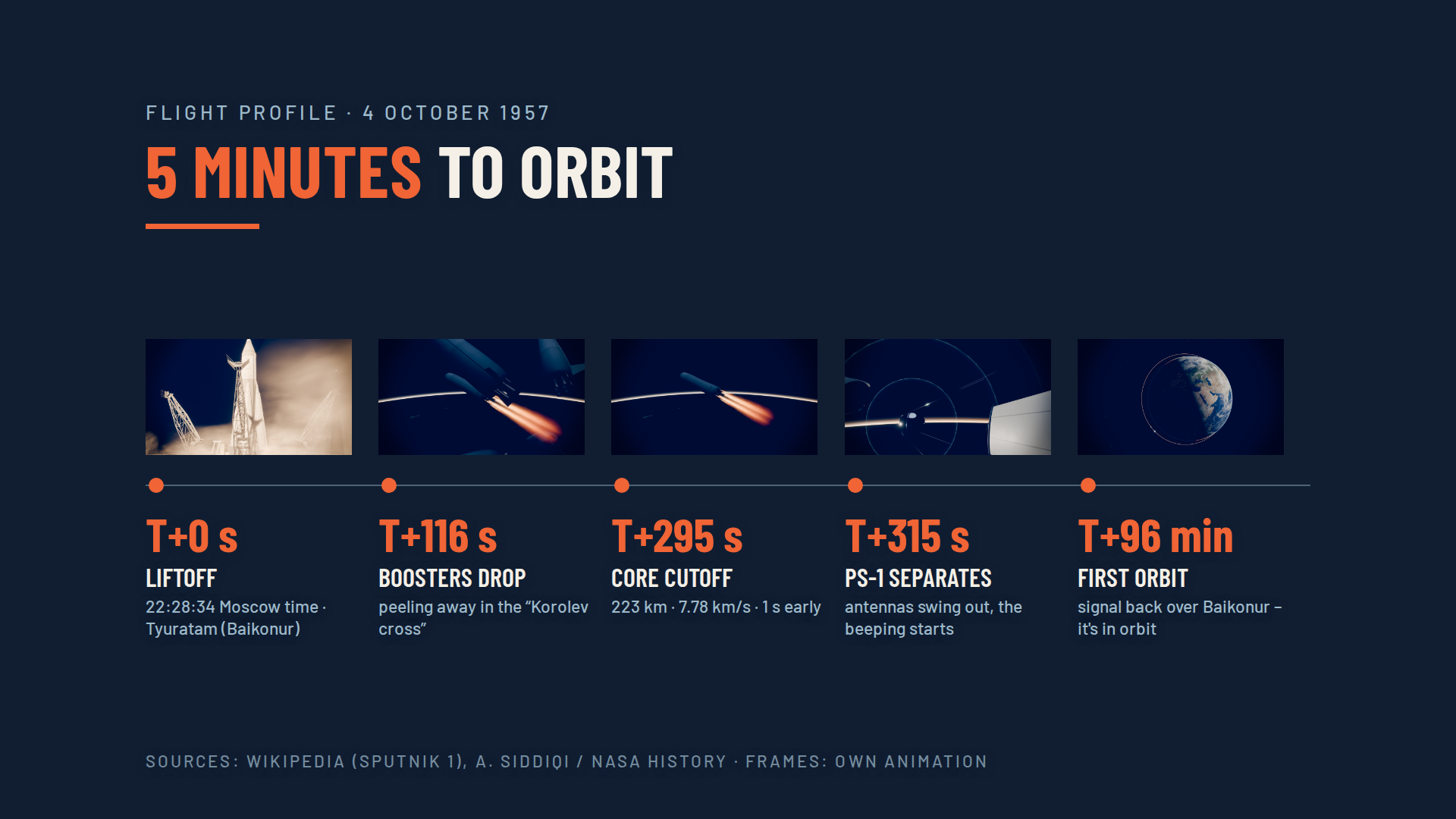
The rocket lifted off from Tyuratam, today’s Baikonur, on 4 October 1957 at 19:28:34 UTC. Some engines were slow to build thrust and a fuel-control system failed during ascent. Nevertheless, the four boosters separated roughly 116 seconds after liftoff and the core continued climbing. Its engine shut down around T+295 seconds, slightly earlier than planned.
After the fairing was discarded, PS-1 separated from the launcher, its antennas deployed and its transmitters switched on. The first received pulses confirmed that the satellite was working; a subsequent pass confirmed that it really orbited Earth. Historical sources differ slightly on the timing of some steps, so the infographic uses rounded values.
Follow us
Follow us on social media
New plates, trivia and behind-the-scenes updates as soon as they are ready.
Flight sequence
Video: The night the Space Age began
Ninety-six minutes around Earth
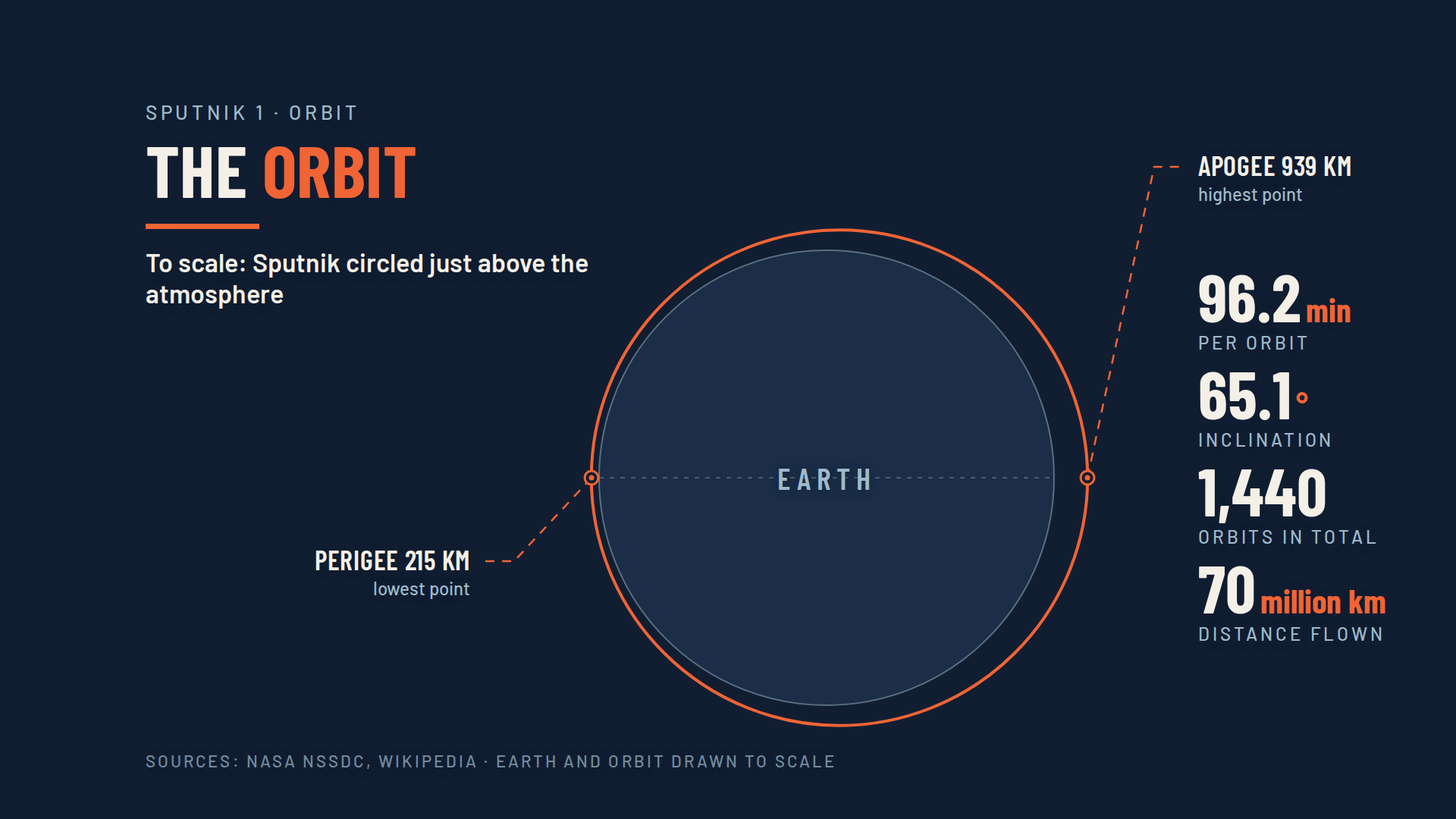
Sputnik travelled in an elliptical orbit inclined about 65.1°. Its initial low point was roughly 215–230 km above Earth and its high point around 940 km. One circuit took about 96.2 minutes. Changes in the orbit helped researchers estimate drag from the thin upper atmosphere.
People went outside at dawn and dusk to watch a bright point cross the sky. Usually they saw the R-7 core stage, which followed a similar orbit and was much larger than Sputnik itself. The small satellite was hard to see with the naked eye; its radio signal was far easier to detect.
The orbit
The beep that changed politics
The Soviet success was a scientific milestone and a political signal: a rocket that could reach orbit also demonstrated the potential of intercontinental technology. In the United States it triggered the “Sputnik crisis”. The Vanguard TV-3 launch attempt ended in an explosion on 6 December 1957; Juno I carried the first American satellite, Explorer 1, into orbit on 31 January 1958.
Sputnik was not the sole cause of subsequent changes, but it accelerated American investment in research, technical education and rocket development. ARPA and NASA were established in 1958, and Congress passed the National Defense Education Act. The Space Race became a visible public contest.
Twenty-two days of signals, 92 days in orbit
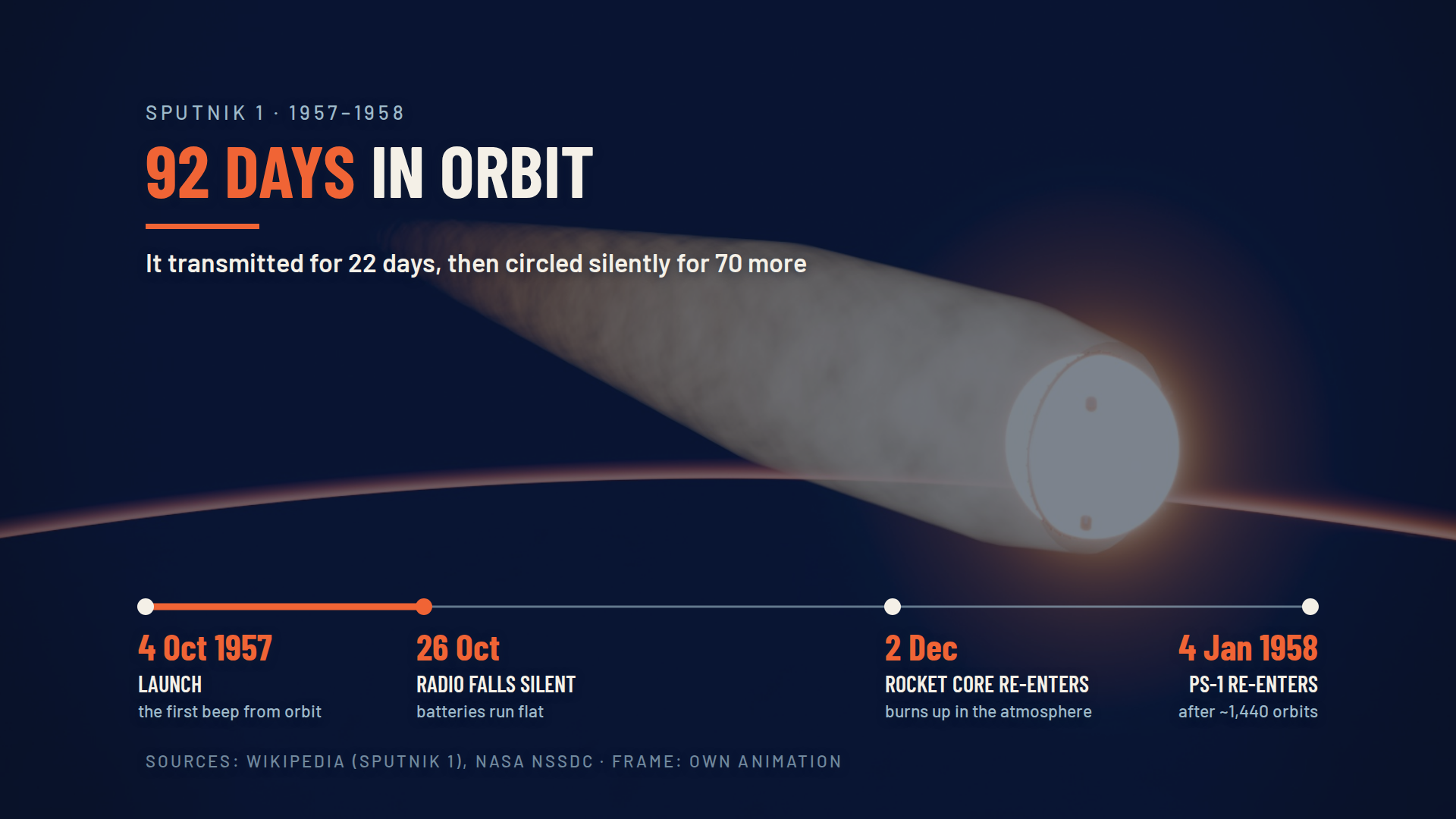
The batteries stopped powering the transmitters on 26 October 1957. The silent satellite continued around Earth until it re-entered the atmosphere on 4 January 1958. In about 92 days it completed roughly 1,440 orbits. The rocket core re-entered earlier, on 2 December 1957.
Sputnik 2 with Laika followed; a human first orbited Earth in 1961, and Apollo 11 landed on the Moon in 1969. PS-1 was small and short-lived, but it proved unmistakably that a human-made object could remain in orbit around our planet.
Ninety-two days in space
Key facts
- Sputnik 1 carried no camera; its signal and trackable orbit were its key contributions.
- The bright object most people saw in the sky was usually the rocket core stage.
- Transmission lasted about 22 days, while the satellite remained in orbit for 92 days.
Article on the timeline
The first artificial satellite of Earth opened the Space Age and kicked off the space race between the USA and the USSR.
Open the entry →Check yourself
Why would a beeping metal ball frighten a whole country?
Answer in your own words — everything you need is in the article above.
Sources & further reading
- Asif A. Siddiqi, NASA History: Korolev, Sputnik and the International Geophysical Year; development and launch chronology.
- NASA NSSDCA Master Catalog: spacecraft specifications, orbit and mission end.
- NASA History: contemporary context, the US response and the beginning of the Space Race.
- Anatoly Zak, RussianSpaceWeb: PS-1 design, antennas and launch vehicle.
- NASA History: the unsuccessful Vanguard TV-3 launch of 6 December 1957.
Spaceflightpedia. (n.d.). Sputnik 1 — the first artificial satellite. Retrieved 9 October 2026, from https://spaceflightpedia.com/article/sputnik-1
article text — CC-BY-SA · ◉ NASA photography — public domain · ✦ AI illustration — marked, generated from sources