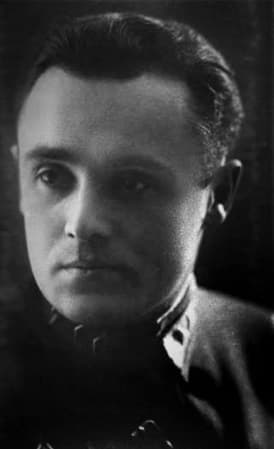
Biography
He was born on 12 January 1907 in Zhytomyr, Ukraine. Fascinated from an early age by aviation and rocketry, in the 1930s he was among the founders of Moscow’s Group for the Study of Reactive Motion (GIRD). In 1938, at the height of Stalin’s purges, he was arrested, tortured and sentenced to forced labour. He passed through a camp in Kolyma in the far north-east of Siberia and then a “sharashka” — a prison design bureau led by aircraft designer Andrei Tupolev. He was released only in 1944 and fully rehabilitated in 1957. After the war he headed the OKB-1 design bureau, where he developed the R-7 Semyorka — the world’s first intercontinental ballistic missile and the launch vehicle that carried Sputnik 1 into orbit on 4 October 1957. There followed Sputnik 2 with the dog Laika, the Luna probes and the crewed Vostok spacecraft, aboard which Yuri Gagarin orbited Earth on 12 April 1961 and, in 1963, the first woman Valentina Tereshkova. The Voskhod programme then produced the first spacewalk (Alexei Leonov, 1965). Korolev’s identity was strictly concealed — Soviet leaders feared for his safety and for the secrecy of the whole programme, so in the West he appeared only as the anonymous “Chief Designer”. He died on 14 January 1966 during surgery, before he could complete his great goal of a crewed flight to the Moon. Only after his death was his role revealed, and he was buried with state honours at the Kremlin Wall.