- Date
- 16 November – 11 December 2022
- Body
- The Moon
- Launcher
- Space Launch System (SLS)
- Mission
- Artemis I
Artemis I was the first integrated mission of the Space Launch System rocket, Orion spacecraft, European Service Module, Florida ground systems and Houston flight control. The complete chain intended to carry people back to the Moon flew together for the first time. It launched without a crew on 16 November 2022, spent 25 days in deep space and splashed down in the Pacific on 11 December. It proved the route to the Moon and back, but also found an issue that could not be ignored on a crewed flight.
Artemis I by the numbers
- Launch
- 16. 11. 202206:47:44 UTC
- Duration
- 25 dní10 h 53 min
- Maximum distance
- 432 210 kmfrom Earth
- Closest flyby
- 130 kmabove the Moon
- Entry
- Mach 32skip entry
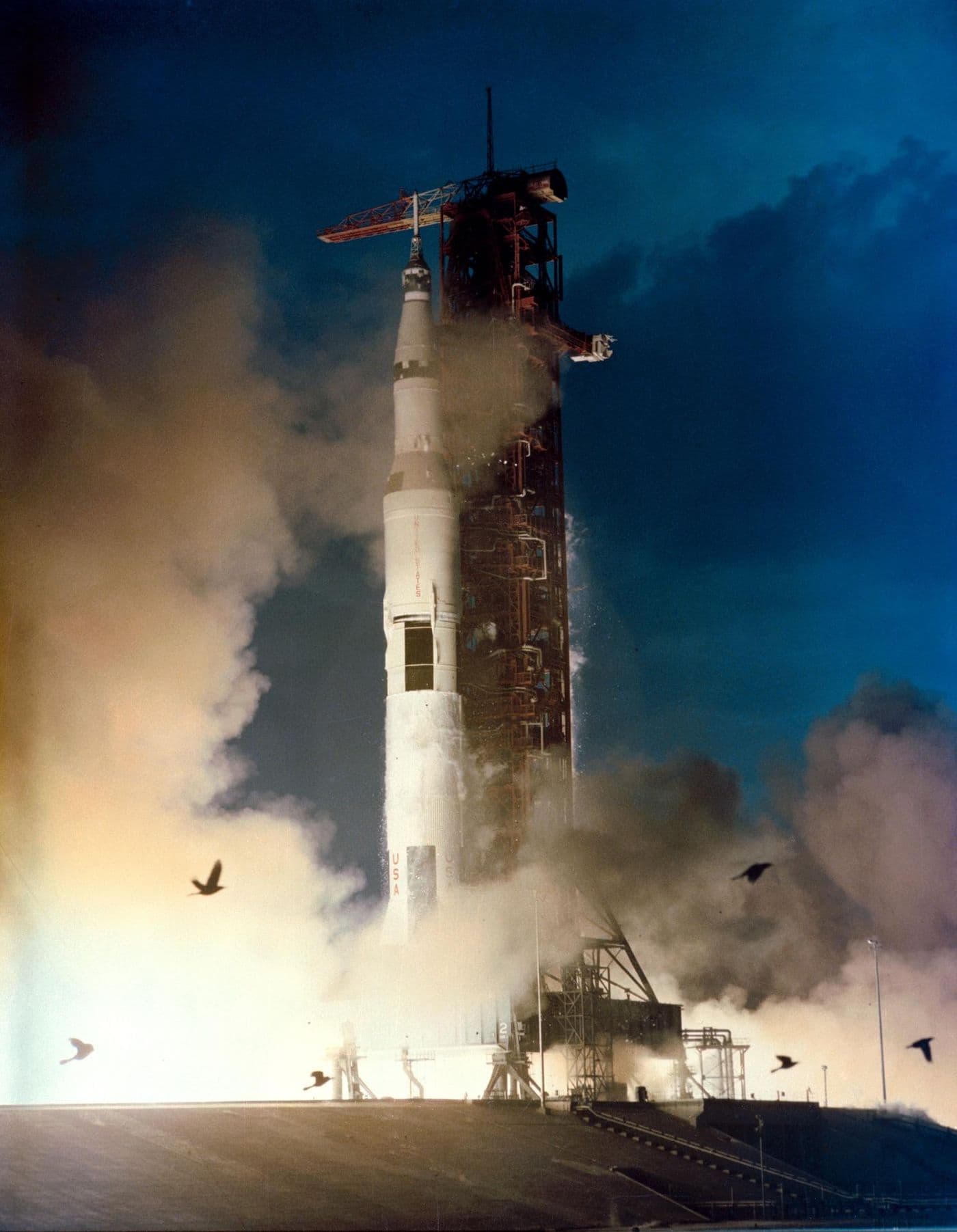
SLS Block 1 stands 98 metres tall and produces 39.1 MN of thrust at liftoff, about fifteen percent more than Saturn V. The core stage’s four RS-25D engines had flown on Space Shuttle missions; the two five-segment boosters also descend from Shuttle hardware and provide roughly three quarters of liftoff thrust. The ICPS upper stage sent Orion toward the Moon. Lockheed Martin builds the crew module. ESA’s European Service Module, built by Airbus in Bremen, supplies propulsion, power, water, air and thermal control; cameras on its solar-array wings made most images of the mission.
The cabin was not empty. Commander Moonikin Campos sat in the commander’s seat, a mannequin carrying accelerometers and radiation detectors named for Arturo Campos, whose procedure helped Apollo 13 return. Helga and Zohar, two female phantom torsos for the DLR and Israeli Space Agency MARE experiment, flew alongside it. Zohar wore an AstroRad radiation-protection vest and Helga did not, creating a direct comparison. The flight also carried Callisto, a voice-assistant and video-conferencing demonstrator, Snoopy as a zero-g indicator, and ESA’s Shaun the Sheep. These were not decorations: each payload turned an uncrewed flight into measurements for a future crew.
The journey to the pad was a test in itself. Spring wet dress rehearsals repeatedly failed; one fault was ultimately traced to a piece of rubber in a helium check valve. The first attempt on 29 August 2022 ended with a faulty engine-temperature reading, a hydrogen leak and communications issues. A second attempt on 3 September stopped for another hydrogen leak at the service-arm quick disconnect. Hurricane Ian forced NASA to return the stack to the VAB. In November the rocket endured Hurricane Nicole at Pad 39B; after inspections, the third attempt succeeded.
Mission timeline
Select a phase to read what happened. Every chapter has its own detailed page.
SLS launch: a new launcher after the Shuttle era
On 16 November 2022 the most powerful launcher NASA had fielded since Saturn V lifted off from Pad 39B at Kennedy Space Center. An uncrewed Orion spacecraft rode atop SLS; instrumented mannequins recorded the environment of future crewed flights.
Read the chapter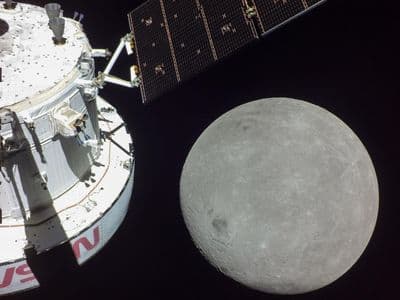
Orion heads into deep space
After separating from the launcher, Orion deployed its solar arrays and began a weeks-long flight. The spacecraft tested navigation, communications beyond the reach of Earth systems and radiation protection — exactly what astronauts will need on journeys to the Moon and beyond.
Read the chapter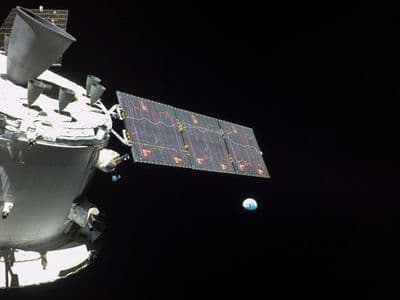
Around the Moon and into distant orbit
Orion entered a distant retrograde orbit around the Moon and spent several days there. The orbit gave the spacecraft the distance from Earth needed to test deep-space systems.
Read the chapter
A lunar-speed return
On 11 December 2022 Orion entered the atmosphere at nearly 11 km/s. Its heat shield was tested in flight for the first time at lunar-return energy and protected the crew module from the heat.
Read the chapterBoosters separated at T+2:12 and the core stage at T+8:03. Solar arrays deployed at T+18:09. A perigee raise preceded the roughly eighteen-minute trans-lunar injection burn at T+1:29:27; ICPS then separated and released ten CubeSats. On 21 November, Orion passed only 130 km above the Moon during its outbound powered flyby. Behind the far side, out of contact with Houston, the burn changed speed and direction for entry into distant retrograde orbit.
Distant retrograde orbit is a stable high path travelled opposite to the Moon’s motion around Earth and requiring little propellant to maintain. Orion stayed there for six days, allowing controllers to observe avionics, power, communications and thermal control in deep space. On 28 November it reached 432,210 km from Earth — a record distance for a spacecraft designed for people. After leaving DRO on 1 December, it made a return flyby 129.7 km above the lunar surface on 5 December.
Gallery
Follow us
Follow us on social media
New plates, trivia and behind-the-scenes updates as soon as they are ready.
Before return, the European Service Module that had performed every major maneuver was jettisoned and burned up; only the crew module returned. Orion reached entry interface on 11 December at 24,581 mph, about Mach 32, with shield temperatures near 2,760 °C. Rather than descend directly, it executed a skip entry: it dipped into the upper atmosphere, decelerated, rose back above it and descended a second time. About twenty minutes after entry, it splashed down under three main parachutes in the Pacific west of Baja California, where USS Portland recovered it.
The return revealed the mission’s main technical lesson. Post-flight inspection found Avcoat ablative material had shed at more than one hundred locations, with fragments also found floating nearby. In December 2024, NASA concluded that gases within the Avcoat could not vent during the cool phase between skip-entry heating pulses. The resulting pressure damaged the material from within. NASA assessed that a crew would have survived Artemis I, but changed Artemis II’s entry trajectory and specified deliberately uniform permeability for later shields.
Beyond the heat shield, the mission had a less visible bill. Of the ten CubeSats released from the ICPS adapter, three operated as planned: Italy’s ArgoMoon, NASA’s BioSentinel and Japan’s EQUULEUS. CuSP, Lunar IceCube, LunaH-Map, NEA Scout, OMOTENASHI, LunIR and Team Miles either never checked in, went silent or failed their primary objectives. LunaH-Map did not start its propulsion system, for example, and OMOTENASHI never attempted its landing. A likely shared factor was months spent in a fully integrated rocket during delays: the small spacecraft reached space with batteries depleted before their missions could begin. Orion also recorded repeated unexpected trips of current limiters in its power-distribution unit and a short electrical event during the 5 December return flyby. None threatened completion, but all became qualification data for later flights.
Any assessment of Artemis I cannot be separated from the price of its architecture. NASA’s Office of Inspector General put SLS development through 2022 at about $23.8 billion, Orion development at $20.4 billion and ground infrastructure at $5.7 billion — roughly $49.9 billion in total. SLS development exceeded its original estimate by 42.5 percent and Orion by 37.4 percent. OIG also estimated at least $4.2 billion per launch for the first four Artemis missions and roughly $93 billion for Artemis across fiscal years 2012–2025. Artemis I was therefore not only a technical test; it tested whether such an expensive system could provide a credible safety foundation before people flew.
Artemis I qualified the whole deep-space chain: launcher, Orion, the European Service Module, navigation, communications, ground operations, recovery and mission control. Orion’s power generation and thermal control exceeded expectations; the heat shield, by contrast, required changes to the entry profile and the manufacture of later shields. That is the point of an uncrewed test flight: the problem was found on a flight where discovering it cost no one their life. Artemis II then tested the crewed part of the chain during its lunar flyby in April 2026. Artemis I is therefore not a prologue to dismiss in one sentence, but the reference flight against which each later step of humanity’s return to the Moon is judged.
Key context
- Artemis I set the distance record for a spacecraft designed for people, not for a crewed flight.
- Orion’s European Service Module was jettisoned before entry and did not return with the crew module.
- NASA assessed the shield would have kept a crew safe, but still changed Artemis II’s entry trajectory.
- NASA OIG estimated at least $4.2 billion per launch for the first four Artemis missions.
Related articles
Article on the timeline
Sources & further reading
- NASA: flight chronology from liftoff to splashdown.
- NASA: Orion’s return, skip entry and recovery.
- NASA: conclusion of the Orion heat-shield investigation.
- NASA Engineering and Safety Center: technical context for the heat-shield investigation.
- NASA OIG: Artemis costs and programme risks.
Spaceflightpedia. (n.d.). Artemis I: the test that returned Orion to the Moon. Retrieved 9 October 2026, from https://spaceflightpedia.com/article/artemis-i
article text — CC-BY-SA · ◉ NASA photography — public domain · ✦ AI illustration — marked, generated from sources