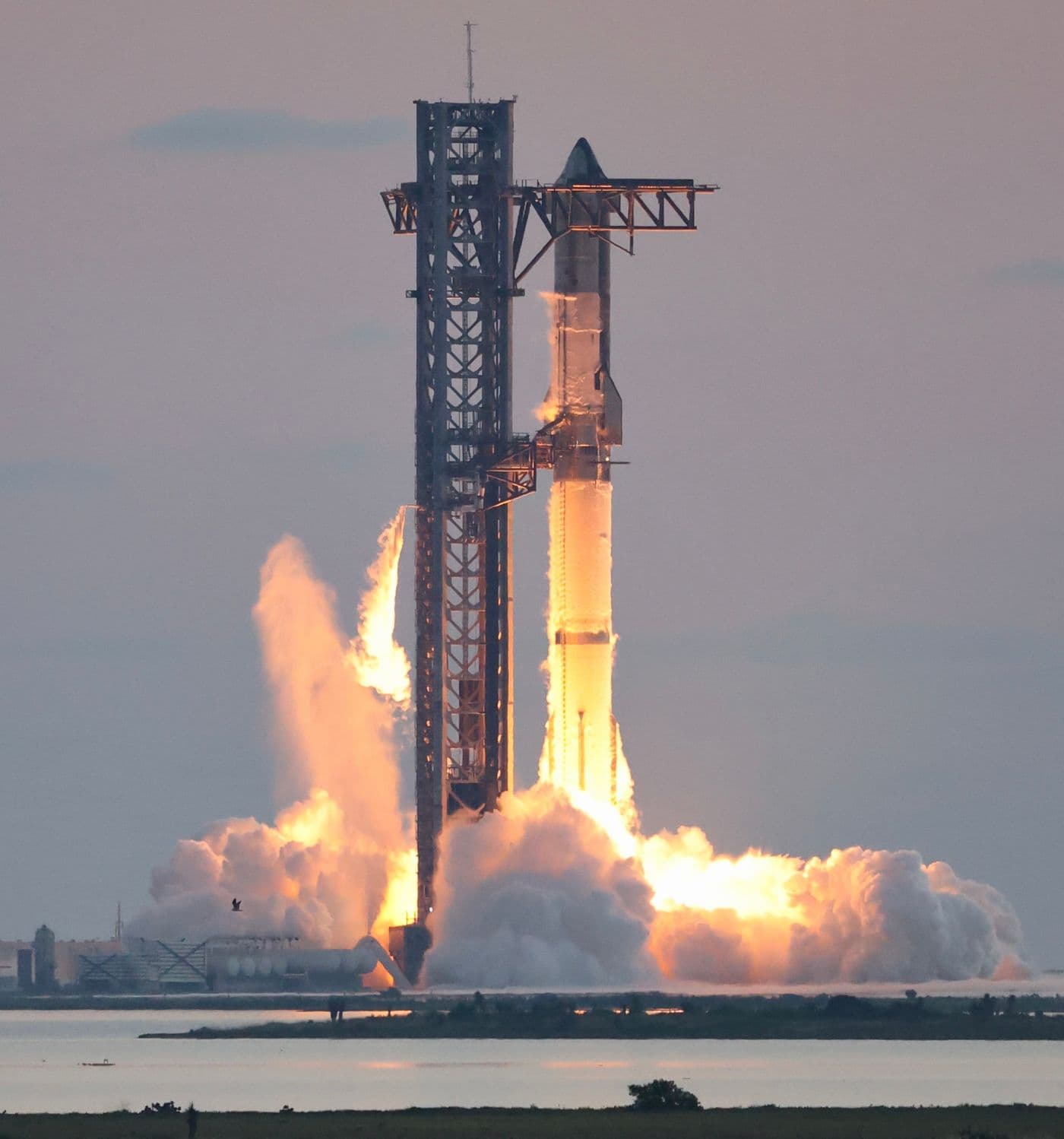
The tower does not stop a rocket arriving at full speed. Engines first slow the returning stage, and guidance brings it into a small region beside the catch arms. The arms then take its load through dedicated structural contact points.
What the stage must accomplish
Recovery requires the correct trajectory, attitude and landing-burn timing. Aerodynamic devices help through the atmosphere; engines provide final deceleration. Arms and stage must match position and speed sufficiently to keep capture within structural limits.
Why pursue a catch
Catching can reduce the need for heavy landing legs and simplify handling at the pad. It also shifts some complexity and risk to ground infrastructure. Catching a booster does not prove an upper-spacecraft catch capability: the return conditions and structures differ.
Why accurate GPS alone is insufficient
Return control needs continuous estimates of position, velocity and attitude, plus the ability to change them. Mechanical arms must also move and accept loads. Navigation-signal accuracy is only one part of the problem. A catch requires the correct position, correct velocity and functioning hardware to coincide at the final moment.
Follow us
Follow us on social media
New plates, trivia and behind-the-scenes updates as soon as they are ready.
Key points
- Recovery requires the correct trajectory, attitude and landing-burn timing.
- Catching can reduce the need for heavy landing legs and simplify handling at the pad.
- Return control needs continuous estimates of position, velocity and attitude, plus the ability to change them.
Sources & further reading
- Two-stage system concept, propulsion and intended applications.
- Development of recovery manoeuvres and tower capture of Super Heavy.
- Attitude control and thrust-vector steering.
Spaceflightpedia. (n.d.). How can a tower catch a rocket?. Retrieved 17 October 2026, from https://spaceflightpedia.com/article/tower-catching-rocket
article text — CC-BY-SA · ◉ NASA photography — public domain · ✦ AI illustration — marked, generated from sources
More questions on this topic
- How does Starship work?
- Why does Starship have so many engines?
- Why does Starship descend belly-first?
- Why does Starship need orbital refuelling for a Moon mission?