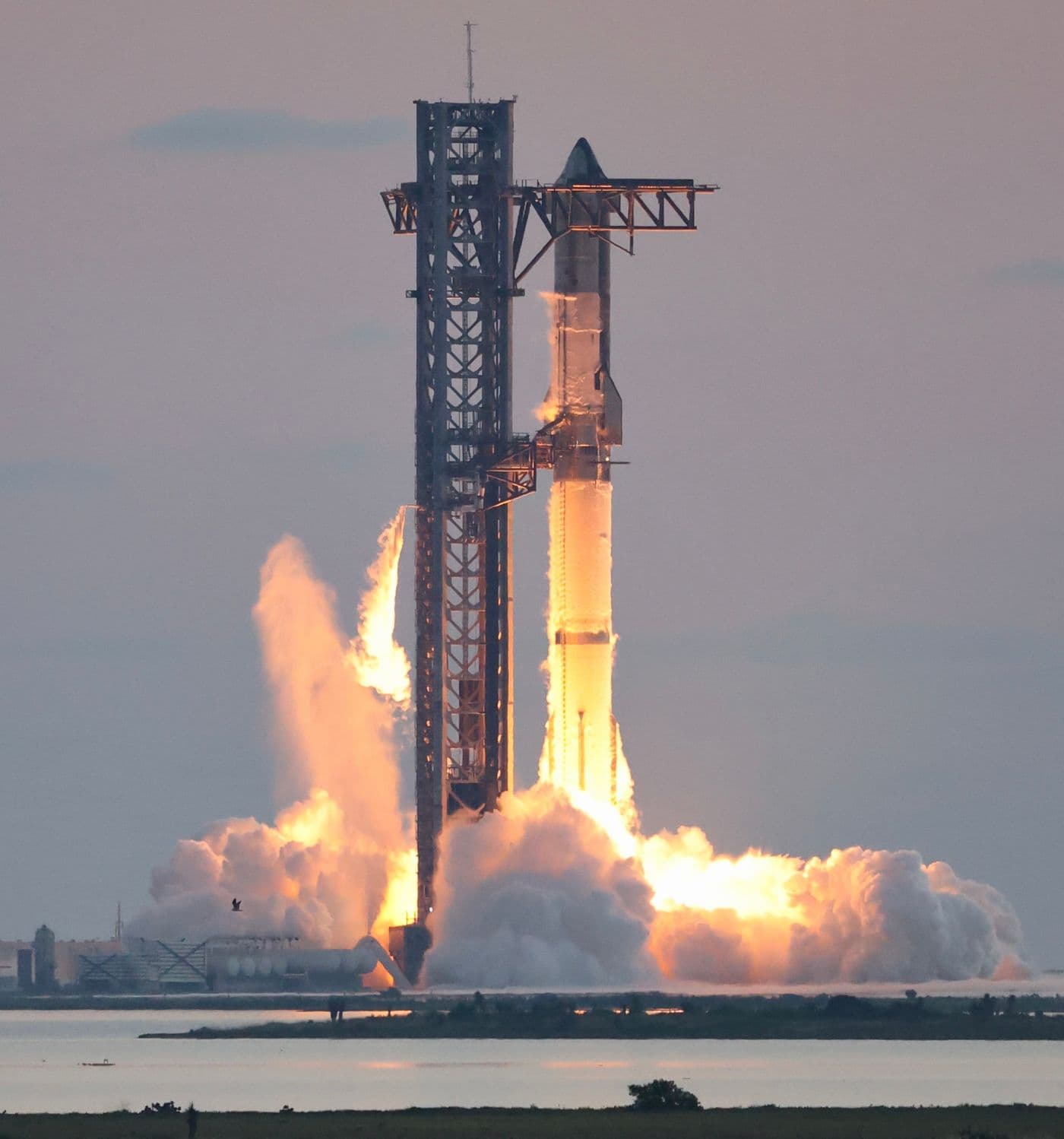
Starship is SpaceX's developing two-stage system: the lower Super Heavy accelerates the upper Starship spacecraft, which continues after separation. Both stages use methane and liquid oxygen. Reusing both components is a design objective.
One name, several meanings
Starship refers both to the full system and to the upper stage itself. The booster provides thrust at liftoff and during initial ascent. The upper stage carries the payload and gains additional velocity. Generations and variants differ, so engine counts, dimensions and recovery procedures must refer to a particular design.
Recovery is a separate task
For upper-stage Earth returns, thermal protection, aerodynamic control and a final powered manoeuvre serve distinct roles. Super Heavy is intended to return independently. Demonstrating one capability does not automatically establish routine operation of the whole system; current results belong in individual flight articles.
Why booster and spacecraft return differently
The booster completes its main task earlier and does not perform the upper spacecraft's full flight. An upper stage returning from an orbital profile must manage different energy and needs appropriate thermal protection. A shared system name does not erase those differences. Test assessment should separately examine launch, separation, continued spacecraft flight and each stage's return.
Follow us
Follow us on social media
New plates, trivia and behind-the-scenes updates as soon as they are ready.
What reusability means
Hardware recovery enables reuse but does not prove immediate readiness for another launch. Its condition must be assessed and necessary preparation completed between flights. Rapid operations therefore also depend on manufacturing, maintenance and ground equipment. One striking recovery manoeuvre does not describe the transport system's whole operating cycle.
Key points
- Starship refers both to the full system and to the upper stage itself.
- For upper-stage Earth returns, thermal protection, aerodynamic control and a final powered manoeuvre serve distinct roles.
- The booster completes its main task earlier and does not perform the upper spacecraft's full flight.
- Hardware recovery enables reuse but does not prove immediate readiness for another launch.
Sources & further reading
- Two-stage system concept, propulsion and intended applications.
- Development of recovery manoeuvres and tower capture of Super Heavy.
- Attitude control and thrust-vector steering.
Spaceflightpedia. (n.d.). How does Starship work?. Retrieved 17 October 2026, from https://spaceflightpedia.com/article/how-starship-works
article text — CC-BY-SA · ◉ NASA photography — public domain · ✦ AI illustration — marked, generated from sources
More questions on this topic
- Why does Starship have so many engines?
- Why does Starship descend belly-first?
- How can a tower catch a rocket?
- Why does Starship need orbital refuelling for a Moon mission?