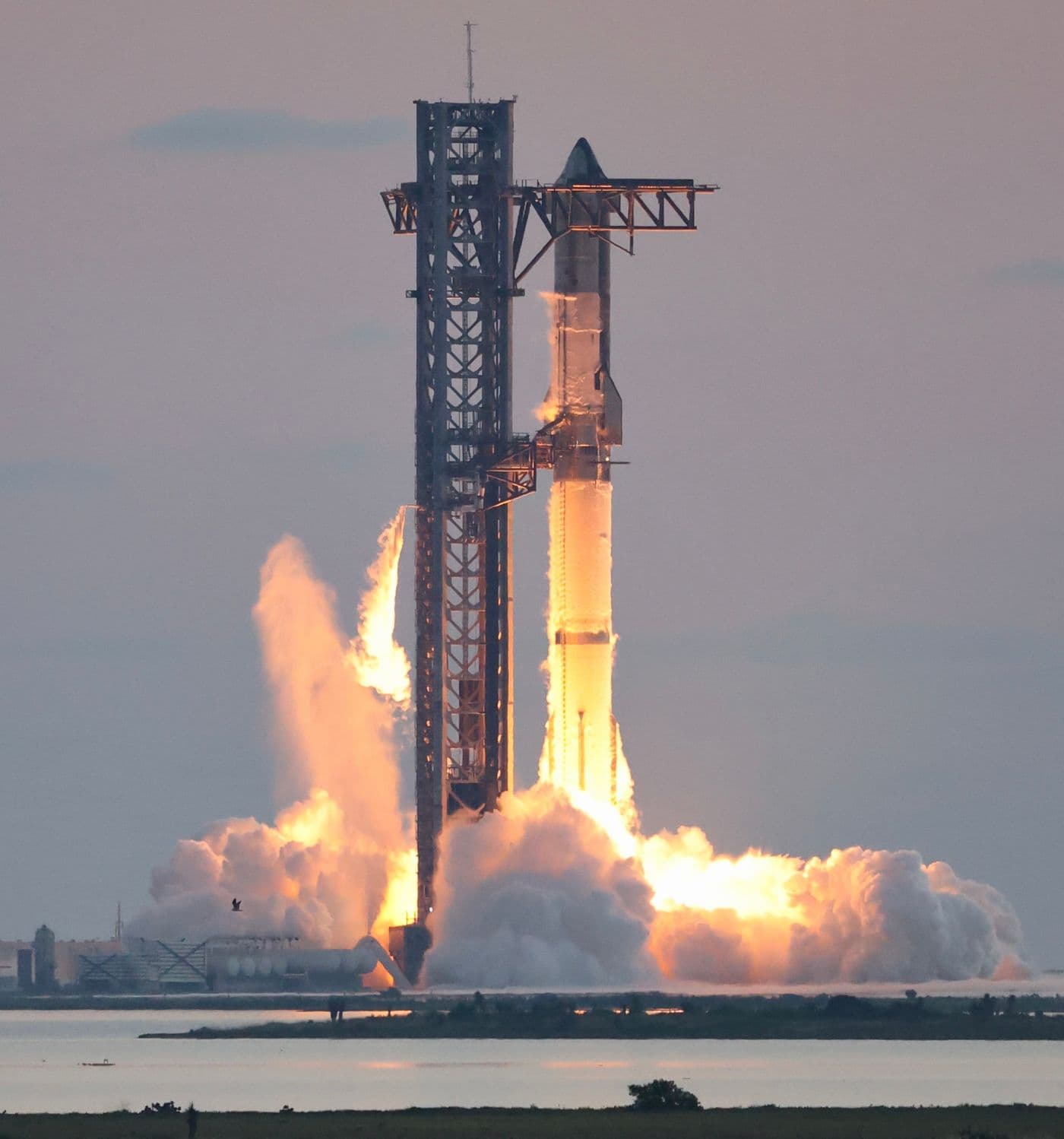
A very heavy launcher needs substantial total thrust at liftoff. Super Heavy produces it with many Raptor engines rather than a few gigantic engines. The upper spacecraft has a different engine count and arrangement for its different role.
Performance and manufacturing
Repeating an engine type concentrates development and production on a common family. More engines also mean more plumbing, valves, control interactions and thermally stressed locations. The design balances individual-engine thrust, manufacturing and overall engine-section complexity.
Redundancy has limits
Multiple engines may allow continued flight after some failures under suitable conditions. The outcome depends on flight phase, remaining thrust, control authority and failure type. A failure can damage neighbouring equipment. Many engines therefore do not mean arbitrary failures leave a mission unaffected.
Why engines can look different
A vacuum engine can have a larger nozzle expansion section than a sea-level version. The upper spacecraft can therefore combine variants from the same engine family. Bell size is not merely a measure of greater power: it also relates to operating ambient pressure and how exhaust gases expand.
Follow us
Follow us on social media
New plates, trivia and behind-the-scenes updates as soon as they are ready.
Key points
- Repeating an engine type concentrates development and production on a common family.
- Multiple engines may allow continued flight after some failures under suitable conditions.
- A vacuum engine can have a larger nozzle expansion section than a sea-level version.
Sources & further reading
- Two-stage system concept, propulsion and intended applications.
- Development of recovery manoeuvres and tower capture of Super Heavy.
- Attitude control and thrust-vector steering.
Spaceflightpedia. (n.d.). Why does Starship have so many engines?. Retrieved 17 October 2026, from https://spaceflightpedia.com/article/starship-many-engines
article text — CC-BY-SA · ◉ NASA photography — public domain · ✦ AI illustration — marked, generated from sources
More questions on this topic
- How does Starship work?
- Why does Starship descend belly-first?
- How can a tower catch a rocket?
- Why does Starship need orbital refuelling for a Moon mission?