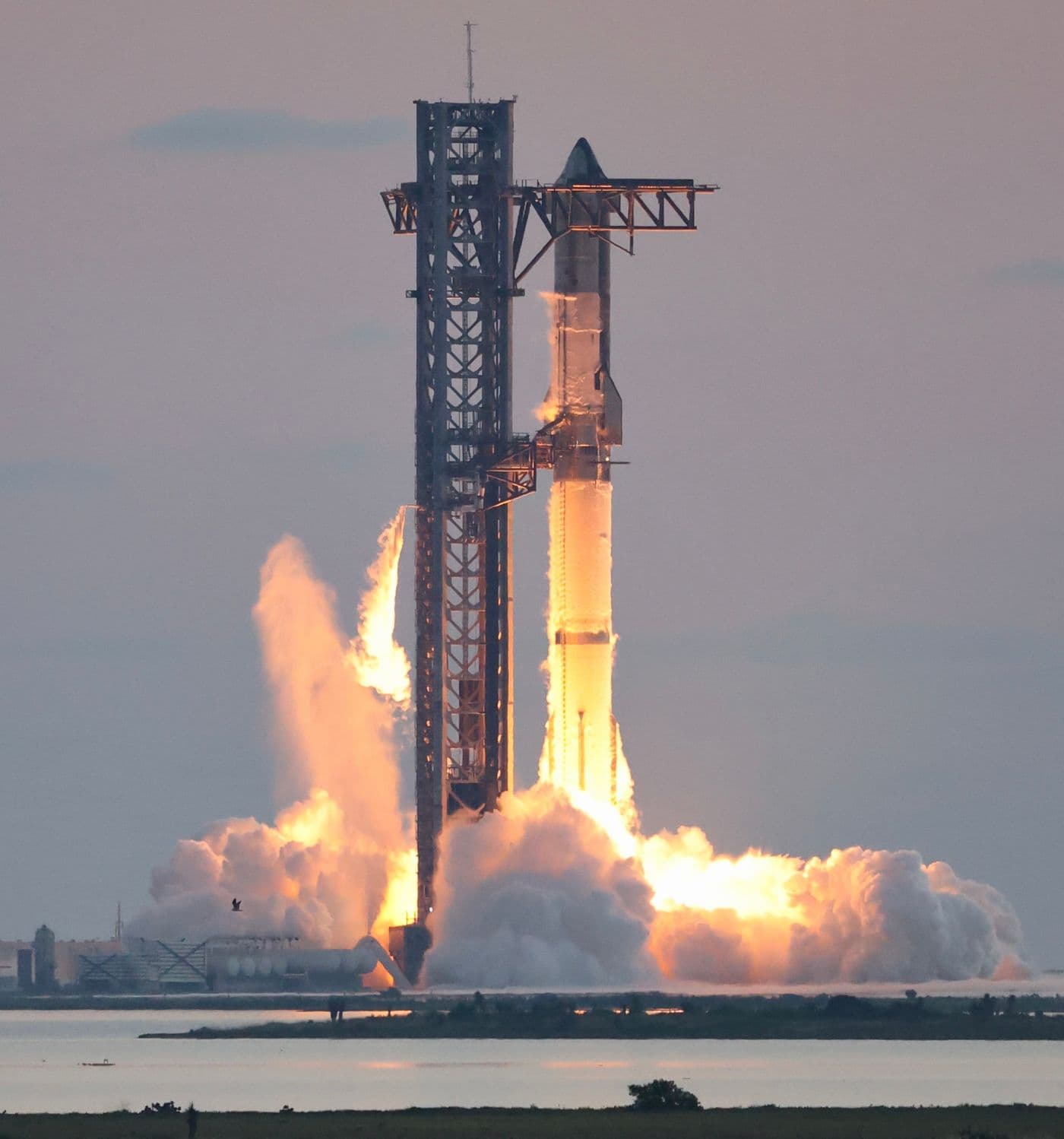
During part of its return, the upper spacecraft presents a large body area to the atmosphere. Aerodynamic drag helps reduce speed. Movable flaps control attitude and descent; before powered touchdown, the vehicle must transition to a suitable orientation for engine thrust.
It is not an aircraft landing
Starship does not use wings and landing gear like a conventional airliner. Its flaps help distribute aerodynamic forces around the body. At high speeds, thermal protection on the windward side also matters. Atmospheric braking and final powered deceleration are different return phases.
Why it must turn at the end
Engine thrust acts along the engine axes and must oppose the vehicle's descent. The transition requires coordinated attitude control, ignition and propellant availability. This profile concerns return through Earth's atmosphere; the airless Moon offers no comparable aerodynamic braking.
What happens without an atmosphere
Aerodynamic flaps need gas flow to produce significant forces. In a vacuum they cannot control descent in the same way, and presenting a large body area does not itself slow the spacecraft. That explains why an Earth-return profile cannot simply be reused on the Moon. Propulsion may work in both environments, but environmental braking differs fundamentally.
Follow us
Follow us on social media
New plates, trivia and behind-the-scenes updates as soon as they are ready.
Key points
- Starship does not use wings and landing gear like a conventional airliner.
- Engine thrust acts along the engine axes and must oppose the vehicle's descent.
- Aerodynamic flaps need gas flow to produce significant forces.
Sources & further reading
- Two-stage system concept, propulsion and intended applications.
- Development of recovery manoeuvres and tower capture of Super Heavy.
- Attitude control and thrust-vector steering.
Spaceflightpedia. (n.d.). Why does Starship descend belly-first?. Retrieved 17 October 2026, from https://spaceflightpedia.com/article/starship-belly-flop
article text — CC-BY-SA · ◉ NASA photography — public domain · ✦ AI illustration — marked, generated from sources
More questions on this topic
- How does Starship work?
- Why does Starship have so many engines?
- How can a tower catch a rocket?
- Why does Starship need orbital refuelling for a Moon mission?