#explainer
A returning spacecraft must shed an enormous amount of kinetic energy. At high speed it forms a shock wave and intensely heats the surrounding gas. Some energy reaches its surface, which requires a heat shield.
More than everyday friction
Calling the process friction alone is incomplete. Compression and energy changes across the shock, together with convective and radiative heat transfer to the surface, matter. Heating depends on speed, atmospheric density, vehicle shape and trajectory. Greater entry speed makes protection substantially harder.
Why a blunt shape helps
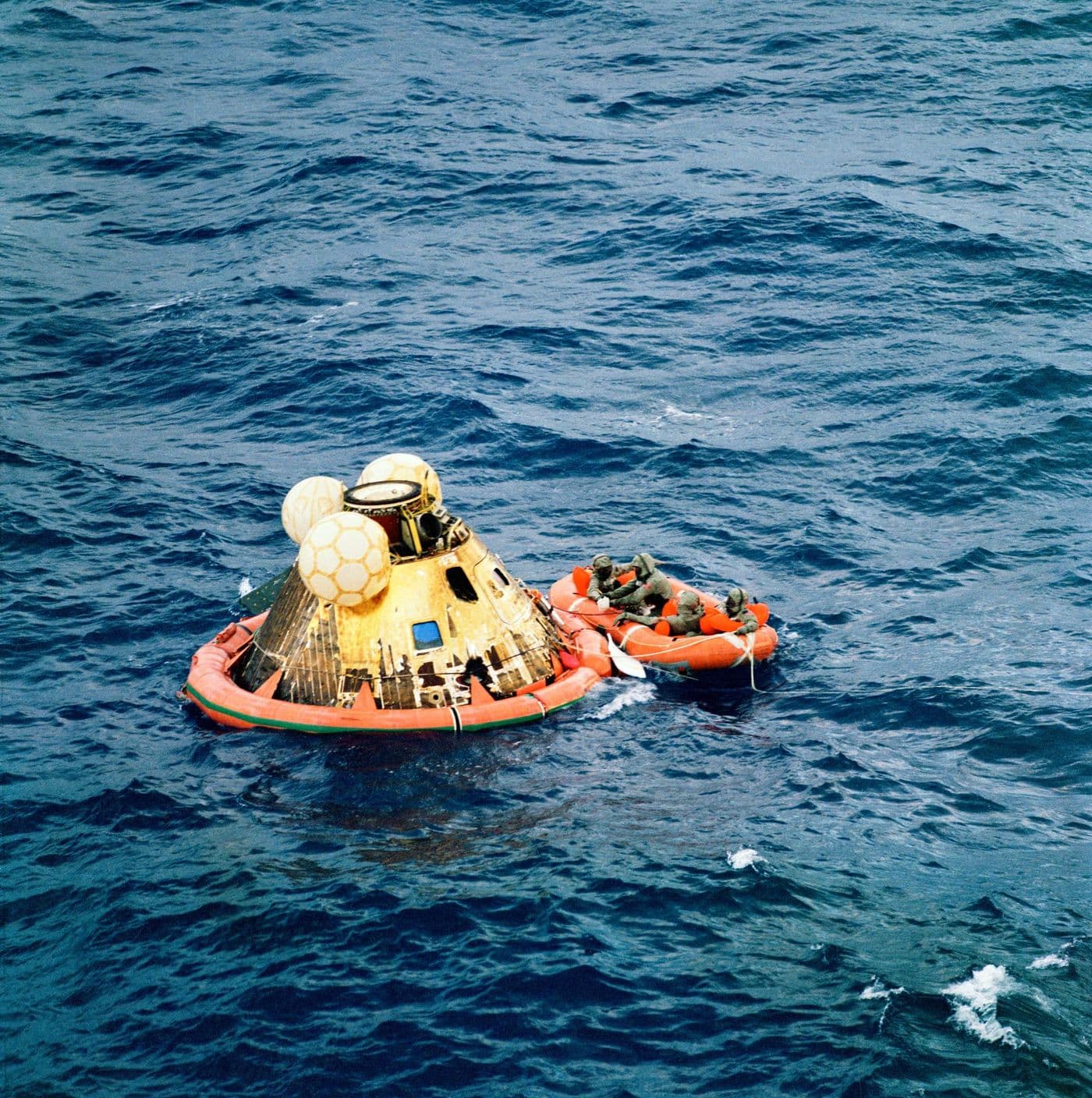
A blunt capsule can hold the shock away from its surface and distribute loads appropriately. Its heat shield limits energy penetration into the structure and cabin. Gas temperature ahead of the spacecraft is not the cabin temperature: protective materials, structure and a carefully designed entry profile separate them.
Why return is more than descending
An orbiting capsule has substantial sideways speed. Returning means shedding that kinetic energy, not merely losing altitude. Lower altitude without enough deceleration is not a safe landing. The atmosphere reduces the propellant needed for braking but introduces thermal and mechanical loads that the spacecraft must be designed to withstand.
Follow us
Follow us on social media
New plates, trivia and behind-the-scenes updates as soon as they are ready.
Key points
- Calling the process friction alone is incomplete.
- A blunt capsule can hold the shock away from its surface and distribute loads appropriately.
- An orbiting capsule has substantial sideways speed.
Sources & further reading
- Entry aerothermodynamics and thermal-protection design.
- Behaviour and analysis of ablative heat-shield materials.
- Relationship between entry angle, deceleration and safe return.
Spaceflightpedia. (n.d.). Why does a spacecraft get so hot during re-entry?. Retrieved 17 October 2026, from https://spaceflightpedia.com/article/reentry-heating
article text — CC-BY-SA · ◉ NASA photography — public domain · ✦ AI illustration — marked, generated from sources
More questions on this topic
- How does a heat shield work?
- Why is a parachute not enough for returning from space?
- Why does atmospheric entry angle matter?