- Date
- 20 February 1962
- Mission
- Friendship 7
#NASA#Mercury
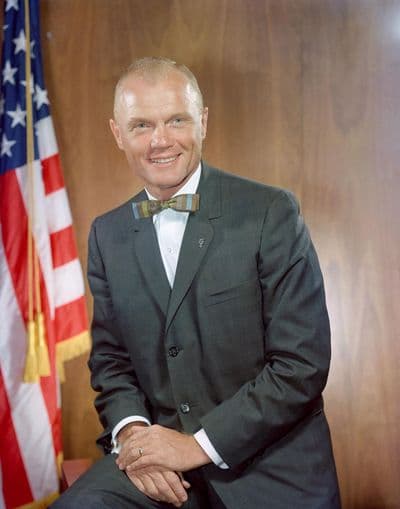
riendship 7 caught the American Mercury program up to the Soviet level: John Glenn became the first American to orbit Earth, doing so three times. A more powerful Atlas rocket replaced the Redstone, opening the way to longer orbital flights.
Pilot
During the flight a warning suggested the heat shield had come loose — Mission Control kept the spent retrorocket pack attached to help hold it in place during reentry. The signal turned out to be false, but those minutes of uncertainty were among the tensest of the whole Mercury program.
Mission timeline
Select a phase to read what happened. Every chapter has its own detailed page.
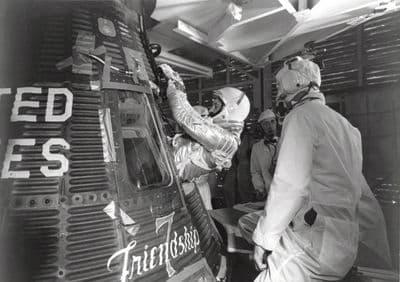
“Godspeed, John Glenn”
John Glenn boarded the Friendship 7 capsule at 11:03 UTC. Before the mission could even begin, an hour-long repair to the Atlas booster’s guidance system was needed, along with a broken hatch bolt that required the whole hatch to be unbolted and re-bolted.
Read the chapterA shower of stars and a false heat-shield alarm
During three orbits of the Earth at over 28,000 km/h, Glenn experienced a phenomenon he called “fireflies” — thousands of tiny glittering particles (later found to be ice crystals venting from the spacecraft) drifting past the capsule at sunrise.
Read the chapter“A real fireball” and a landing near Puerto Rico
Because the retrorocket package had been kept in place, Glenn had to operate several systems manually during reentry, including retracting the periscope. As the package burned away in the atmosphere, he saw glowing chunks flying past the window and briefly feared they were pieces of the heat shield itself.
Read the chapterMission in numbers
- Crew
- 1
- Launch
- 20. 2. 1962, 14:47 UTC
- Duration
- 4 h 55 min
- Flight type
- orbitální, 3 oblety
- Launch vehicle
- Atlas LV-3B (MA-6)
- Orbital speed
- ~28 200 km/h
- Splashdown
- ~350 km od Portorika
- Recovery ship
- USS Noa
Follow us
Follow us on social media
New plates, trivia and behind-the-scenes updates as soon as they are ready.
Facts
- John Glenn became the first American to orbit the Earth — after the Soviet flights of Gagarin and German Titov.
- CAPCOM Scott Carpenter’s words “Godspeed, John Glenn” became legendary, even though Glenn himself never heard them at launch because of a radio glitch.
- During the flight Glenn observed thousands of glittering particles he called “fireflies” — ice crystals venting from the spacecraft.
- A false alarm from a faulty sensor led Mission Control to keep the retrorocket package attached during reentry as a safeguard for the heat shield.
- The capsule splashed down 64 km from the planned site, and the destroyer USS Noa reached it in just 17 minutes.
- In 1998, at age 77, Glenn became the oldest person ever to fly in space aboard the Space Shuttle Discovery.
Related articles
Eyewitness account
“Zero-g, and I feel fine.”
Sources & further reading
- NASA: Results of the First United States Manned Orbital Space Flight, 1962 — the primary source of mission data.
- Alexander, Grimwood, Swenson: This New Ocean: A History of Project Mercury, NASA, 1966.
- NASA Image and Video Library (images.nasa.gov) — mission photographs, public domain.
- Wikipedia: Mercury-Atlas 6 — the starting structure of the article, CC-BY-SA 4.0.
- NSSDCA Master Catalog (NASA) — technical parameters of the spacecraft (COSPAR ID 1962-003A).
Spaceflightpedia. (n.d.). Friendship 7. Retrieved 9 October 2026, from https://spaceflightpedia.com/article/friendship-7
article text — CC-BY-SA · ◉ NASA photography — public domain · ✦ AI illustration — marked, generated from sources