- Launcher
- Falcon Heavy
- Mission
- Nancy Grace Roman Space Telescope
- 01Overview
- 02The name behind the mission
- 03The observatory in numbers
- 04From concept to launch
- 05From launch to first images
- 06Wide field instrument — how the wide view is built
- 07The data program — from detector to archive
- 08The first science program
- 09What the mission is built to deliver
- 10Key points
- 11Gallery
- 12Related articles
- 13Article on the timeline
- 14Sources
- 15Connections
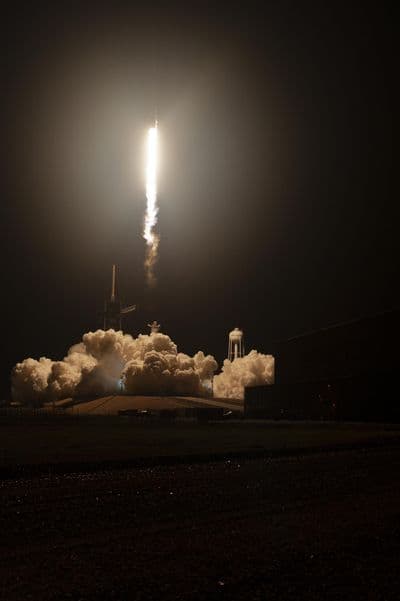
The Nancy Grace Roman Space Telescope is NASA’s new flagship infrared observatory. Falcon Heavy launched it from Launch Complex 39A on Aug. 30, 2026 toward the Sun–Earth L2 region; the journey to its working orbit is expected to take about three months. Roman is not simply a sharper view of a small patch of sky: it pairs a Hubble-sized mirror with an exceptionally wide field of view, turning individual images into systematic maps of the cosmos.

THE NAME BEHIND THE MISSION
Nancy Grace Roman
NASA’s first Chief of Astronomy argued that astronomy’s biggest questions required observatories above Earth’s atmosphere. Her work paved the way for Hubble and for today’s Roman Space Telescope.
The observatory in numbers
- Launch
- Aug. 30, 2026 · 11:26 UTC
- Launch vehicle
- Falcon Heavy
- Primary mirror
- 2.4m
- Wide Field Instrument
- 300megapixels
- WFI field of view
- 0.281deg²
- Destination
- Sun–Earth L2
From concept to launch
- Science priority
- 2010US decadal-survey priority
- WFIRST formulation
- 2013AFTA study
- Renamed Roman
- 2020honouring Nancy Roman
- Critical design review
- 2021design completed
- Full integration
- 2026pre-launch testing
The mission did not begin as a finished telescope. The 2010 U.S. astronomy decadal survey ranked a wide-field infrared observatory as its highest-priority large space mission. NASA then developed the concept under the working name WFIRST — the Wide Field Infrared Survey Telescope. AFTA design definition began in 2013, and by 2014 the two core instruments had taken shape: the wide-field WFI camera and a coronagraph technology demonstration for directly imaging exoplanets.
That long preparation phase had a practical purpose: connect the science questions to concrete requirements for optics, detectors, stability, and data volume before full-scale production began. The telescope’s preliminary design review in 2019 and critical design review in 2021 confirmed that the design met the technical, schedule, and budget conditions required to build it. In May 2020 NASA renamed the mission for Nancy Grace Roman, the astronomer who championed a program of major space observatories at NASA.
Construction of the observatory proceeded in parallel at several sites. The optical telescope — with its 2.4-metre primary mirror, nine additional mirrors, and supporting structure — was built as a separate assembly; its inherited primary mirror was modified for Roman and given a silver surface optimized for near-infrared light. Meanwhile WFI underwent assembly and environmental tests, the coronagraph was built at JPL, and the observatory team prepared the spacecraft bus, outer barrel, and solar-array sunshield.
Before Roman left the clean room, the team tested not just individual parts but their interaction. In 2024, all ten mirrors were aligned, WFI and the coronagraph were attached to the instrument carrier, and in 2026 the inner and outer observatory segments were joined. Vibration tests simulated launch, followed by vacuum and thermal testing that mimicked the space environment. Only after that cycle was the observatory shipped to Kennedy Space Center in June 2026 for launch preparations.
From launch to first images
- Liftoff
- Aug. 30, 2026 · 11:26 UTC
- DSN takes control
- ~70minutes after launch
- Deployments begin
- 1 h 23 minafter launch
- Target distance
- ~1.5million km from Earth
- Commissioning
- ~3months
- First images
- early 2027NASA plan
After separation from its launch vehicle, Roman is not headed for an ordinary Earth orbit. Roughly 70 minutes after liftoff, NASA’s Deep Space Network takes control, and around one hour 23 minutes after launch the solar arrays and sunshade begin to deploy. A high-gain antenna and aperture cover follow in the coming days; over about three months the team will verify thermal stability, pointing, optics, and both instruments.
Its operating path loops around the Sun–Earth L2 region, about 1.5 million kilometres beyond Earth away from the Sun. Roman will not sit at a stationary point: it will follow a halo orbit that keeps the Sun, Earth, and Moon on the same side of the observatory. That arrangement simplifies shielding, power, and the stable thermal environment needed for infrared observing.
Roman’s main working tool is the Wide Field Instrument (WFI), a 300-megapixel infrared camera for imaging and slitless spectroscopy. Its 0.281-square-degree field of view is at least 100 times wider than Hubble’s infrared instrument at comparable sharpness. That scale is crucial for science needing both detail and enormous statistical samples: faint galaxies, variable stars, gravitational lenses, and planets revealed by microlensing.
Roman’s role therefore differs from Webb’s. Webb can study selected targets deeply and sensitively; Roman will map broad regions rapidly, identifying rare phenomena and promising targets for follow-up. Its wide surveys will also leave a community archive from which discoveries can emerge beyond the mission’s original headline goals.
Wide field instrument — how the wide view is built
- Detector mosaic
- 18infrared detectors
- One detector
- 4 096 × 4 096pixels
- Combined resolution
- >300megapixels
- Imaging filters
- 8filters · 0.48–2.3 μm
- Spectroscopy
- 2slitless modes · 0.8–1.93 μm
- Detector temperature
- −178°C
Follow us
Follow us on social media
New plates, trivia and behind-the-scenes updates as soon as they are ready.
The second instrument is the Coronagraph Instrument. It is not Roman’s main statistical survey tool but a technology demonstration: it aims to suppress starlight precisely enough to reveal the faint light of an exoplanet or dust disk close to the star. It combines precision masks, deformable mirrors for wavefront control, sensitive detectors, and its own sensing-and-correction system. Its value includes the lessons it provides for future observatories designed to study Earth-like planets directly.
The data program — from detector to archive
- Downlink rate
- 250–500Mbps
- Daily volume
- ~1,4TB of data per day
- Technical equivalent
- ~11Tbit per day
- Survey speed
- ~1 000×faster than Hubble
- Baseline mission
- 5years · goal up to 10 years
Data volume is part of the mission design. Roman is expected to send about 1.4 terabytes to Earth per day; NASA lists a technical volume of roughly 11 terabits per day and a 250–500 Mbps downlink rate. That enables exceptionally large images and spectra, but it also makes calibration, cataloguing, and a public archive essential. The surveys are not one-off pictures: they are repeated, time-stamped measurements that can reveal changes and rare events.
The first science program
- High-latitude wide survey
- ~17months
- High-latitude time-domain survey
- ~6months
- Galactic bulge time-domain survey
- ~15months
- Core questions
- dark energy · exoplanets · galaxy evolution
Roman’s largest cosmology goal is to investigate why cosmic expansion is accelerating. It will measure three complementary effects: distances to Type Ia supernovae, the growth of large-scale structure through weak gravitational lensing, and the distribution of galaxies across space and time. Agreement or tension among these measurements can test whether the result fits dark energy or whether gravity needs revision on the largest scales.
In the Galactic bulge, Roman will search for exoplanets through gravitational microlensing. A brief, characteristic brightening of a background star can reveal a planet even when it is small, far from its star, or orbiting a host too faint for other methods. Together with the coronagraph, Roman combines a population census of planets with a path toward directly viewing a handful of nearby systems.
The observatory now faces its cruise, deployments, insertion into its orbit around the L2 region, and roughly three months of commissioning. First science images therefore do not arrive immediately after launch: the team must verify electrical systems, thermal conditions, pointing, optics, and calibration of both instruments. This article keeps confirmed post-launch facts distinct from future planned milestones.
What the mission is built to deliver
- Primary mission
- 5years of observing
- Data archive
- ~20PB over five years
- Distant worlds
- >100 000expected discoveries
- Stars
- stovky mil.measured objects
- Galaxies
- miliardyin surveys
The result is not meant to be a single “iconic” image but a reusable map of the cosmos. NASA expects a data set on the order of 20 petabytes during the first five years: images, spectra, time series, and catalogues that can be used to search both for predefined targets and for phenomena nobody expected. This open-survey approach is crucial for dark-energy science and for variable objects, because individual measurements gain their power in an enormous ensemble.
The numbers in the card are planned science returns, not completed discoveries. NASA expects more than 100,000 distant worlds, hundreds of millions of stars, and billions of galaxies, but concrete catalogues will emerge only after calibration and the start of the surveys. That is why post-launch preparation matters as much as launch itself: bring complex hardware to a stable operating state, verify data quality, and only then decide what can be reliably claimed about the universe.
Key points
- The observatory honors Nancy Grace Roman, NASA’s first chief astronomer and a key advocate for the Hubble Space Telescope.
- Roman’s primary mirror is 2.4 meters across, the same size as Hubble’s; the decisive difference is WFI’s exceptionally wide field of view.
- The coronagraph is a technology demonstration, not a replacement for WFI as Roman’s main survey instrument.
- L2 is not a fixed point on which the observatory sits: Roman will follow a large orbit around the Sun–Earth gravitational-balance region.
Gallery
Related articles
Article on the timeline
Sources & further reading
- NASA, Aug. 30, 2026: launch, vehicle, launch site, and initial flight phase.
- Official overview of the mission, its science goals, and wider context.
- NASA: basic observatory parameters, 2.4 m mirror, launch, and participating institutions.
- NASA: Wide Field Instrument capabilities and the Coronagraph technology demonstration.
- NASA: Roman’s wide field of view in comparison with Hubble.
- NASA: first five-year core community surveys and planned observing allocations.
- NASA, Aug. 31, 2026: post-launch deployments, journey to L2, and observatory commissioning.
- NASA: mission technical parameters, communications, and data volume.
- NASA: WFI’s 18-detector mosaic, resolution, and operating temperature.
- Official press kit, quick facts, brochure, and downloadable materials.
- Official NASA observatory illustration, released in 2026.
- NASA: biography of its first Chief of Astronomy and why the observatory bears her name.
- NASA: planning, construction, integration, testing, and transport of the observatory to the launch site.
- Official timeline: science recommendation, WFIRST formulation, engineering milestones, and mission renaming.
Spaceflightpedia. (n.d.). Nancy Grace Roman Space Telescope. Retrieved 15 October 2026, from https://spaceflightpedia.com/article/nancy-grace-roman-space-telescope
article text — CC-BY-SA · ◉ NASA photography — public domain · ✦ AI illustration — marked, generated from sources