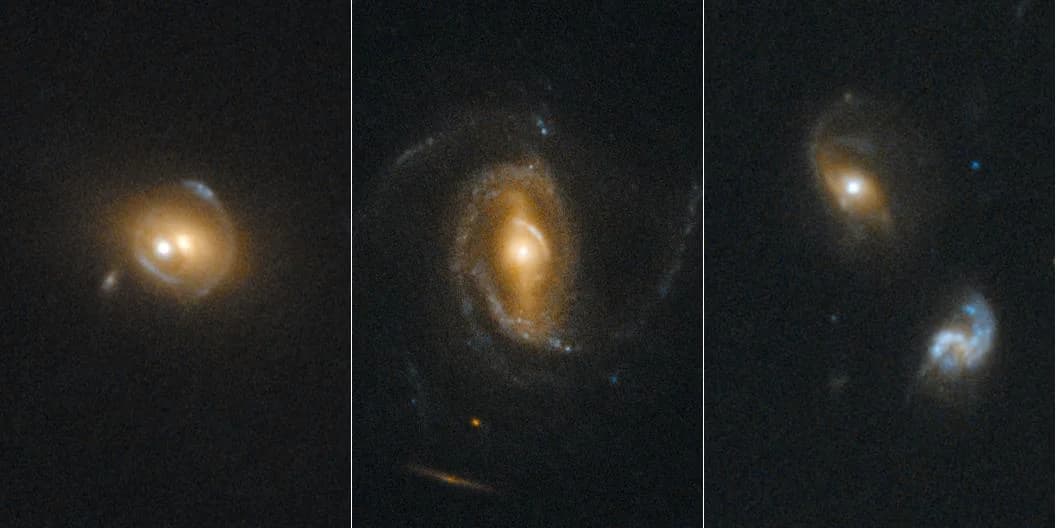
NASA has released a gallery of gravitational lenses photographed by the Hubble Space Telescope. According to the agency, the set is meant to show how many different forms this phenomenon can take.
A gravitational lens arises when a massive foreground object, such as a galaxy or a galaxy cluster, bends the light of a more distant source lying behind it. The background object then appears magnified and distorted, often as arcs, multiple images or an almost complete ring. Astronomers use the effect to study galaxies that would otherwise be too faint, and to map matter that emits no light.
NASA presents the collection as groundwork for follow-up observations by the Nancy Grace Roman Space Telescope. Roman is designed to combine sharpness comparable to Hubble's with a far wider field of view, so it should be able to survey lenses in much greater numbers. Hubble's detailed views give researchers a reference sample to build on.