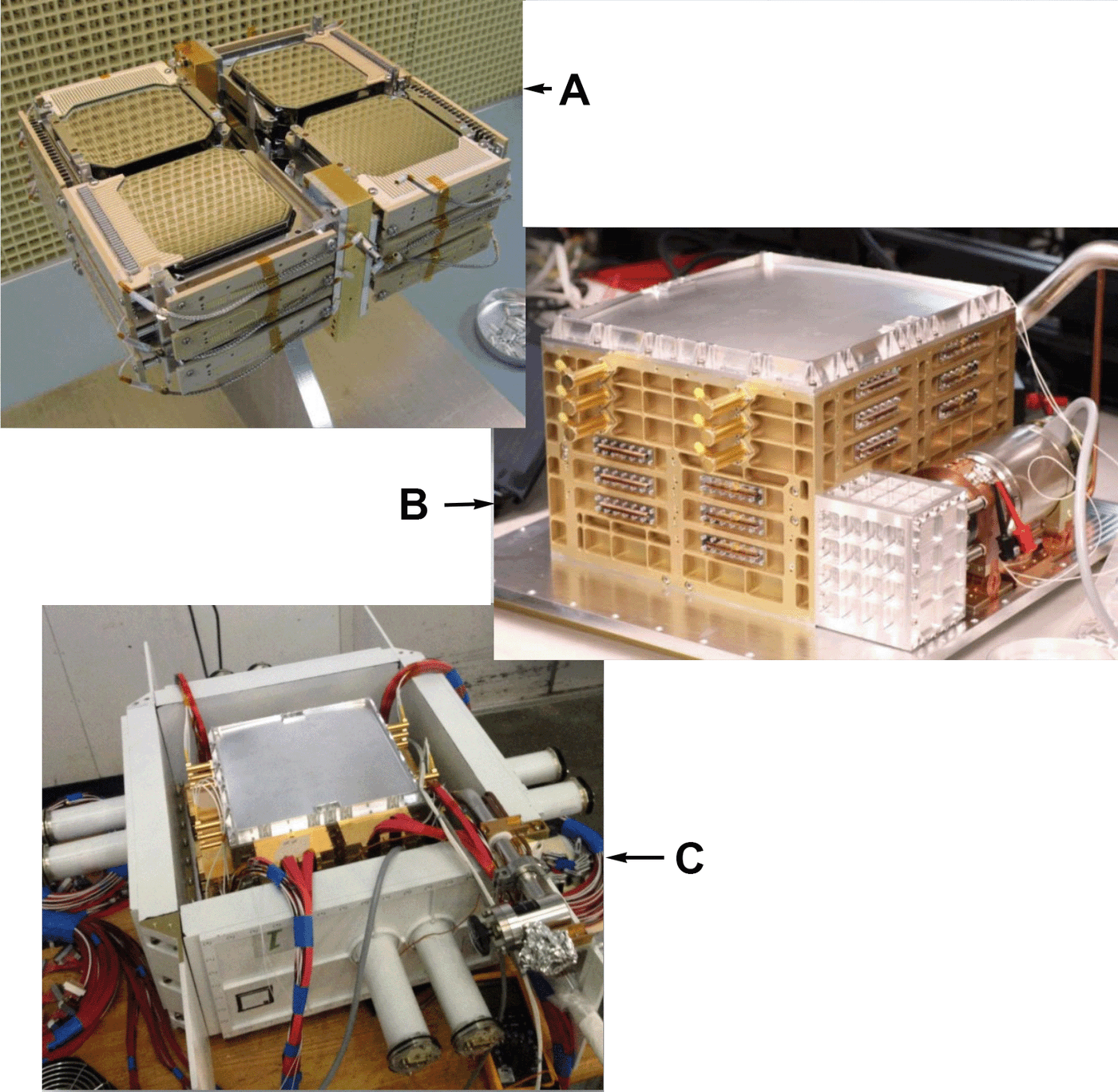
Engineers and managers at the University of California, Berkeley, gathered to watch the detector assembly of COSI — the Compton Spectrometer and Imager — being hoisted slowly off a work table, a moment captured in a NASA image dated July 8, 2026. Lifting an instrument core of this kind is a deliberate, low-speed operation, since the stack contains the mission's most delicate and irreplaceable hardware.
On top of the detector box sit four panels of silver-colored material. According to NASA, these shield the flex circuits that route signals out of the detectors and into the readout electronics. Flexible printed circuits are common in space instruments because they bend around tight geometry and cut down on connector count, but they are fragile enough to warrant protective covering during handling and integration.
COSI is designed to survey the sky in soft gamma rays, a band that carries the fingerprints of nuclear processes: freshly forged radioactive elements from supernovae, positron annihilation in the galactic center, and emission from compact objects. A Compton telescope reconstructs a photon's arrival direction from how it scatters between detector layers, so the geometric precision of the assembly seen in the photograph feeds directly into the instrument's imaging performance.
Integration milestones like this one mark the transition from component fabrication to a working instrument, with environmental testing and calibration still ahead before flight.